Apollo.io vs Clay (2026): Database-First Prospecting or Build-Your-Own Enrichment?
Apollo.io gives sales reps a ready-made contact database with sequences and a dialer in one plan. Clay gives GTM teams a spreadsheet-style workbench that pulls from 150+ data providers and AI research agents. Here is how they compare on data, price, workflow and who each one suits.
Short verdict: pick Apollo.io if you want reps to search a contact database, add people to a sequence and start calling on the same day, with a free plan to try it. Pick Clay if you have someone technical enough to build enrichment workflows and you need data Apollo alone cannot give you: better coverage outside North America, custom research on each account, or signals pulled from anywhere on the web.
They are often described as rivals, but they solve different problems. Apollo is a finished product for sellers. Clay is a toolkit for the people who design how sellers get their data, a role now often called a GTM engineer. Many teams end up using both: Apollo as one of the sources inside a Clay table, or Clay to clean and enrich records before they go into Apollo sequences. This comparison is based on official pricing pages, product documentation and public user feedback, not hands-on testing. If you are looking to replace Apollo entirely, our Apollo.io alternatives guide covers the wider field.


Quick verdict by use case
A small sales team that needs leads and outreach in one place: Apollo.io.
Testing B2B prospecting for free: Apollo.io's free plan is more usable for outreach. Clay's free plan is better for learning the workflow.
Finding emails and phones that one database misses: Clay, with waterfall enrichment across many providers.
Custom research per account (pricing pages, job posts, tech stack): Clay, using its Claygent AI agents.
Calling and sequencing: Apollo.io, with a built-in dialer and sequences.
Keeping a CRM enriched automatically: both, but Clay needs its Growth plan for CRM sync.
Lowest total cost for one rep: Apollo.io.
Pricing compared (as of October 2026)
Both tools run on credits, which makes headline prices only part of the story. Figures below come from the official Apollo.io pricing page and Clay pricing page in October 2026. Apollo shows most prices through an interactive calculator, so confirm the live figures there before you budget.
| Plan | Price | What you get or key limits |
|---|---|---|
| Apollo.io Free | $0 | No time limit. Small credit allowance; email campaigns from Gmail accounts only |
| Apollo.io Basic | From $49 per user/mo | Email sequencing, core integrations, more credits than Free |
| Apollo.io Professional | Listed at $99 per user/mo; annual billing is cheaper | Higher credit limits, AI features, call recording, advanced CRM integrations |
| Apollo.io Custom | Contact sales | SSO, advanced security, dedicated support, API access |
| Clay Free | $0 | 500 actions and 100 data credits per month, up to 200 rows per table, unlimited seats |
| Clay Launch | $185/mo, or $167/mo billed annually | 15,000 actions and about 2,500 data credits per month, phone enrichment, signals, scheduled runs |
| Clay Growth | $495/mo, or $446/mo billed annually | 40,000 actions and 6,000 data credits per month, CRM sync, HTTP API, webhooks |
| Clay Enterprise | Custom | Bulk enrichment, SSO, SCIM, role-based access, dedicated support |
The structural difference matters more than the numbers. Apollo charges per seat, and every seat on an account must be on the same plan. Clay charges per workspace with unlimited seats on every plan, so cost scales with how much data you process, not with headcount. For one or two reps, Apollo is far cheaper. For a team of fifteen sharing one enrichment engine, the gap narrows quickly.
What each tool actually is
Apollo.io
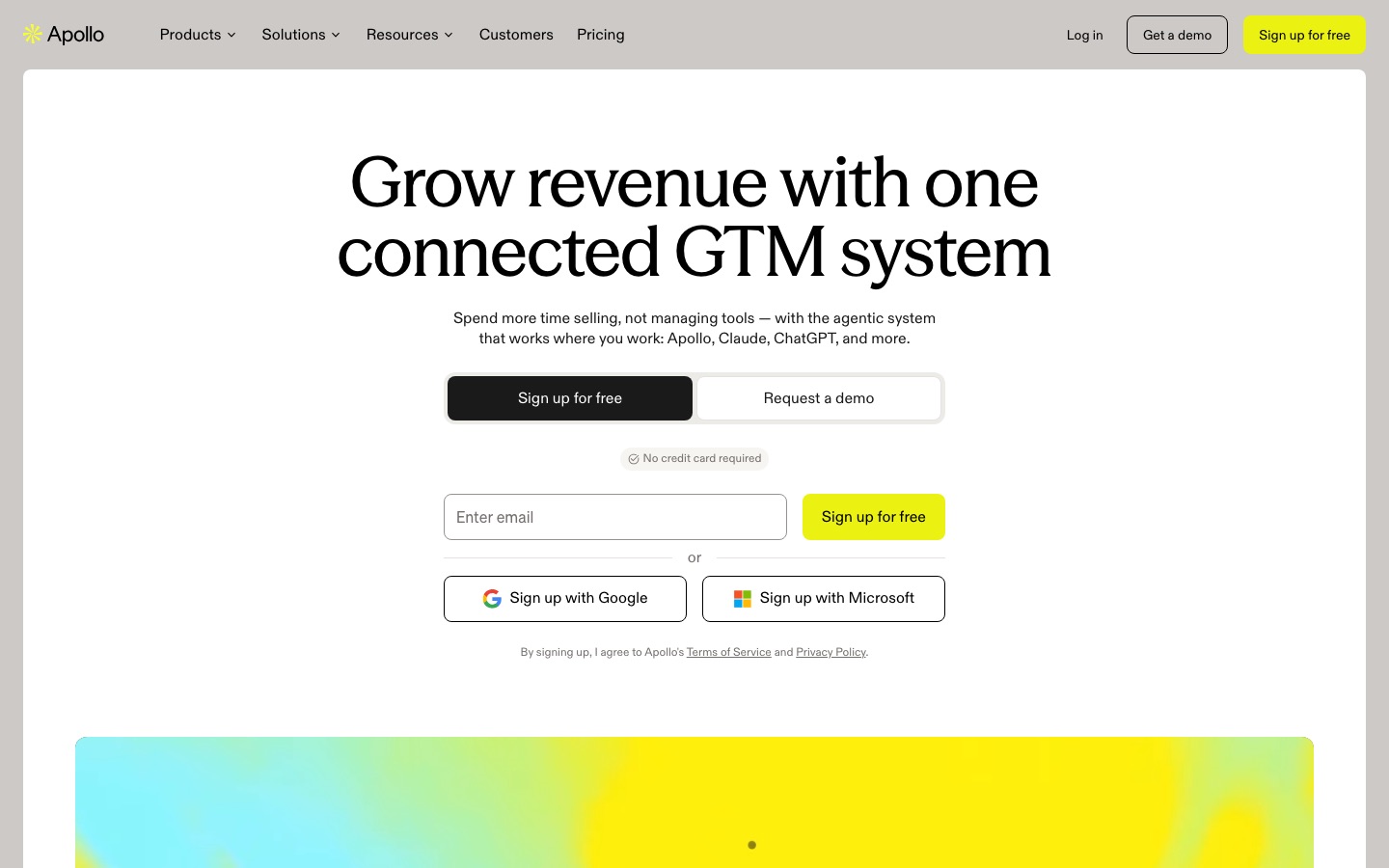
Apollo.io is an all-in-one sales platform. Its homepage cites roughly 240 million contacts and 30 million companies, with filters for title, seniority, industry, headcount, technology and buying signals such as intent, job changes and website visits. Around that database it adds email sequences, a parallel dialer, a Chrome extension that finds emails and phone numbers on LinkedIn and company sites, waterfall enrichment, CRM sync with 200+ integrations, and AI agents that research accounts, build lists and draft outreach. Apollo says more than 600,000 companies use it.
Clay
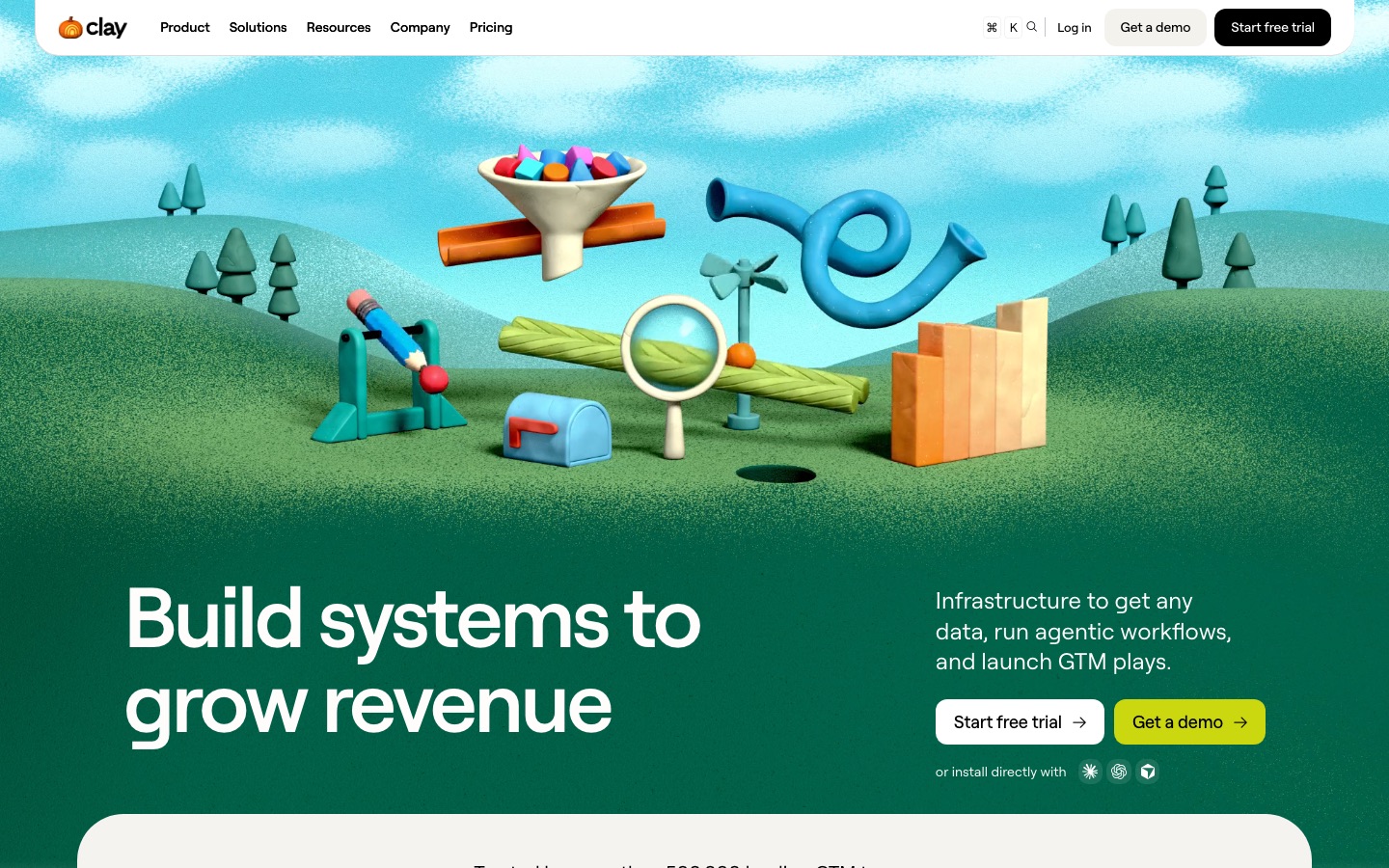
Clay looks like a spreadsheet, but each column can call a data provider, an AI model or an API. Its signature feature is waterfall enrichment: if the first provider has no email for a contact, Clay tries the next one, and so on, which raises match rates beyond what any single database delivers. Clay cites 150+ premium data sources and a marketplace of 200+ data and AI vendors. Claygent agents browse the web to answer custom questions about each company, Sculptor helps build workflows, Audiences syncs lists to LinkedIn, Meta and Google ads, and signals track job changes, news and web intent. Clay says more than 500,000 GTM teams use it.
Head-to-head
Data coverage and accuracy
Apollo's data is broad and fast to search, and public feedback rates it well for North American companies. Accuracy drops in some regions and for fast-moving roles, which is the most common complaint about Apollo. Clay does not own one database. It queries many, in sequence, so coverage depends on which providers you add to your waterfall. That design is why teams selling into Europe, the Middle East or Asia often turn to Clay when a single source keeps bouncing.
Winner: Clay for coverage and match rate, Apollo for speed of search.
Enrichment and AI research
Apollo now offers waterfall enrichment and AI-researched data inside its credit system, which closes part of the gap. Clay still goes much further. A Claygent column can read a prospect's careers page and summarize hiring plans, check whether a company uses a competitor, or pull pricing details, and the result becomes a field you can filter on or drop into an email. If your outbound depends on account-level personalization, this is Clay's biggest advantage.
Winner: Clay.
Outreach: sequences, email and calling
Apollo is built to send. Sequences, task queues, email tracking, a dialer, call recording on Professional, and the option to buy domains and mailboxes with credits are all in the same product. Free accounts can run email campaigns from Gmail, and paid plans can connect Microsoft and other providers. Clay includes an email sequencer and can buy domains and mailboxes on Growth, but most Clay users push their enriched lists into a dedicated sender such as Smartlead, Instantly or lemlist.
Winner: Apollo.io, clearly.
Ease of use and setup time
Apollo can feel dense, with many menus, but a new rep can be productive within a day: search, filter, save, sequence. Clay has a real learning curve. Building a good waterfall, writing reliable Claygent prompts and managing credit burn takes practice, which is why Clay invests heavily in templates and learning resources. Teams without a technically minded owner often struggle to get value from Clay.
Winner: Apollo.io for reps, Clay only once someone owns the workflow.
CRM sync and integrations
Apollo lists 200+ integrations, syncs with major CRMs on paid plans, and adds advanced CRM integrations on Professional. Its Apollo Anywhere features let reps work from their CRM, Gmail, the browser and AI assistants. Clay's CRM sync, HTTP API connections, webhooks and data warehouse sync arrive on the Growth plan, and once available they are extremely flexible: you can enrich every new CRM record automatically or trigger workflows from any signal.
Winner: Apollo for out-of-the-box sync on cheaper plans, Clay for flexibility.
Credits and cost control
Both charge for data through credits that do not roll over on Apollo, and both reward careful use. Apollo pools credits across the team and lets admins set per-user caps. Clay splits usage into actions and data credits, and a badly designed table can burn through a month of credits in an afternoon. Clay's Enterprise plan adds credit budgeting controls.
Winner: Apollo for predictability, Clay for teams with the discipline to optimize workflows.
Feature comparison
| Feature | Apollo.io | Clay |
|---|---|---|
| Own contact database | Yes, about 240M contacts and 30M companies | No single database; queries 150+ providers |
| Waterfall enrichment | Yes, credit based | Yes, core feature |
| AI research agents | AI agents for research and outreach | Claygent, plus Sculptor workflow builder |
| Email sequences | Yes, all plans | Clay sequencer, or push to a dedicated sender |
| Built-in dialer | Yes, parallel dialer | No |
| Intent and job change signals | Yes | Yes, from Launch |
| Website visitor identification | Inbound add-on | Web intent signals on Growth |
| CRM sync | Paid plans, advanced on Professional | Growth plan and above |
| Pricing model | Per seat, all seats on one plan | Per workspace, unlimited seats |
| Free plan | Yes, no time limit | Yes, 500 actions and 100 data credits/mo |
Who should pick which
Choose Apollo.io if...
You are a founder or small team doing outbound for the first time.
Reps need to search, sequence and call from a single tool.
Most of your buyers are in North America and the database covers them well.
You want a free plan you can actually prospect with before paying.
Choose Clay if...
You have a RevOps lead, growth marketer or GTM engineer to own the workflows.
Single-database match rates are too low for your market.
Your outreach depends on custom research about each account.
You want one enrichment engine feeding your CRM, ads and sender for the whole team.
Use both if...
You want Apollo's database and sequencing for reps, with Clay enriching and scoring records upstream. This is a common setup among mid-market teams, and it lets each tool do what it does best.
Alternatives worth a look
If you need a better sender rather than better data, look at the dedicated cold email platforms. If you need to know who is in-market, look at intent tools. The full list lives in our AI marketing and sales category.




[Smartlead](/tools/smartlead): flat-priced cold email with unlimited mailboxes, popular with agencies.
[Instantly](/tools/instantly): outreach plus a 450M+ lead database and AI reply handling.
[lemlist](/tools/lemlist): multichannel sequences across email, LinkedIn, calls and SMS.
[Warmly](/tools/warmly): identifies companies visiting your website and routes them to sales.
[6sense](/tools/6sense): enterprise intent data and account-based marketing.
[HubSpot Breeze](/tools/hubspot-breeze): AI prospecting and enrichment for teams that live in HubSpot.
FAQ
Is the Apollo.io free plan really free?
Yes. Apollo's free plan has no time limit, and paid trials fall back to it when they end. It includes a small monthly credit allowance under a fair-use policy: Apollo caps free accounts at 10,000 credits per month with a verified corporate email domain, and 100 per month without one, so sign up with a work address. Mobile number and export credits are much more limited, and email campaigns can only be sent from Gmail accounts on the free plan.
How much does Apollo.io cost per month?
As of October 2026, Basic starts at $49 per user per month and Professional is listed at $99 per user per month, with lower effective prices on annual billing. Custom plans are quoted by sales. Extra credits for phone numbers, exports and AI usage can raise the real cost, so estimate your credit needs in Apollo's pricing calculator.
Is Clay better than Apollo for data quality?
Usually, yes, because Clay checks several providers in turn instead of relying on one database. The tradeoff is cost and setup time. For North American mid-market contacts, Apollo alone is often good enough.
Can I use Apollo inside Clay?
Many teams do. Clay lets you bring your own API keys for data providers, and Apollo is a common source in Clay waterfalls. Check both vendors' terms and your plan's API access before setting it up.
Does Clay have a free plan?
Yes. Clay's free plan includes unlimited seats, 500 actions and 100 data credits per month, and tables of up to 200 rows. It is enough to learn the product and test a waterfall, but not to run ongoing prospecting.
Is Apollo.io good for beginners?
Yes. It is one of the easiest ways to start outbound, because data, sequences and calling are in one place. Beginners should start with small, well-filtered lists and verify emails before sending at volume.
Final verdict
Apollo.io is the better choice for most small sales teams: one tool, a usable free plan, and a fast path from search to sequence. Clay is the better choice when data quality and custom research decide whether your outbound works, and when someone on the team can own the workflows. If you are unsure, start on Apollo's free plan, note where its data falls short, and bring in Clay to fill exactly those gaps.
Compare every prospecting, enrichment and outreach tool we track in the AI marketing and sales category. Building a sales tool we have missed? Submit it for a listing.