Surfer SEO Review (2026): Is It Still Worth Paying For?
Surfer is now an AI visibility platform as much as an on-page optimizer: Content Editor, Content Score, Topical Map, Content Audit and an AI Tracker for ChatGPT and Gemini. Here is what each plan really gets, the common complaints, and when Frase, Clearscope or Ahrefs is the better buy.
Short verdict: this Surfer SEO review comes down to one question: do you publish enough content to use a live optimizer every week? If you or your team write several search-driven articles a month, Surfer SEO is still one of the best tools for turning a keyword into a well-covered page, and its 2026 additions (AI visibility tracking, a rebuilt Topical Map, rank drop detection) make it more than a scoring widget. If you publish a few posts a quarter, need deep keyword and backlink data, or want the cheapest research-to-draft flow, skip it and look at Frase or a data platform like Ahrefs AI instead.
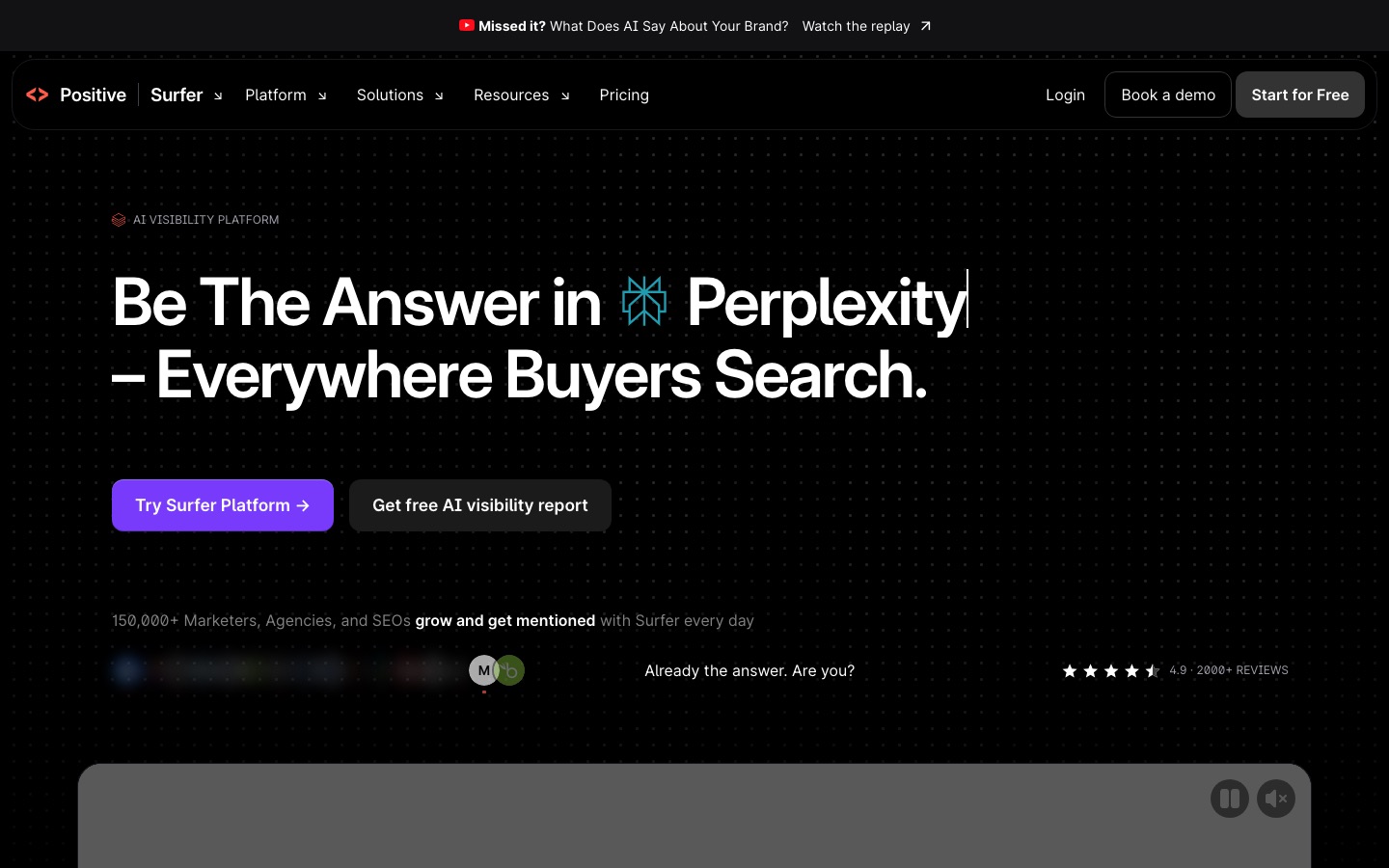
Surfer has changed a lot since it became famous for its Content Score. It now lives at surfer.ai, it was acquired by the European software group Positive in October 2025, and it markets itself as an "AI search" platform for ranking in Google and getting cited by ChatGPT, Gemini, Claude and Perplexity. This review is based on Surfer's official pricing page and product pages, its documentation and public user feedback as of October 2026. We did not run controlled ranking tests, and nobody honestly can promise rankings from any optimizer.

Surfer SEO at a glance
What it is: a content optimization and AI search visibility platform. You write or import a draft, and Surfer tells you what a competitive page for that query covers.
Best for: content marketers, SEO agencies, affiliate and B2B blogs publishing weekly.
Skip it if: you need backlink, keyword difficulty or technical crawl data (use Ahrefs AI), or you publish rarely.
Pricing: Discovery from $49/mo billed yearly, Standard $99/mo, Pro $182/mo, Peace of Mind $299/mo, plus a standalone AI Search Analytics plan at $82/mo. Monthly billing costs up to about 17% more.
Key features: Content Editor with Content Score, Surfy AI writing assistant, Topical Map, Content Audit, AI Tracker, Humanizer and AI Detector, WordPress and Google Docs integrations, MCP server.
Free option: no permanent free plan for the core product, but several free tools (AI Visibility Audit, AI Detector, Humanizer, Chrome extension).
What Surfer SEO is, and what changed in 2026
At its core, Surfer analyzes the pages that currently rank for a keyword and turns them into guidelines: which terms and entities to mention, how many headings and images competitive pages use, a rough word count range and which questions people ask. As you write, a Content Score from 0 to 100 updates in real time. That loop is still the main reason people buy it.
The 2026 version wraps that loop in a wider platform. Three shifts matter most:
AI search visibility. The AI Tracker monitors whether your brand appears in answers from ChatGPT, Gemini, Google AI Overviews and other models, and flags when competitors are mentioned instead. Every plan above Discovery includes tracked prompts, and there is a separate AI Search Analytics plan for teams that only want the tracking.
More automation. Surfy, the in-editor AI writing assistant, drafts and rewrites sections against the guidelines. Pro adds 1-click internal linking, coverage gap analysis and a cannibalization report. A fuller "Surfy Agent" for strategy, reporting and publishing is listed as coming soon.
New ownership and a new domain. Surfer moved from surferseo.com to surfer.ai and now sits inside Positive's content and social group alongside Iconosquare. The team says the product vision continues. In October 2026 Surfer shipped a WordPress plugin with the full Content Editor, French and Polish interfaces, and a beta rebuild of Topical Map.
Surfer's strength is still the same: it makes "what should this page cover?" a visible, shared checklist that writers and editors can agree on.
Surfer SEO features, tested against the docs
Content Editor and Content Score
The Content Editor is where most users spend their time. Enter a keyword and location, pick the competitors you want to benchmark against (you can exclude outliers such as Reddit threads or huge brand pages), and Surfer builds guidelines: suggested terms with target counts, heading and paragraph ranges, and questions to answer. The Content Score rises as coverage improves.
Two details make the editor better than a generic checklist. First, you control the competitor set, which matters when the top results mix product pages and guides. Second, the score is relative: a 75 against strong competitors can beat a 95 against weak ones. Surfer's own guidance is to treat the score as a coverage signal, not a target, and that advice is worth taking seriously.
Surfy, the AI writing assistant
Surfy (included from Discovery up) can outline a brief, write or expand sections, rewrite paragraphs to hit missing terms and apply a brand voice. Standard and above add Brand Knowledge, so the assistant draws on facts about your company, and Pro adds templates and custom voices. The output is useful as a first draft and for filling coverage gaps. Like every AI writer, it still needs an editor who knows the subject, adds original examples and checks facts.
Topical Map
Topical Map suggests clusters of related articles based on audience intent and competitive gaps, so you can plan a hub of pages instead of guessing one keyword at a time. It is a lighter take on what MarketMuse does for topical authority. The rebuilt version was in beta in October 2026, so expect it to keep changing.
Content Audit and rank drop detection
Content Audit connects to your published pages and produces a prioritized list of fixes: missing terms, thin sections, internal link opportunities and pages that are losing positions. Standard and above include rank drop detection, which is the feature content teams with large back catalogs tend to value most, because refreshing decaying pages is often cheaper than writing new ones. Pro adds a keyword cannibalization report for sites where several pages compete for the same query.
AI Tracker and AI Search Analytics
The AI Tracker runs a set of prompts you choose (for example "best project management software for agencies") across AI assistants and records whether your brand is mentioned, how it is described and which competitors appear. Plans include mention gap and brand sentiment views, and higher tiers refresh prompts daily across all tracked models rather than weekly on ChatGPT only. This is still an early category, and results vary run to run, so treat the trend over weeks as the signal, not a single answer.
Integrations, MCP and free tools
Surfer works inside Google Docs and WordPress, and Pro adds Contentful. Peace of Mind adds Zapier and API access. An MCP server lets you pull live Surfer data into assistants like ChatGPT and Claude, which is handy if you already draft with an assistant. Free tools include an AI Visibility Audit, the Surfer Pulse AI search volatility tracker, an AI Detector, an AI Humanizer and an SEO Chrome extension.
Surfer SEO pricing in 2026
Surfer's pricing page lists prices billed yearly. Monthly billing is available at a higher rate (third-party trackers list about $59, $119, $219 and $359 for the four main tiers), and Surfer says annual billing saves up to 17%. Annual plans are charged upfront, and document credits reset yearly or when you change plans. Figures below are from the official Surfer pricing page as of October 2026.
| Plan | Price (billed yearly) | Documents / tracked pages | AI prompts tracked | Seats | What it adds |
|---|---|---|---|---|---|
| Discovery | $49/mo | 120 / 10 pages | None | 1 | Content Editor, Surfy, Humanizer, AI SEO guidelines |
| Standard | $99/mo | 360 / 50 pages | 25, refreshed weekly | 3 | WordPress and Google Docs, Brand Knowledge, plagiarism checker, rank drop detection |
| Pro | $182/mo | 360 / 200 pages | 50, daily, all models | 5 | Internal linking, coverage gaps, custom voices, cannibalization report, MCP |
| Peace of Mind | $299/mo | Unlimited (fair use) / 500 pages | 100, daily | 10 | Zapier, API, advanced SERP analysis, dedicated success manager |
| AI Search Analytics | $82/mo | No documents | 50, daily | 5 | AI visibility tracking only, sentiment, mention gaps, MCP |
| Enterprise | Custom | Custom | Custom | Custom | SSO, white-label, custom limits, priority support |
Which Surfer plan should you buy?
Solo bloggers and freelancers: Discovery is enough if you only need the editor. 120 documents a year is about ten articles a month.
Small content teams: Standard is the sweet spot. Google Docs and WordPress integrations, three seats and rank drop detection are the features that save real time.
Agencies and multi-brand teams: Pro, mainly for five brand spaces, internal linking and daily AI tracking across all models.
Large publishers: Peace of Mind if you need API access or more than 360 documents a year.
Brand or PR teams who do not write SEO content: the AI Search Analytics plan alone.
Is there a Surfer SEO free trial? The site uses "start for free" buttons and offers free standalone tools, but trial terms change, so check the pricing page before you sign up rather than assuming a long trial.
Pros and cons
Pros
The best-known live content editor. Writers understand it quickly, and the score makes editorial standards visible.
Competitor control. Excluding irrelevant results gives cleaner guidelines than tools that average everything.
Refresh workflow. Content Audit plus rank drop detection is genuinely useful for sites with hundreds of posts.
AI visibility in the same tool. You can track ChatGPT and Gemini mentions without buying a separate product.
Good integrations. Google Docs, WordPress and MCP fit how most teams already write.
Cons
Price climbs fast. Internal linking, coverage gaps and daily all-model tracking sit on Pro at $182/mo billed yearly.
No keyword or backlink database. You still need Ahrefs, Semrush or similar for research and link data.
Score chasing. Writers who optimize for 100 can produce repetitive, keyword-stuffed copy.
Upfront annual billing. The headline prices assume you pay for a year in advance.
Moving target. Plan names, limits and features have changed repeatedly, which makes budgeting harder.
Common complaints from public user feedback
Reading reviews on software marketplaces, Reddit and SEO forums, the same themes come up again and again:
Pricing and credits. Long-time users complain that prices rose and that limits moved to document and credit allowances. Several 2026 reviews note that the jump from Discovery to Pro is steep once you need team features.
Term lists that feel mechanical. Some suggested terms are irrelevant or brand names from competitor pages. Experienced users prune them rather than following every suggestion.
Correlation, not causation. SEOs point out that matching what ranks describes the current results page. It does not account for links, brand strength or experience signals, so a perfect score on a new site may not rank.
AI drafts need work. Users like Surfy for outlines and gap filling but say full drafts read generically without editing.
Surfer SEO alternatives
Surfer is not the only way to optimize content. Here is how it compares with the alternatives people most often weigh against it. For a wider view, see our guide to the best AI SEO tools.
| Tool | Best for | Starting price (as of October 2026) | Key difference vs Surfer |
|---|---|---|---|
| Frase | Research-to-draft flow plus GEO | $39/mo billed yearly ($49 monthly) | Includes AI visibility on every plan, an agent that can publish, 70+ languages |
| Clearscope | Editorial teams that write by hand | $129/mo | Simpler grades, unlimited users, no heavy AI writer |
| MarketMuse | Topical authority and planning | Check official page | Site-wide inventory and cluster strategy rather than live editing |
| Ahrefs AI | Keyword, backlink and audit data | $29/mo (Starter) | A data platform; content and AI features are add-ons |
| Semrush Content Toolkit | Small businesses on a budget | Check official page | Topic ideas and drafts from Semrush data, less optimization depth |
Surfer vs Frase
This is the most common head-to-head. Frase is cheaper at the entry level, includes AI visibility tracking on every plan and leans harder into automation, with an agent that can draft, optimize and publish. Surfer has the more mature editor and a stronger refresh workflow. We compare them in detail in Surfer SEO vs Frase.
Surfer vs Clearscope
Clearscope suits editorial teams who want clean letter grades and unlimited seats, and who do not want an AI writer pushing drafts. Its Essentials plan is $129/mo on the Clearscope pricing page. Surfer offers more features per dollar, but Clearscope is easier to roll out to large writer pools.
Who should use Surfer SEO?
Content teams publishing 8 or more articles a month: yes, Standard or Pro pays for itself in editing time.
SEO agencies: yes, especially Pro for brand spaces and client-ready guidelines writers can follow.
Affiliate and niche site owners: often yes, on Discovery, as long as you edit for readers and do not chase a perfect score.
Brand and communications teams: consider the AI Search Analytics plan if you only care about how assistants describe you.
Small businesses posting occasionally: probably not. A general assistant plus a free keyword tool, or Frase's Starter plan, is enough. Our list of best AI writing tools has cheaper options.
How to get the most out of Surfer
Pick competitors deliberately. Remove results that do not match your page type before you write.
Aim for a solid score, not a perfect one. Many teams treat 70 to 85 as good enough and spend the rest of their time on originality.
Write the expert parts yourself. Use Surfy for structure and coverage gaps, then add first-hand examples, data and opinions.
Run the audit every quarter. Refreshing pages flagged by rank drop detection is usually the best return on the subscription.
Track a small, stable prompt set. For AI visibility, choose 20 to 50 prompts that map to revenue and watch the trend for a few months.
If you plan to pair Surfer with a writing assistant, our comparison of Jasper vs Copy.ai vs Writesonic covers the main options, including Jasper.
FAQ
Is Surfer SEO worth it in 2026?
It is worth it if you publish search content every week and have an editor to keep quality high. The Content Editor, audit and AI visibility tracking save real time at that volume. For occasional publishing, the $49/mo Discovery plan billed yearly is still a meaningful commitment, and a cheaper tool like Frase or a general AI assistant may be enough.
How much does Surfer SEO cost?
As of October 2026, Surfer lists Discovery at $49/mo, Standard at $99/mo, Pro at $182/mo and Peace of Mind at $299/mo, all billed yearly. Monthly billing costs up to about 17% more. A standalone AI Search Analytics plan is $82/mo, and Enterprise is custom priced. Check the official pricing page for current limits.
Does Surfer SEO have a free plan or free trial?
There is no permanent free plan for the core Content Editor. Surfer offers free standalone tools, including an AI Visibility Audit, AI Detector, AI Humanizer and a Chrome extension. The pricing page shows "start for free" options, but trial terms change, so confirm them on the official site before signing up.
Does a high Content Score guarantee rankings?
No. The Content Score measures how well your page covers what currently ranking pages cover. Rankings also depend on links, site authority, search intent, freshness and user satisfaction. A strong score removes coverage gaps, which helps, but a new site with a perfect score can still lose to an established site with a lower one.
Is Surfer AI content detectable or penalized by Google?
Google's public guidance focuses on whether content is helpful, not whether AI helped write it. Publishing large volumes of unedited AI pages to manipulate rankings can violate spam policies. Use Surfy for drafts and gaps, then edit, fact-check and add original expertise. Surfer's Humanizer is not a substitute for real editing.
What is the best alternative to Surfer SEO?
Frase is the closest alternative, with a lower entry price and AI visibility on every plan. Clearscope suits editorial teams that write by hand, MarketMuse suits content strategists planning clusters, and Ahrefs or Semrush are the picks if you need keyword and backlink data rather than an optimizer.
Final verdict
Surfer is still one of the most practical content optimizers you can buy, and the 2026 additions make it a credible place to watch your AI search visibility too. Buy Standard if you are a content team publishing weekly, Pro if you run several brands or need internal linking and daily AI tracking, and the standalone AI Search Analytics plan if you only care about mentions. Skip it if you publish rarely or need research data first. Whatever you choose, use the score as a checklist, not a goal: original expertise is what turns a well-covered page into one that ranks and gets cited.
Browse every SEO and content tool we track in the AI marketing tools category, or compare AI writers in the writing category. Building an SEO tool we have not covered? Submit it for a listing.