Synthesia Review (2026): Avatars, Credits and Enterprise Value
Synthesia is the enterprise standard for AI avatar video: training, onboarding and internal comms in 140+ languages, with SOC 2, ISO 42001 and SSO. In 2026 it added a free plan, a credit system, Roleplay and Surveys, and pushed many power features into Enterprise. Here is what each plan really gets, the common complaints, and when HeyGen or Colossyan fits better.
Verdict: the short version of this Synthesia review is that Synthesia is the safest choice for companies that need to produce a lot of consistent training, onboarding, compliance and internal communication videos, and the passport it carries through procurement (SOC 2, GDPR, ISO 42001, SAML SSO) is a big part of its value. Express-2 full-body avatars look polished, the editor is easy for non-video people, and translation covers 140+ languages. It is a weaker buy for solo creators and marketers: the Starter plan is limited, many headline features sit in Enterprise, and HeyGen is more flexible for personal avatars and translating real footage.
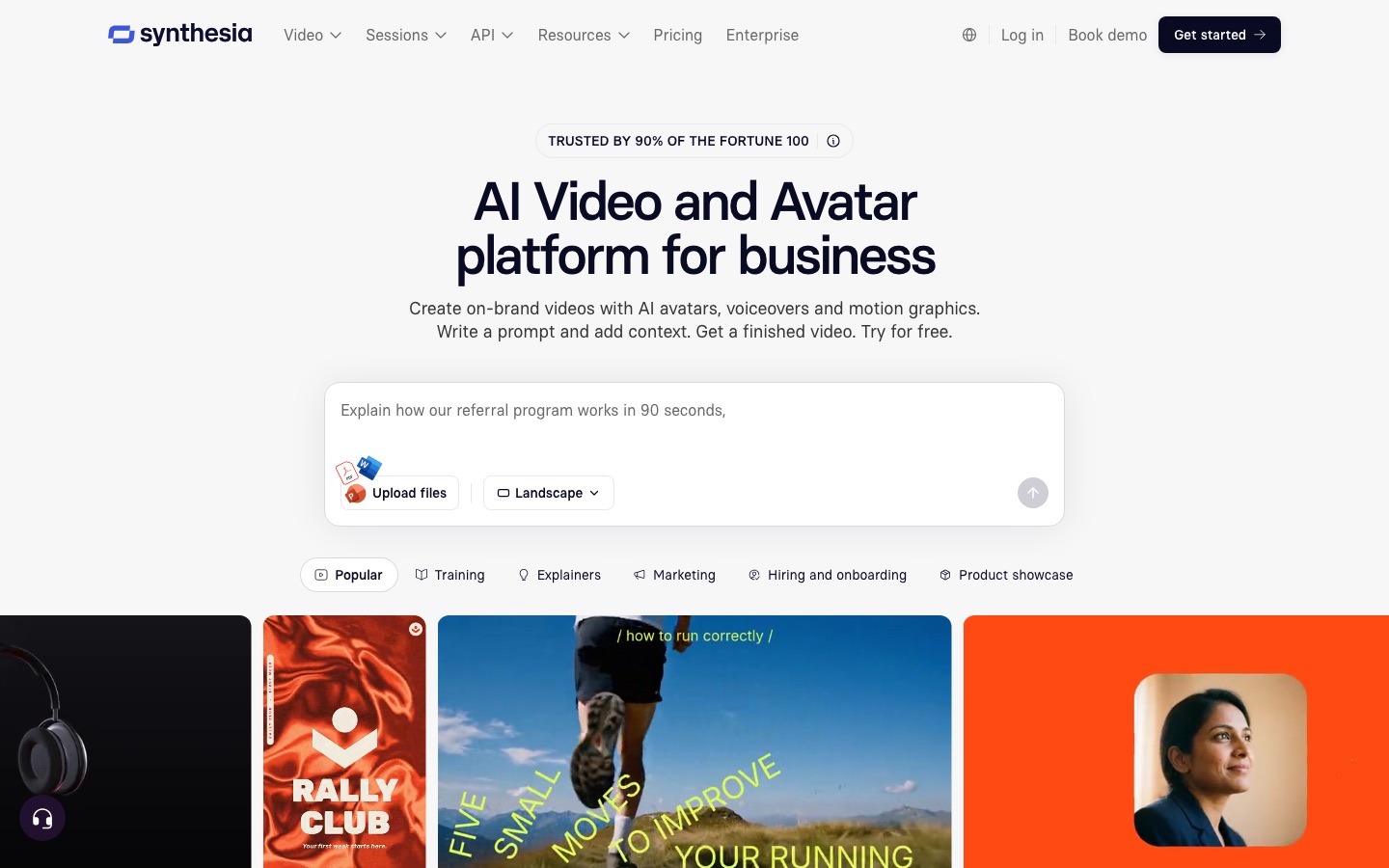
Synthesia, founded in 2017 in London, sells mainly to large organizations and says it is used by 90% of the Fortune 100. In 2026 it reworked its plans around credits, launched a free Basic tier, and expanded beyond video into Roleplay practice sessions, Surveys and conversational Video Agents. This review is based on the official Synthesia pricing page, product announcements and public user feedback as of late October 2026. We did not run our own benchmark tests.

Synthesia at a glance
What it is: a browser-based platform that turns scripts, documents and slides into presenter-led videos with AI avatars, plus dubbing, interactive video, surveys and roleplay.
Best for: L&D, HR, internal comms, customer education and product teams in mid-size and large companies.
Skip it if: you are a solo creator, you want to translate footage of yourself with lip sync on a small budget, or you need cinematic AI video.
Pricing: Basic free; Starter $19 a month ($14 billed yearly); Pro $89 a month ($59 billed yearly); Enterprise custom.
Standout features: Express-2 full-body avatars, 140+ languages, Personal Avatars, templates, screen recording, SCORM, branching and quizzes (Enterprise).
Biggest complaints: strict content moderation, price, credits that expire, and some avatars or voices that still feel artificial.
What changed at Synthesia for 2026
Synthesia 3.0, announced in October 2025, set the roadmap that played out this year:
Express-2 avatars: full-body presenters with hand and body gestures, facial expression and lip sync, rendered at 1080p and 30fps.
Express-Voice: an in-house voice cloning model designed to keep accent and rhythm.
Easier Personal Avatars: avatars from a single photo, plus AI-generated avatars from a text prompt that you can place in different settings.
Video Agents: conversational avatars embedded in a video that can run training scenarios, screen candidates or guide customers, rolling out to Enterprise customers in 2026.
AI Playground: third-party generative models inside the editor for B-roll, charged per asset.
New products: Roleplay (practice hard conversations with an AI partner) and Surveys (collect video responses), now on the homepage alongside Video and Dubbing.
New plans: a free Basic plan and a credit system that covers video, dubbing, surveys and B-roll.
Synthesia also announced Copilot (a scripting and visuals assistant connected to your knowledge base) and Courses (interactive learning built from avatars, agents and quizzes) for 2026. Check your account for availability, since both were described as rolling out.
Key features in depth
Avatars: stock, personal and studio
The stock library grows with your plan: 9 avatars on Basic, 125+ on Starter, 180+ on Pro and 240+ on Enterprise. Express-2 avatars gesture like a professional presenter, which makes long training videos far less stiff than older chest-up avatars. They are deliberately neutral and well lit, ideal for compliance and HR, though some users find them corporate.
Personal Avatars of your own people are included on paid plans (Pro lists 5; Enterprise is unlimited within reasonable use), with consent verification built into the process. For a premium, studio-filmed presenter, Synthesia sells a Studio Express-1 avatar as a $1,000 a year add-on on annual plans.
The editor: slides, not timelines
Synthesia's editor works like a presentation tool. Each scene has an avatar, a script, text, media and transitions, and the voice is generated from the script. You can start from hundreds of templates, import a PowerPoint or document, or record your screen for software training. This is why non-technical subject matter experts can publish a decent video on their first day. It is not a video editor, so complex cuts, motion graphics and color work still belong in another tool.
Languages, translation and dubbing
Scripts can be voiced in 140+ languages. Synthesia offers two kinds of localization: one-click translation of a finished Synthesia project into 140+ languages (listed under Enterprise in the plan table), and dubbing of uploaded videos with optional lip sync. Starter and Pro dub into 70+ output languages; Enterprise into 140+. Dubbing costs 80 credits per minute with lip sync and 40 without. As with every tool in this category, have a native speaker review output before publishing.
Interactivity, quizzes and SCORM
For training teams, these are the features that matter most: clickable calls to action, branching paths, quizzes, branded video pages and SCORM export for your learning management system. The pricing page's comparison table lists interactive CTAs, branching, quizzes and SCORM under Enterprise, while the Pro plan card mentions interactive videos, so confirm exactly what your tier includes with sales before you build a course around it.
Roleplay, Surveys and Video Agents
Roleplay gives learners a conversational AI partner to practice sales calls, feedback conversations or customer complaints; every plan includes 10 shared sessions a month, and Enterprise 25. Surveys collect responses from viewers (3 included on Basic and Starter, 17 on Pro, then 350 credits per response). Video Agents push this further by putting a live, talking avatar inside a video. These tools move Synthesia from "make a video" toward measuring whether people learned something.
Security, governance and the API
Synthesia advertises SOC 2, GDPR and ISO 42001 compliance and SAML SSO, along with workspaces, live collaboration, brand kits and content moderation that reviews scripts before rendering. The API, with 360 minutes a year included, sits in Enterprise. Interactive Avatars through the API cost 10 credits per minute (20 with the full widget). For security teams with a long questionnaire, this is Synthesia's strongest selling point.
Synthesia pricing (as of October 2026)
Synthesia moved to credits in 2026. As a rule of thumb from its FAQ, a typical finished minute of avatar video uses about 100 credits, more if the avatar is on screen the whole time. Credits are spent only on generation, never on editing or previewing.
| Plan | Monthly | Billed yearly | Credits | What you really get |
|---|---|---|---|---|
| Basic | $0 | n/a | 500 per month | About 10 min of video or dubbing, 9 avatars, 1 editor, Synthesia watermark, no video download. |
| Starter | $19 ($9 first month) | $14/mo ($168/yr) | 1,250 per month | About 12 min of video, 125+ avatars, no watermark, downloads, 1 editor and 3 guests. |
| Pro | $89 ($49 first month) | $59/mo ($708/yr) | 6,000 per month (higher tiers available) | About 60 min of video, 180+ avatars, 5 personal avatars, 1 editor and 5 guests, priority support. |
| Enterprise | Custom | Custom | Custom | 240+ avatars, unlimited personal avatars, 1-click translation, SSO, SCORM, branching, brand kits, API, workspaces. |
Credit rules to know before you buy
No rollover: monthly allowances reset each billing period. Annual plans load the full year's credits upfront.
Running out pauses you: video creation stops until renewal unless you buy extra credits or move up a tier. Extra credits are valid for 12 months.
Only new footage counts: you are charged for the avatar footage generated, so editing a scene and re-rendering only that part is cheaper than a full re-render.
Annual is much cheaper: Pro drops from $89 to $59 a month, a third less.
Pros and cons
Pros
Enterprise-grade security and compliance, including SOC 2, ISO 42001 and SSO.
Express-2 full-body avatars that look natural in long training videos.
Easy, slide-like editor that subject matter experts can use without training.
140+ languages for scripts and broad dubbing support.
Learning features few rivals match: SCORM, branching, quizzes, Roleplay and Surveys.
A free plan for evaluation, new in 2026.
Cons
Key features are Enterprise-only, including SCORM, SSO, brand kits, 1-click translation and the API, according to the plan table.
Starter is thin: about 12 minutes of video a month.
Credits expire at the end of each period.
Strict moderation can reject or delay legitimate scripts.
Avatars can feel corporate, and creator-style content is not its strength.
Free plan does not allow downloads, so it is for testing only.
Common complaints from public user feedback
Synthesia's Trustpilot page showed a TrustScore of about 3.8 out of 5 from roughly 1,800 reviews when we checked in October 2026. Reviewers praise ease of use, support staff and webinars. The recurring complaints:
Moderation: scripts sent to manual review or rejected, with suggested rewrites some users found unusable.
Price: small teams describe it as expensive for the minutes included.
Expiring credits: subscribers unable to finish a video after unused credits reset.
Trial and sign-up friction: confusing trial steps and browser limits (reviewers mention Chrome and Edge only).
Voice control: mispronunciations and limited control over emphasis and emotion in some languages.
Tip: put brand names, acronyms and product terms in a pronunciation list before scaling, and keep sensitive topics (medical, legal, financial) factual and neutral to avoid moderation delays.
Synthesia vs the alternatives






Synthesia vs HeyGen
HeyGen is the stronger creative tool: Avatar V builds a lifelike twin from 15 seconds of footage, lip-synced translation of real video covers 175 languages on the $29 Creator plan, and Video Agent makes full videos from a prompt. Synthesia wins on governance, structured training features and procurement readiness. See our HeyGen vs Synthesia comparison and our full HeyGen review.
Synthesia vs Colossyan
Colossyan is the closest like-for-like rival for workplace learning, with doc-to-video, quizzes, branching and SCORM export. It is worth pricing against Synthesia if those learning features are what you need and Enterprise is out of budget.
Synthesia vs AI Studios and Elai
AI Studios, formerly DeepBrain AI, offers realistic avatars, dubbing and interactive kiosks. Elai.io turns documents into training videos with one-click translation into 75+ languages. Both are cheaper routes to avatar training content.
Synthesia vs Vyond and Google Vids
If you do not need a human presenter, Vyond makes animated business videos with AI-written scripts, and Google Vids is a simple AI video creator built into Google Workspace, included with many business plans.
| Tool | Best for | Free plan | Entry paid plan | Standout |
|---|---|---|---|---|
| Synthesia | Enterprise training and comms | Yes (Basic) | $19/mo | Compliance, Express-2, learning features |
| HeyGen | Marketing, creators, translation | Yes | $29/mo | Avatar V, lip-synced translation |
| Colossyan | Workplace learning | Check site | Check site | Quizzes, branching, SCORM |
| Elai.io | Docs to training video | Yes | Check site | 75+ language translation |
For more options, see our guides to the best AI avatar generators, the best AI video translators and the best AI tools for teachers.
Who should use Synthesia
L&D and HR teams producing onboarding, compliance and policy training at scale.
Internal communications teams sending leadership updates in many languages.
Customer education and support teams building how-to libraries with screen recordings.
Regulated industries where security review, SSO and moderation are required.
Who should skip it
Solo creators and YouTubers: HeyGen or a creator-focused clone tool like Argil is a better fit.
Teams that need cinematic AI footage: use a generator such as Runway or Kling; see our Runway review.
Small teams on a tight budget that need SCORM or SSO, which require Enterprise.
FAQ
Is Synthesia free?
Yes, since 2026 Synthesia has a free Basic plan with 500 credits a month, about 10 minutes of video or dubbing, 9 stock avatars and 140+ languages. Free videos carry a Synthesia watermark and cannot be downloaded, so the plan is for testing. Paid plans start at $19 a month, or $14 billed yearly.
How much does Synthesia cost?
Starter is $19 a month or $14 a month billed yearly, with 1,250 credits (about 12 minutes of video). Pro is $89 a month or $59 billed yearly, with 6,000 credits (about 60 minutes) and higher credit tiers. Enterprise is custom priced and adds SSO, SCORM, the API and unlimited personal avatars.
Is Synthesia worth it?
For companies producing training and internal video at scale, usually yes: it replaces filming, presenters and translation with a secure, easy workflow. For individuals and small marketing teams it is harder to justify, because Starter is limited and key features need Enterprise. HeyGen offers more creative value per dollar for that audience.
Can I make an avatar of myself in Synthesia?
Yes. Personal Avatars are included on paid plans, and Synthesia now supports creating them from a webcam recording or even a single photo, with consent checks. Pro includes 5 personal avatars and Enterprise unlimited. A studio-filmed Express-1 avatar is a $1,000 a year add-on.
Is Synthesia better than HeyGen?
Synthesia is better for enterprise training, compliance and governance. HeyGen is better for personal avatars, translating real footage with lip sync, marketing content and API-driven personalization. Many organizations use Synthesia in learning and development and HeyGen in marketing.
How many languages does Synthesia support?
Synthesia supports 140+ languages and voices for script-based videos on every plan. Dubbing of uploaded videos covers 70+ output languages on Starter and Pro and 140+ on Enterprise, with optional lip sync at 80 credits per minute.
Do Synthesia credits roll over?
No. Monthly allowances reset each billing period, and unused video minutes do not carry over. Annual plans give you the whole year's credits upfront, and separately purchased credits stay valid for 12 months. If you run out, creation pauses until renewal.
Final verdict
Synthesia remains the benchmark for enterprise AI avatar video. Express-2 avatars, a slide-simple editor, 140+ languages and a serious security posture make it easy to roll out across a large company, and Roleplay, Surveys and Video Agents push it toward measurable training. The value story is weaker below Enterprise, where minutes are tight and many learning features are gated. If you are a company buying for many creators, put Synthesia on the shortlist first. If you are one person making marketing videos, start with HeyGen.
Compare Synthesia with every avatar and AI video tool we track in the AI video category, or see AI education tools for training use cases. If you build a tool we have missed, you can submit it for a listing.