Lovable vs Bolt vs v0 (2026): Which AI App Builder Should You Use?
Lovable is the easiest way for non-developers to ship a full app with a database and login. Bolt is the most flexible browser workspace, with mobile apps through Expo. v0 is the pick for React and Next.js teams that deploy on Vercel. Here is how the three vibe coding tools compare on stack, backend, code ownership and credits.
Short verdict on Lovable vs Bolt vs v0: choose Lovable if you are not a developer and want a working app with a database, user accounts and hosting handled for you. Choose Bolt.new if you want a flexible coding workspace in the browser, a choice of JavaScript frameworks, or a path to iOS and Android through Expo. Choose v0 if your team already works in React and Next.js and deploys on Vercel, because its output drops straight into that workflow. All three have free plans, and paid plans start at $25 a month for Lovable and Bolt and $30 per user for v0.
These are the three best-known AI app builders, the tools behind the "vibe coding" wave: you describe an app in plain English, the AI writes the code, and you watch a live preview update as you chat. They look similar in a demo. The differences show up when you need a real backend, want to own the code, or start paying for heavy use. This comparison is based on the official pricing pages, product documentation and public user feedback as of October 2026, not hands-on benchmark testing. Plans change often, so confirm on each vendor's site before you buy.



Quick verdict by use case
Non-technical founder building an MVP with logins and data: Lovable.
Internal tool or dashboard for a small team: Lovable, or Bolt if a developer will maintain it.
Developer prototyping in a real browser IDE: Bolt.
Mobile app for iOS and Android: Bolt, through its Expo integration.
Polished React UI or landing page for an existing Next.js codebase: v0.
Team that already deploys on Vercel and reviews code in pull requests: v0.
Cheapest way to try all three: start on the free plans. Lovable gives 5 credits a day, Bolt 1M tokens a month, v0 7 messages a day.
All-in-one with more control over the runtime: Replit.
Lovable vs Bolt vs v0 at a glance
| Lovable | Bolt.new | v0 by Vercel | |
|---|---|---|---|
| Best for | Non-developers shipping full apps | Developers and tinkerers who want flexibility | React and Next.js teams on Vercel |
| Default stack | React, Vite, TypeScript, Tailwind, shadcn/ui | JavaScript frameworks such as React and Vue, Node.js backend | Next.js, React, Tailwind, shadcn/ui |
| Built-in backend | Lovable Cloud (database, auth, storage, edge functions) | Bolt Cloud with Bolt Database (PostgreSQL with auth) | Through Vercel and integrations such as Neon and Supabase |
| Bring your own Supabase | Yes | Yes, via its APIs | Yes, as an integration |
| Hosting | Publish to a lovable.app URL; custom domains on paid plans | Bolt Cloud hosting on bolt.host; custom domains on paid plans | One-click deploy to Vercel |
| Code ownership | Git sync with GitHub, GitLab or Bitbucket; edit and download code on paid plans | GitHub integration and code export | GitHub sync on every plan, including Free |
| Mobile apps | Web apps (responsive) | iOS and Android via Expo | Web apps (responsive) |
| Billing unit | Credits | Tokens | Dollar credits, priced per model |
| Free plan | 5 credits a day, up to 30 a month | 1M tokens a month, 300K a day | 7 messages a day |
| Paid from | $25/mo (100 credits) | $25/mo (10M tokens) | $30/user/mo ($30 in credits) |
What each AI app builder is
Lovable
Lovable is a Stockholm-based AI app builder aimed squarely at people who do not write code. You chat, it builds the frontend and backend together, and you publish to a live URL. Generated apps use React with TypeScript, Vite, Tailwind CSS and shadcn/ui components, a mainstream stack any developer can pick up later. Its built-in backend, Lovable Cloud, adds a database, file storage, user authentication, realtime updates and edge functions without a separate account. Lovable says Cloud is built on Supabase's open-source foundation, and you can connect your own Supabase project instead if you prefer.
Lovable has grown well beyond a single chat box. Plan Mode lets you talk through a feature before any code changes, at 1 credit per message. Projects sync to GitHub, GitLab or Bitbucket. There are desktop and mobile apps, an MCP server and connectors for outside services, and Business adds SSO.
Bolt.new
Bolt.new was built by the StackBlitz team, creators of WebContainers, which run a full Node.js environment inside your browser tab. That heritage shows: Bolt feels more like a real development environment, with a file tree, terminal output and the freedom to pick a framework. It focuses on JavaScript web frameworks such as React and Vue, chooses one for you by default, and lets you name a preferred one in your prompt.
Bolt Cloud is its infrastructure layer: hosting on a free bolt.host subdomain, custom domains on paid plans, and Bolt Database, a PostgreSQL database with built-in authentication that Bolt creates automatically when your app needs one. Bolt offers two agents, Standard and Max, plus a Plan Mode for thinking through a build without generating code. Its Expo integration is the standout: it is the only one of the three that can turn a project into a native iOS or Android app.
v0 by Vercel
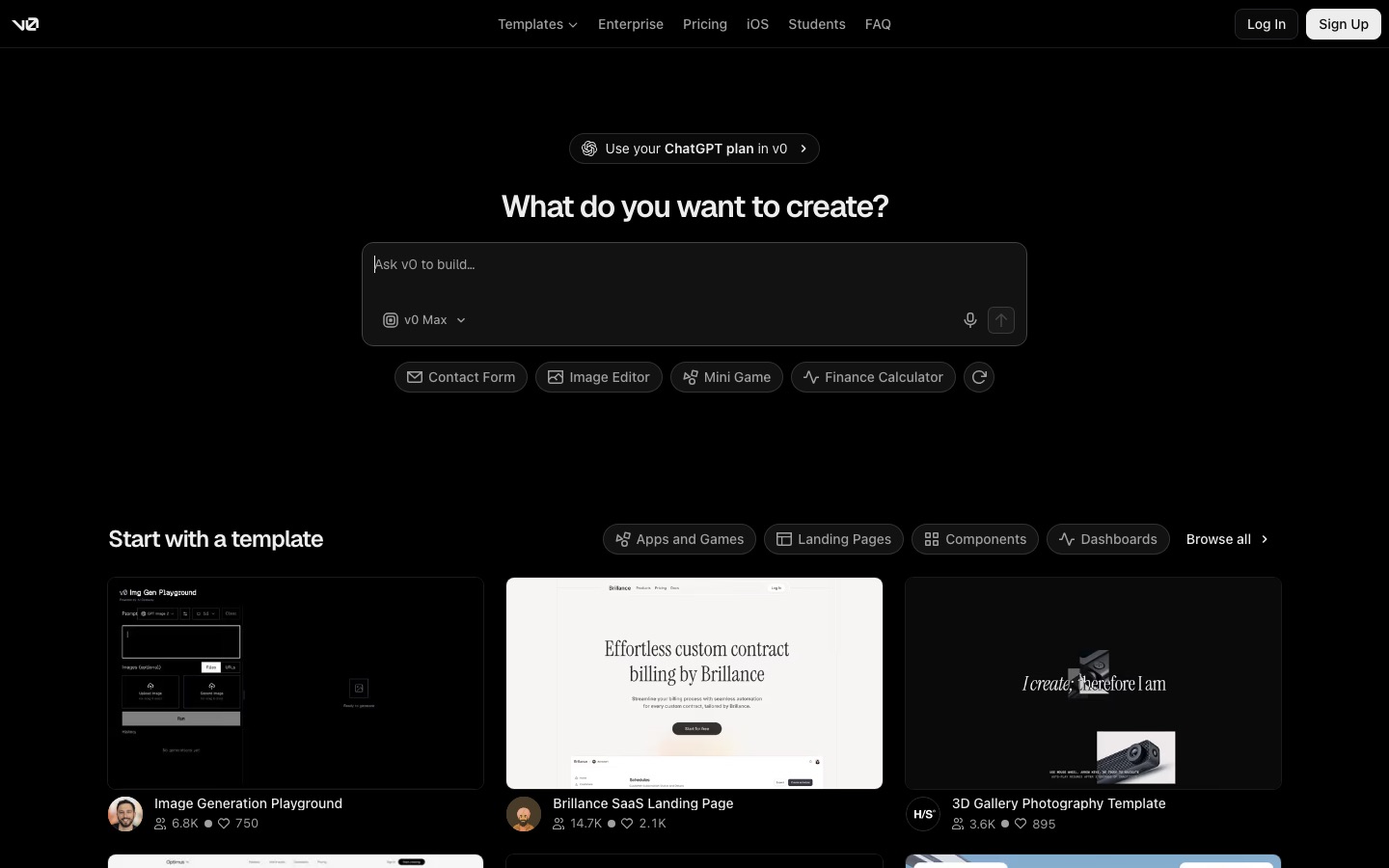
v0 is Vercel's AI builder. It started as a UI component generator and is now a full app builder, but its sweet spot is still the Next.js, Tailwind and shadcn/ui stack. Its agent can search the web, inspect sites, fix its own errors and turn screenshots, wireframes or Figma files into working interfaces. Design Mode lets you tweak layouts visually without spending a prompt.
The 2026 version of v0 leans toward professional workflows. It can import an existing GitHub repository, works on Git branches, and can open and merge pull requests. Previews run in Vercel Sandbox, an isolated virtual machine, so server-side code behaves as it would in production. Databases, auth and payments come through integrations, with providers such as Neon and Supabase connected through your Vercel project.
Lovable vs Bolt vs v0, dimension by dimension
Ease of use for non-developers
Lovable is the most forgiving. It hides infrastructure, sets up login and data storage when you ask for them, and explains what it changed in plain language. Bolt is approachable but exposes more of the machinery. v0 assumes you are comfortable with concepts like environment variables, deployments and pull requests, which makes sense for its audience.
Winner: Lovable.
Frontend and design quality
All three produce clean, modern interfaces built on Tailwind. v0 has the edge for pixel-level UI work: it was built for components first and handles design references well. Lovable produces attractive apps quickly and offers visual edits for small changes. Bolt's designs are solid, but users more often report needing a few prompts to polish them.
Winner: v0.
Backend and database
This is where the tools separate. Lovable Cloud is the most complete out of the box: database, auth, storage, edge functions, scheduled jobs, secrets and logs, all managed from a Cloud tab, according to the Lovable Cloud docs. You can pick a hosting region (Americas, Europe or Asia Pacific), though it locks once enabled. If you outgrow it, you can export your database, but moving to your own Supabase project is a manual migration of data, storage, auth and secrets. If you expect to need that control, connect your own Supabase from day one.
Bolt Cloud gives you a managed PostgreSQL database with auth built in, created automatically when needed, plus hosting and domains in one place. Bolt can also call outside services such as Supabase and Stripe through their APIs. v0 does not run its own database. Instead it wires your app to providers through Vercel, which is the most flexible and production-friendly approach, but also the one that assumes you know what Neon or Supabase is.
Winner: Lovable for simplicity, v0 for production flexibility.
Deployment and hosting
Each tool deploys in one click. Lovable publishes to a lovable.app address and says hosting is free for most small apps, though high-traffic apps may use credits. Bolt publishes to bolt.host, and its free-plan sites go offline if they hit the monthly bandwidth limit. Both need a paid plan for custom domains. v0 deploys straight to Vercel, with production-grade hosting and preview deployments billed on your Vercel account.
Winner: v0 for serious production hosting, Lovable and Bolt for zero-setup publishing.
Code ownership, export and GitHub sync
You own the code in all three, but access differs. v0 includes GitHub sync even on its Free plan. Lovable's Git sync connects to GitHub, GitLab or Bitbucket, and edits in Lovable are committed to the linked repo, but editing and downloading code directly are paid features. Bolt integrates with GitHub for backups and collaboration and lets you export projects. An open-source sibling, bolt.diy, even lets developers self-host the builder with their own models.
One warning for all three: editing code outside the builder while still prompting inside it invites conflicts. Many teams prototype in the builder, then move the repo into an AI editor such as Cursor or a terminal agent such as Claude Code once the app gets serious. Our Claude Code vs Cursor comparison covers that next step.
Winner: v0, narrowly, for Git-native workflows on every plan.
Mobile apps
Bolt is the only one of the three with a documented path to native mobile apps, through Expo. Lovable and v0 build responsive web apps that work on phones, which is enough for many MVPs but not for an App Store listing.
Winner: Bolt.
Pricing and credits
All three meter usage, so the sticker price is a floor. Here is what each plan includes as of October 2026, from Lovable's subscription plans page, Bolt's pricing page and v0's pricing page:
| Plan | Price | Included usage and key limits |
|---|---|---|
| Lovable Free | $0 | 5 build credits a day, up to 30 a month; 20 Cloud credits and 4 AI credits a month; no custom domain or code editing |
| Lovable Pro | $25/mo, or $250/yr | 100 monthly credits plus 5 a day; custom domains, edit and download code, remove badge. Higher tiers up to 10,000 credits |
| Lovable Business | $50/mo, or $500/yr | 100 monthly credits plus Pro features, SSO and governance controls |
| Bolt Free | $0 | 1M tokens a month, 300K daily cap, Bolt branding, no custom domain |
| Bolt Pro | $25/mo | 10M tokens a month, no daily cap, unused tokens roll over, custom domain, newest models, MCP connectors |
| Bolt Teams | $30 per member/mo | Starts at 10M tokens per member, admin controls, private NPM registries, team templates |
| v0 Free | $0 | 7 messages a day, deploy to Vercel, Design Mode, GitHub sync; new users get $5 in one-time credits |
| v0 Plus | $30 per user/mo | $30 of monthly credits per user plus $2 of daily credits on login; all models |
| v0 Business | $100 per user/mo | Same credits as Plus, plus training opt-out by default |
Lovable charges by credit, and a message's cost depends on how complex the change is. Plan Mode messages cost 1 credit each. Monthly credits expire two months after issue, top-ups last 12 months, and workspaces allow unlimited members, so you pay for usage rather than seats. Bolt charges by tokens, and large projects use more per prompt because Bolt reads more files. Paid tokens roll over, and yearly billing saves up to 28%. v0 converts your plan into dollar credits spent at per-model token rates: v0 Mini is $0.20 per million input tokens and $1.20 per million output, while v0 Max is $5 and $25, so choosing the right model matters.
Users of all three report the same pattern: credits go fast when the AI gets stuck fixing its own bugs. Plan before you build, make one change per prompt, and roll back to a working version instead of asking the AI to fix a broken one five times.
Winner: tie. Lovable and Bolt are cheaper for a solo builder at $25. v0's per-seat pricing makes more sense for teams already paying for Vercel.
Pros and cons
Lovable
Pros: easiest for non-coders, most complete built-in backend, Git sync to three providers, Plan Mode, SSO and audit logs on Business, SOC 2 Type II and ISO 27001.
Cons: credit costs vary by task, code editing and download require a paid plan, migrating off Lovable Cloud to your own Supabase is manual.
Bolt.new
Pros: real development environment in the browser, framework choice, native mobile through Expo, token rollover on paid plans, open-source bolt.diy.
Cons: token use climbs on large projects, free sites can go offline at the bandwidth cap, more technical than Lovable.
v0 by Vercel
Pros: best UI quality, Next.js output that fits real codebases, GitHub sync on Free, branches and pull requests, production previews in Vercel Sandbox.
Cons: per-user pricing, tied closely to Vercel and Next.js, backend setup assumes developer knowledge.
Who should pick which
Choose Lovable if...
You have an idea for a SaaS, marketplace or internal tool and no engineering team.
You need sign-up, login and a database without learning what a database is.
Choose Bolt if...
You know some code and want to see and steer what the AI is doing.
You want to pick your framework or build a mobile app with Expo.
Choose v0 if...
Your product is built on Next.js and hosted on Vercel.
You want AI-generated UI that a developer will review and merge through pull requests.
Alternatives worth a look
Replit: the closest all-in-one rival, with an AI agent, databases, hosting and a full cloud IDE. Core is $20/mo ($18/mo billed annually) and Pro is $100/mo, per Replit's pricing page.
Base44: a plain-language app builder for internal tools, sites and agents, popular with non-technical teams.
Anything: formerly Create, focused on shipping iOS, Android and web versions from one description.
If you are a developer, an AI editor or agent may serve you better than any app builder. See our best AI coding tools guide, the Cursor vs Windsurf vs Trae comparison, or our step-by-step guide on how to use Claude Code.
FAQ
Is Lovable better than Bolt?
For non-developers, usually yes. Lovable sets up the database, login and hosting with less technical exposure, and its Lovable Cloud backend is the most complete of the two. Bolt is better if you want to see the code environment, pick your framework or build a native mobile app through Expo. Both start at $25 a month.
Is v0 better than Lovable?
For React and Next.js developers, v0 is often better: its UI quality is excellent, GitHub sync is free, and it deploys to Vercel with production-style previews. For non-technical founders who need a working backend fast, Lovable is easier. v0 costs $30 per user a month on Plus, against $25 for Lovable Pro.
Can I export my code from Lovable, Bolt and v0?
Yes. Lovable syncs projects to GitHub, GitLab or Bitbucket, and paid plans can edit and download code. Bolt integrates with GitHub and lets you export projects. v0 syncs with GitHub on every plan, including Free. In all three cases the code is standard JavaScript or TypeScript you can keep developing in any editor.
Does Lovable use Supabase?
Lovable's built-in backend, Lovable Cloud, is built on Supabase's open-source foundation, so most projects never need a separate Supabase account. You can still connect your own Supabase project if you want direct control. Moving from Lovable Cloud to your own Supabase later is a manual migration, so decide early.
Can Bolt build mobile apps?
Yes. Bolt integrates with Expo, a JavaScript framework for iOS and Android apps, so you can turn a Bolt project into a native mobile app. Lovable and v0 build responsive web apps that work on phones, but they do not offer the same native path.
Do I need to know how to code to use these tools?
Not for Lovable, and only a little for Bolt. v0 is usable without code for UI work, but its backend and deployment features assume developer knowledge. For anything you plan to launch to real users, having someone review security, data access rules and payments is wise, whichever builder you pick.
Final verdict
Lovable is the best AI app builder for most non-developers: the shortest path from idea to an app with users and data. Bolt is the best for builders who want flexibility, framework choice and native mobile. v0 is the best for React and Next.js teams who want beautiful UI and a Git-native workflow on Vercel. If you are torn, build the same small app on all three free plans this week. The one whose code and backend you still understand at the end is your answer.
Browse every AI app builder, editor and coding agent we track in the AI coding category. Building an app builder we have missed? Submit it for a listing.