Best AI Email Marketing Tools (2026): 10 Platforms Compared
The best AI email marketing tools in 2026: Klaviyo for ecommerce, Mailchimp for small businesses, MailerLite for value, HubSpot for B2B, GetResponse for automation, beehiiv for newsletters, plus budget and AI copywriting picks. Free plans, current prices and what the AI actually does.
Quick answer: the best AI email marketing tool for most online stores is Klaviyo AI, thanks to predictive analytics and its Composer marketing agent built on your order data. For small businesses, Mailchimp AI is the easiest all-rounder, and MailerLite is the best value. B2B teams that want email tied to a CRM should pick HubSpot Breeze, and creators building a newsletter business should start with beehiiv AI.
Almost every email platform now advertises "AI", but the features range from a subject line generator to agents that plan, build and send campaigns. This guide compares ten AI email marketing tools on what their AI really does, free plans, starting prices and who each one suits. It is based on official pricing pages, product documentation and public user feedback as of October 2026, not paid placements. Email platforms price by contacts and change plans often (MailerLite renamed every plan this summer, and Mailchimp cut its free tier again), so confirm prices for your list size before you commit.





Quick picks
Best for ecommerce: Klaviyo AI, free up to 250 profiles, about $20/mo at 500.
Best for small businesses: Mailchimp AI, free up to 250 contacts.
Best value: MailerLite, free up to 250 subscribers, Comfort from about $12/mo.
Best for B2B and CRM-driven email: HubSpot Breeze, free CRM, Starter from $20/seat/mo.
Best for automation, webinars and courses: GetResponse, 14-day free trial.
Best for newsletters: beehiiv AI, free up to 2,500 subscribers.
Best budget pick with AI credits: Benchmark Email, free for 500 contacts.
Cheapest paid plans: Hostinger Reach, from under $3/mo on intro pricing.
Best AI email copywriter: Hoppy Copy, from $23/mo billed yearly.
AI email marketing tools compared
| Tool | Best for | Free plan | Starting paid price (as of October 2026) |
|---|---|---|---|
| Klaviyo AI | Ecommerce email and SMS | 250 profiles, 500 emails/mo | About $20/mo (500 profiles) |
| Mailchimp AI | Small business all-rounder | 250 contacts, 500 emails/mo | Essentials about $13/mo; AI on Standard (about $20/mo) |
| MailerLite | Value and simplicity | 250 subscribers, 2,500 emails/mo | Comfort about $12/mo; Power about $25/mo |
| HubSpot Breeze | B2B email on a CRM | Free CRM, up to 2 users | Starter from $20/seat/mo |
| GetResponse | Automation, webinars, courses | 14-day trial, then limited free account | Starter about €16/mo monthly (1,000 contacts) |
| beehiiv AI | Newsletters and monetization | Up to 2,500 subscribers | About $49/mo billed yearly |
| Benchmark Email | Budget with AI credits | 500 contacts, 1,000 emails/mo | Pro $12/mo ($10 yearly) |
| Hostinger Reach | Lowest cost | Starter free for year one (100 recipients) | Grow from $1.74/mo intro |
| Hoppy Copy | AI email copywriting | 7-day trial | $29/mo ($23 yearly) |
| Bardiah | AI email design to HTML | Yes | Check the official page |
What AI actually does in email marketing
Before comparing tools, it helps to know which kind of AI you are paying for. In 2026 there are four layers:
Generative AI: writes subject lines, preview text and email copy, and in some tools designs the whole email from a prompt. Every tool here has it.
Predictive AI: forecasts customer lifetime value, churn risk, next order date and best send time. This is where ecommerce platforms like Klaviyo pull ahead.
Optimization AI: smart sending, send time optimization and automatic A/B winners.
Agents: AI that looks at your data, suggests campaigns, builds them and (with approval) sends them. Klaviyo's Composer and HubSpot's Breeze agents are the most developed examples.
Generative AI saves time writing. Predictive AI makes money. Choose the platform whose AI works on the data you actually have.
The best AI email marketing tools, reviewed
1. Klaviyo AI: best for ecommerce
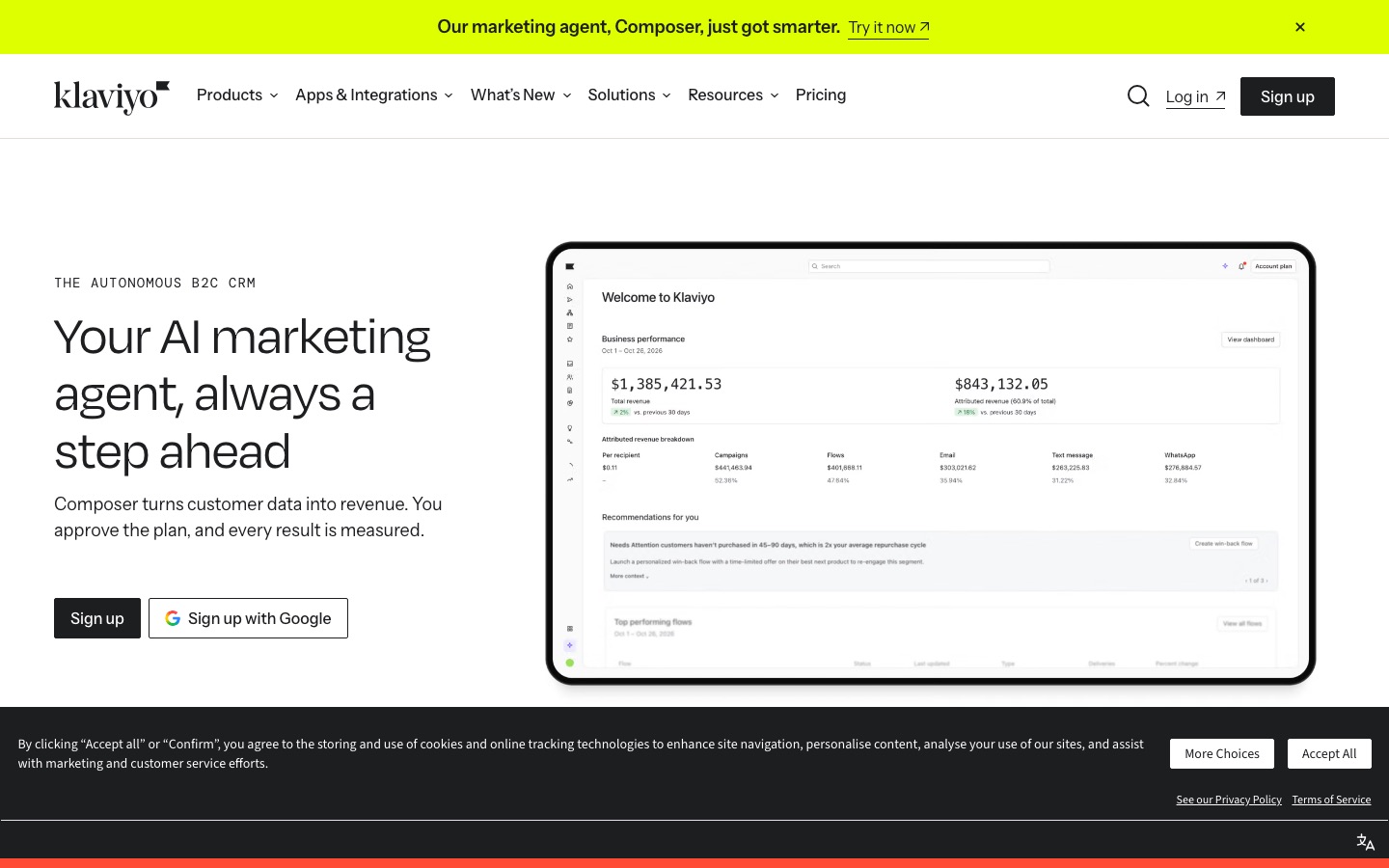
Klaviyo is the default email and SMS platform for Shopify and DTC brands. Its AI runs on order and browsing data: predictive insights such as expected next purchase date and predicted lifetime value, AI-built segments, an AI subject line generator, and Composer, a marketing agent that surfaces what needs attention and builds campaigns grounded in your store. Composer launched in public beta in mid-2026. Customer Agent handles support conversations.
Pricing: the Klaviyo pricing page lists a free plan for up to 250 active profiles, 500 emails a month and $5 of Composer usage. Paid email plans start around $20/mo at 500 profiles and rise steeply with list size. Billing is based on active profiles, not just the ones you email.
Pros: best-in-class ecommerce data, flows and predictions; email and SMS together.
Cons: gets expensive at scale; Composer usage costs extra beyond the included amount.
Best for: online stores where email is a major revenue channel.
2. Mailchimp AI: best for small businesses
Mailchimp, owned by Intuit, is still the most recognized name in email. Its AI includes generative copy and design help, predictive segmentation, send time optimization on higher plans and Intuit Assist (in beta for select English-speaking users on Standard and Premium). The drag-and-drop builder, templates and integrations make it easy for non-marketers.
Pricing: the Mailchimp pricing page shows a free plan for 250 contacts and 500 sends a month (250 a day), with no scheduling or automation flows. Generative AI is not included on Free or Essentials. Third-party trackers put Essentials at about $13/mo and Standard, where AI starts, at about $20/mo for 500 contacts. Prices vary by region and promotion, so check for your list size.
Pros: easy to learn; huge template and integration library; solid predictive segments.
Cons: the free plan keeps shrinking; AI requires Standard; costs rise fast with contacts.
Best for: small businesses that want a familiar, all-round tool.
3. MailerLite: best value
MailerLite is the favorite of small businesses and creators who want a clean editor, automations, landing pages and websites without enterprise prices. In June 2026 it renamed its plans: Growing Business became Comfort and Advanced became Power. AI features include an AI writing assistant, an AI subject line generator, smart sending, an AI landing page builder and an MCP server so assistants like Claude can work with your account.
Pricing: per the MailerLite pricing page, the free plan covers 250 subscribers and 2,500 emails a month. Comfort starts at about $12/mo and Power at about $25/mo for small lists, with 10% off for annual billing. The repricing raised costs for many existing customers.
Pros: excellent value; simple, clean UX; good deliverability reputation.
Cons: Comfort now has sending limits; fewer advanced ecommerce features than Klaviyo.
Best for: creators, freelancers and small businesses on a budget.
4. HubSpot Breeze: best for B2B and CRM-driven email
HubSpot Breeze is the AI layer of HubSpot's CRM and Marketing Hub. Email is personalized with real CRM data, Breeze Assistant drafts emails and campaigns, and agents in the plan comparison include a Customer Agent, Prospecting Agent, Data Agent and Nurture and Content agents in beta. For B2B marketers, the value is having email, forms, lead scoring and the sales pipeline in one database.
Pricing: per the HubSpot pricing page, the free CRM covers up to two users, Starter is listed from $20 per seat per month with 1,000 marketing contacts, and Professional starts at $800/mo with three seats plus a $3,000 onboarding fee. AI agents use HubSpot Credits.
Pros: email tied to CRM, deals and lead scoring; strong AI agents.
Cons: Professional is a major jump; marketing contacts are a separate cost driver.
Best for: B2B companies that need marketing and sales on one platform.
5. GetResponse: best for automation, webinars and courses
GetResponse combines email, automation, landing pages, webinars and online courses. Its AI email generator and AI subject line generator write campaigns from a short brief, and an AI landing page creator and AI website creator build pages. Enterprise adds AI product recommendations.
Pricing: the GetResponse pricing page lists Starter at about €16/mo, Marketer at €54/mo and Creator at €62/mo for 1,000 contacts on monthly billing, with 18% off yearly. Note that Starter caps the AI email and subject line generators at three uses, so Marketer is the real AI plan. A 14-day trial needs no credit card.
Pros: webinars and courses in the same tool; strong automation builder.
Cons: AI limited on Starter; pricing pages show different currencies by region.
Best for: course creators, coaches and marketers who sell through webinars.
6. beehiiv AI: best for newsletters
beehiiv, built by former Morning Brew team members, is designed for newsletters as a business. It includes an in-editor AI assistant, a referral program, an ad network, paid subscriptions, a website builder and growth analytics. Its beehiiv Agent and MCP access let AI assistants read and act on your publication data.
Pricing: free up to 2,500 subscribers with limited AI usage. Paid plans are priced by list size, from about $49/mo billed yearly for small lists per its pricing page, with higher tiers adding more AI usage.
Pros: growth and monetization tools nobody else bundles; generous free plan.
Cons: less suited to ecommerce flows or B2B nurture sequences.
Best for: creators, media brands and anyone treating a newsletter as a product.
7. Benchmark Email: best budget pick with AI credits
Benchmark Email is a straightforward platform with an AI Assistant in the email and form builders that writes copy and generates images, metered by AI credits. The free plan is relatively generous for small lists.
Pricing: per the Benchmark Email pricing page, Free covers 500 contacts, 1,000 emails a month and 150 AI credits. Pro starts at $12/mo ($10 billed yearly) for 500 contacts with 1,000 AI credits and list verification.
Pros: affordable; free plan with AI; list verification on Pro.
Cons: fewer advanced automations and integrations than leaders.
Best for: very small businesses and nonprofits.
8. Hostinger Reach: cheapest AI email marketing
Hostinger Reach is the web host's AI-first email tool. Describe the email you want and its generator writes copy, builds the layout and applies your brand. It also suggests campaign ideas, picks send times and writes subject lines.
Pricing: Starter is free for the first year for 100 recipients and 200 emails a month. Grow starts at $1.74/mo on a 12-month intro term (500 recipients, 3,500 emails) and Pro at $2.79/mo, both renewing at higher rates. Check renewal pricing before you commit.
Pros: extremely cheap; simple prompt-to-email workflow.
Cons: small sending limits; young product with fewer integrations.
Best for: Hostinger website owners and tiny lists.
9. Hoppy Copy: best AI email copywriter
Hoppy Copy focuses on writing: AI-generated campaigns and sequences in your brand voice, competitor email monitoring, and spam-trigger checks. It can also send to subscribers or export to your existing email platform, so it works as a writing layer on top of Mailchimp or Klaviyo.
Pricing: Starter is $29/mo ($23 billed yearly) for 20,000 words and 1,000 subscribers, Pro is $49/mo ($39 yearly). A 7-day free trial needs no card.
Pros: strong email-specific templates; competitor inbox tracking.
Cons: another subscription on top of your sending platform.
Best for: marketers and agencies writing lots of campaigns.
10. Bardiah: best for AI email design
Bardiah learns your brand and turns rough copy into responsive HTML emails you can paste into any platform. It is a niche pick for teams whose bottleneck is design and coding rather than writing. It has a free tier, so check the official site for current limits.
How to choose an AI email marketing tool
Start with your data. Ecommerce revenue data points to Klaviyo. CRM and sales pipeline data points to HubSpot. A simple subscriber list works anywhere.
Price your real list size. Compare plans at your contact count in 12 months, not today. Small differences at 500 contacts become large at 10,000.
Check which plan unlocks the AI. Mailchimp needs Standard for generative AI, and GetResponse caps AI uses on Starter.
Look at deliverability, not just features. Authentication (SPF, DKIM, DMARC), list hygiene and engagement matter more than any AI subject line.
Test the editor with a real campaign. Use free plans and trials to build one actual email and one automation before you migrate.
Email marketing is different from cold outreach. If you need to email prospects who did not opt in, see Smartlead vs Instantly vs lemlist, and for help managing your own inbox, see the best AI email assistants. Popular platforms we have not listed yet include Brevo, ActiveCampaign, Omnisend and Kit.
FAQ
What is the best AI email marketing tool?
For ecommerce, Klaviyo AI is the best because its predictions and Composer agent work on your order data. For small businesses, Mailchimp is the easiest all-rounder and MailerLite is the best value. For B2B, HubSpot Breeze ties email to your CRM. For newsletters, beehiiv offers growth and monetization tools other platforms lack.
Is there a free AI email marketing tool?
Yes. MailerLite's free plan includes 250 subscribers and 2,500 emails a month, Benchmark Email offers 500 contacts with 150 AI credits, Klaviyo and Mailchimp are free up to 250 contacts, and beehiiv is free up to 2,500 subscribers. Free plans limit sends, automations and branding, so they suit testing and small lists.
Can AI write my marketing emails?
Yes. Every tool here can draft subject lines and email copy from a short brief, and tools like Hostinger Reach and Hoppy Copy generate whole campaigns. Treat AI drafts as a starting point: add specific offers, real customer stories and your own voice, and always review facts, links and personalization fields before sending.
Is Mailchimp AI free?
No. As of October 2026, Mailchimp's generative AI features are not included on its Free or Essentials plans. They are included at no extra cost on Standard and Premium, and Intuit Assist is in beta for select users on those plans. Check Mailchimp's pricing page for current inclusions in your region.
Mailchimp vs MailerLite: which is better?
MailerLite is usually better value, with a larger free sending allowance (2,500 emails versus 500) and lower paid prices, plus AI writing on its Comfort plan. Mailchimp has more integrations, templates and predictive features on higher plans. Choose MailerLite for budget and simplicity, Mailchimp for ecosystem and brand familiarity.
Does AI improve email open rates?
It can help, mainly through send time optimization, subject line testing and better segmentation, but no tool guarantees higher rates. Since privacy changes made opens less reliable, measure clicks, conversions and revenue per email instead. Deliverability basics like authentication and list hygiene have a bigger effect than AI-written copy.
Final verdict
Pick the AI email marketing tool whose AI works on your data. Online stores should start with Klaviyo. Small businesses should compare Mailchimp and MailerLite at their real list size, and most will find MailerLite better value. B2B teams belong on HubSpot if they also need a CRM. Creators building a newsletter business should start with beehiiv. On a tight budget, Benchmark Email or Hostinger Reach will do the job, and Hoppy Copy can sit on top of any platform if writing is your bottleneck.
Browse every email and marketing tool we track in the AI marketing tools category, or see our broader guide to the best AI marketing tools. Built an email tool we have missed? Submit it for a listing.