Best AI Marketing Tools (2026): 12 Picks for Every Channel
The best AI marketing tools in 2026, grouped by job: HubSpot Breeze for an all-in-one platform, Jasper for brand-safe copy, Canva for design, Surfer and Ahrefs for SEO, Klaviyo for ecommerce email, AdCreative.ai and Creatify for ads, Buffer and Predis.ai for social, Unbounce for landing pages and Brand24 for listening.
Quick answer: the best AI marketing tools in 2026 are HubSpot Breeze if you want one platform with a CRM and AI agents built in, Jasper for on-brand content at scale, Canva Magic Studio for design, Surfer SEO and Ahrefs AI for search, Klaviyo AI for ecommerce email and SMS, and AdCreative.ai or Creatify for ad creative. Most teams need three or four of these, not twelve.
"AI marketing tools" covers everything from a $5 social scheduler to a $3,600 a month marketing suite, so a single ranking is not much help. This guide groups the best AI tools for marketing by the job they do, with what each one is, its key AI features, current pricing, pros and cons, and who it suits. Picks and prices are based on official pricing pages, product documentation and public user feedback as of October 2026, not paid placements or hands-on lab tests. Confirm prices before you buy, because marketing software repackages plans constantly.




Quick picks
Best all-in-one AI marketing platform: HubSpot Breeze, free CRM, paid Starter seats from $20/mo.
Best for brand-safe content: Jasper, from $59 per seat per month billed yearly.
Best for design and social graphics: Canva Magic Studio, free plan, Pro from about $15/mo.
Best for SEO content: Surfer SEO, from $49/mo billed yearly.
Best for SEO data and AI visibility: Ahrefs AI, from $29/mo.
Best for ecommerce email and SMS: Klaviyo AI, free up to 250 profiles.
Best for static ad creative: AdCreative.ai, from $39/mo.
Best for video ads: Creatify, from about $10/mo billed yearly.
Best for social scheduling: Buffer AI Assistant, free for 3 channels.
Best for landing pages: Unbounce, from $22/mo billed yearly.
Best AI marketing tools compared
| Tool | Best for | Free plan | Starting price (as of October 2026) |
|---|---|---|---|
| HubSpot Breeze | All-in-one CRM and marketing with AI agents | Yes, up to 2 users | Starter from $20/seat/mo; Pro from $800/mo |
| Jasper | On-brand content for marketing teams | 7-day trial | $59/seat/mo yearly ($69 monthly) |
| Canva Magic Studio | Design, social graphics, resizing | Yes | Pro about $15/mo |
| Surfer SEO | Optimizing articles to rank | Free tools only | $49/mo yearly |
| Ahrefs AI | Keyword, backlink and AI visibility data | Limited free tools | $29/mo (Starter) |
| Klaviyo AI | Ecommerce email, SMS and AI agents | Yes, 250 profiles | About $20/mo for 500 profiles |
| AdCreative.ai | Scored static ad creatives | Free trial | $39/mo |
| Creatify | Product URL to video ads | Yes, 10 credits/mo | About $10/mo yearly |
| Buffer AI Assistant | Social scheduling and post ideas | Yes, 3 channels | $5/channel/mo |
| Predis.ai | Generating branded social posts and videos | Yes | About $19/mo yearly ($32 monthly) |
| Unbounce | AI landing pages and traffic routing | 14-day trial | $22/mo yearly ($29 monthly) |
| Brand24 | Social listening and sentiment | 14-day trial | $199/mo yearly ($249 monthly) |
All-in-one platforms
1. HubSpot Breeze: best all-in-one AI marketing platform
HubSpot Breeze is the AI layer across HubSpot's CRM, Marketing Hub, Sales Hub and Service Hub. Breeze Assistant answers questions about your CRM data and drafts emails, blog posts and social copy, while Breeze agents take on whole jobs: a Customer Agent that answers chats and emails, a Prospecting Agent, a Data Agent that keeps records up to date, and Content and Nurture agents in beta. The big advantage is context: the AI writes and segments using the same contact, deal and website data your marketing runs on.
Pricing: per the HubSpot Marketing Hub pricing page, the free CRM covers up to two users, Starter is listed from $20 per seat per month (lower on some annual deals) with 1,000 marketing contacts, Professional starts at $800/mo with three core seats and a $3,000 onboarding fee, and Enterprise starts at $3,600/mo. AI agents consume HubSpot Credits ($0.010 each), and a HubSpot AEO add-on for AI search visibility is in beta at $50/mo.
Pros: CRM, email, forms, ads, social and AI in one place; agents act on your real customer data; huge integration ecosystem.
Cons: Professional is a big jump in price; credits add usage costs; you get the most value only if you commit to HubSpot.
Best for: B2B companies and growing teams that want marketing, sales and service on one database.
Content and copy
2. Jasper: best for brand-safe marketing content
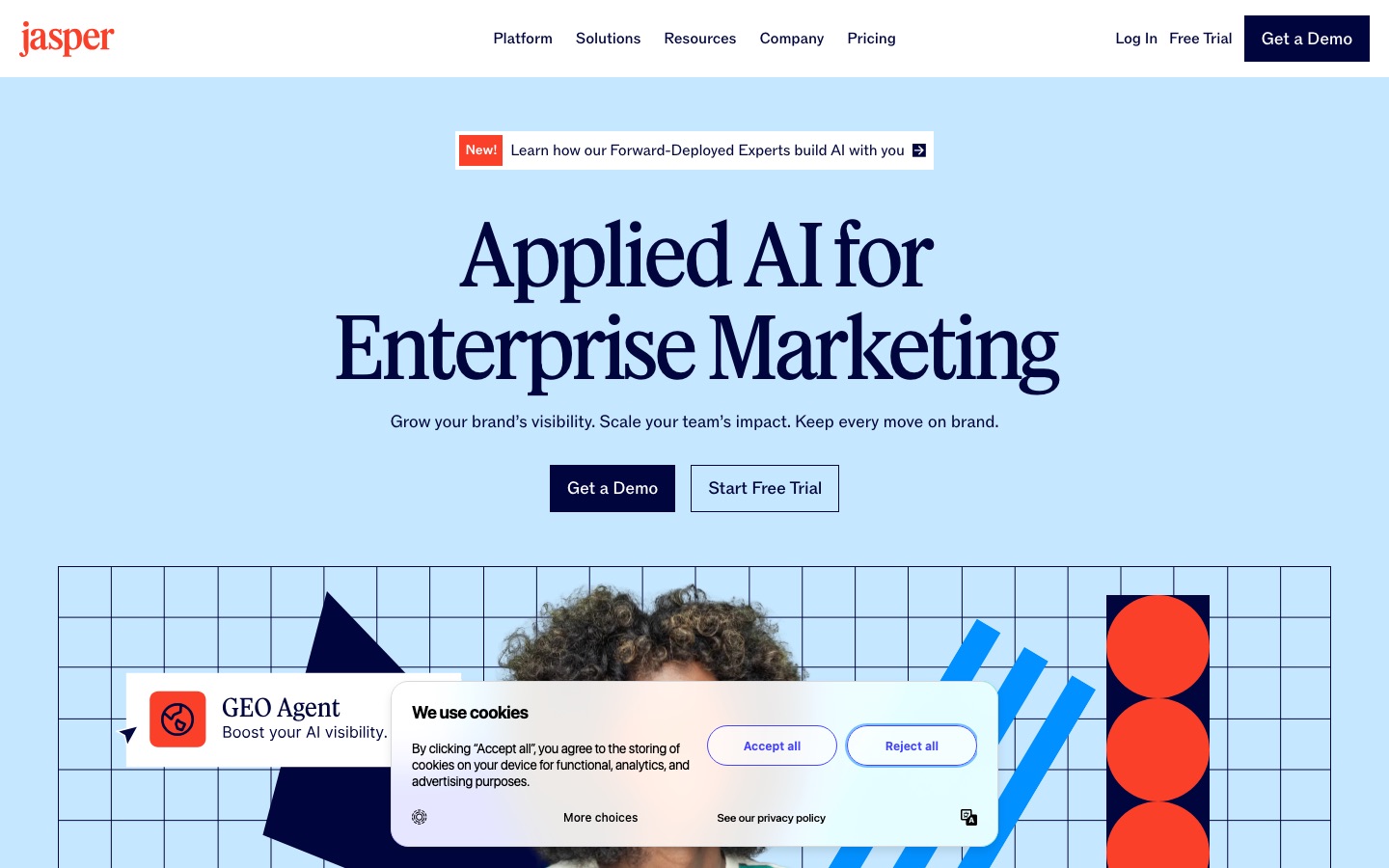
Jasper is built for marketing teams rather than individuals. Brand Voice stores your tone, style rules and product knowledge so every draft starts on-brand, Canvas is a workspace for campaigns, and marketing agents handle repeatable workflows such as turning a product launch brief into blog, email, social and ad copy. The Business plan adds Jasper Studio (a no-code builder for custom agents), Jasper Grid, GEO and translation agents, and API access. All paid plans include AI image generation and editing.
Pricing: the Jasper pricing page lists Pro at $69 per seat per month, or $59 billed yearly, with two brand voices and a 7-day free trial. Business is custom priced with a 12-month minimum.
Pros: strong brand controls, marketing-specific agents, good for multi-channel campaigns.
Cons: pricier than general assistants; extra seats on Pro go through sales.
Best for: content and campaign teams that publish across many channels and care about consistency.
If you are weighing Jasper against similar writers, read Jasper vs Copy.ai vs Writesonic. For many solo marketers, a general assistant like ChatGPT or Claude with a good prompt library covers the same ground for less.
Design and visuals
3. Canva Magic Studio: best for design and social graphics
Canva Magic Studio bundles Canva's AI features: Magic Design for generating layouts from a prompt, Magic Write for copy, text-to-image, background removal, Magic Expand and Magic Eraser for photo edits, and Magic Switch for resizing one design into every social format. Brand kits keep fonts, colors and logos consistent across a team, which is what makes it a marketing tool rather than just a design app.
Pricing: a generous free plan, with Canva Pro listed from about $15/mo and team plans priced per person. Canva adjusts AI usage limits by plan, so check the official pricing page.
Pros: fastest way for non-designers to produce on-brand assets; huge template library; one-click resizing.
Cons: outputs can look templated; heavy AI use is capped on lower plans.
Best for: small teams and social managers producing graphics daily.
For a deeper look, see our Canva Magic Studio review.
SEO and content optimization
4. Surfer SEO: best for SEO content
Surfer SEO analyzes the pages ranking for a keyword and gives writers a live Content Score, term suggestions and structure guidance. In 2026 it adds Surfy (an AI writing assistant), Topical Map, Content Audit with rank drop detection, and an AI Tracker that monitors how ChatGPT, Gemini and AI Overviews mention your brand.
Pricing: Discovery is $49/mo billed yearly, Standard $99/mo and Pro $182/mo, per the Surfer pricing page. Read our full Surfer SEO review or the Surfer SEO vs Frase comparison if budget is tight.
Pros: the most widely adopted live optimizer; strong refresh workflow; AI visibility in the same tool.
Cons: no keyword or backlink database; team features sit on higher plans.
Best for: content teams publishing search-driven articles every week.
5. Ahrefs AI: best for SEO data and AI search visibility
Ahrefs AI is the data platform behind many SEO programs: keyword research, backlinks, competitor analysis and site audits, with AI on top for keyword suggestions and content grading. Brand Radar tracks how often your brand appears in AI chatbot answers compared with competitors, which has become a board-level metric for some brands.
Pricing: per the Ahrefs pricing page, Starter is $29/mo, Lite $129/mo, Standard $249/mo and Advanced $449/mo, with annual billing saving up to 17%. Brand Radar AI is an add-on from $199/mo.
Pros: one of the best SEO datasets; AI visibility tracking from a trusted data source.
Cons: gets expensive with add-ons; a learning curve for non-SEOs.
Best for: SEO specialists, agencies and in-house growth teams.
More options, including MarketMuse, Clearscope and Frase, are in our best AI SEO tools guide.
Email and lifecycle
6. Klaviyo AI: best for ecommerce email and SMS
Klaviyo AI is the default email and SMS platform for many Shopify and DTC brands, because its AI works on order data: predictive insights such as expected next order date and customer lifetime value, AI segments, an AI subject line generator, and Composer, a marketing agent that surfaces what needs attention and builds campaigns grounded in your store data. Customer Agent handles support conversations on the service side.
Pricing: the Klaviyo pricing page lists a free plan for up to 250 active profiles and 500 emails a month, including $5 of Composer usage. Paid email plans start around $20/mo at 500 profiles and rise with list size.
Pros: best-in-class ecommerce data and predictions; strong flows and segmentation.
Cons: costs climb quickly with list size; billing is based on active profiles.
Best for: online stores that want revenue-driven email and SMS.
Not an ecommerce brand? Mailchimp, MailerLite and GetResponse are covered in our guide to the best AI email marketing tools.
Paid ads and creative
7. AdCreative.ai: best for static ad creative
AdCreative.ai generates batches of ad images, banners and copy from your brand assets, then scores each creative for predicted conversion performance so you can pick likely winners before spending. It also offers competitor creative insights and product photoshoots.
Pricing: monthly billing starts at $39 for 20 credits and one brand on the Starter plan, with a free trial. Check the official site for current credit tiers.
Pros: fast volume of ad variations; scoring helps prioritize tests.
Cons: scores are predictions, not results; credits run out quickly at scale.
Best for: performance marketers testing lots of Meta and Google display creatives.
8. Creatify: best for AI video ads
Creatify turns a product URL into scripted short video ads with AI avatars and voiceovers, in multiple aspect ratios for TikTok, Reels and YouTube Shorts. Batch mode generates many variations for testing hooks and formats.
Pricing: a free plan with 10 credits a month (watermarked), and paid plans from about $10/mo billed yearly. Our best AI ad generators guide compares it with Arcads, Predis.ai and others.
Pros: very fast from product page to UGC-style ad; good for creative testing.
Cons: avatar ads can feel generic; best results still need human scripting.
Best for: ecommerce and app marketers running short-form video ads.
Social media
9. Buffer AI Assistant: best for simple social scheduling
Buffer is a clean social scheduler with an AI Assistant on every plan that generates post ideas, rewrites drafts for each network and repurposes content. It covers the major networks, plus analytics and a shared ideas board.
Pricing: per the Buffer pricing page, the free plan covers 3 channels with 10 scheduled posts each, and paid plans are $5 per channel per month (Essentials) or $10 per channel per month (Team).
Pros: simple, affordable, AI included even on the free plan.
Cons: lighter on listening and inbox features than enterprise suites.
Best for: solo marketers, creators and small businesses.
10. Predis.ai: best for generating social content from scratch
Predis.ai turns one line of text, a product link or a blog post into branded carousels, single images and short videos with captions and hashtags, then schedules them. It is a content factory rather than a scheduler, so it pairs well with teams that struggle to fill the calendar.
Pricing: a free plan, with Core at $32/mo or about $19/mo billed yearly for 1,300 credits and one brand.
Pros: fast, on-brand social content in many formats; ecommerce templates.
Cons: output needs a human eye for originality; credits limit video volume.
Best for: small brands and agencies that need volume on Instagram, TikTok and LinkedIn.
We cover more schedulers and generators in the best AI social media tools guide.
Conversion and insight
11. Unbounce: best for AI landing pages
Unbounce builds landing pages from a prompt or template, writes copy with built-in AI, and on its Optimize plan uses Smart Traffic to route each visitor to the page variant most likely to convert for people like them. It now offers an MCP server for connecting AI assistants.
Pricing: per the Unbounce pricing page, Starter is $29/mo ($22 billed yearly) for up to 500 visitors, Build is $99/mo, Experiment $149/mo and Optimize (with Smart Traffic) $249/mo, all with a 14-day free trial.
Pros: unlimited conversions; AI traffic routing is a real conversion lever at volume.
Cons: Smart Traffic only on the $249 plan; visitor caps can trigger overages.
Best for: paid acquisition teams that need many campaign-specific pages.
12. Brand24: best for social listening
Brand24 monitors mentions of your brand, competitors and keywords across social networks, news, blogs, forums and podcasts. AI sentiment analysis runs on every plan, and higher tiers add AI Insights, AI Topics, event detection and an AI Brand Assistant you can question in plain English.
Pricing: Individual starts at $199/mo billed yearly ($249 monthly) for 3 keywords, and Pro, where most AI features live, is $399/mo yearly. There is a 14-day free trial without a credit card.
Pros: broad source coverage; useful AI summaries of what people are saying.
Cons: expensive for small brands; keyword limits are tight on lower plans.
Best for: PR, brand and community teams tracking reputation.
Honorable mentions
General assistants: ChatGPT and Claude remain the most flexible marketing tools for briefs, research and first drafts. See our best ChatGPT prompts for ready-made marketing prompts.
Mailchimp AI: the easy starting point for small business email.
Manychat: AI replies and automation for Instagram, WhatsApp and Messenger DMs.
Zapier AI: glue between all of the above. Compare it in n8n vs Zapier vs Make.
How to build an AI marketing stack
Start with your system of record. If you have no CRM, HubSpot's free tier is the obvious base. Ecommerce brands usually anchor on Shopify plus Klaviyo.
Pick one content engine. A general assistant for most teams, or Jasper if brand consistency across many writers is the bottleneck.
Add a design tool. Canva covers nearly every marketing asset for non-designers.
Add the channel tools you actually use. Surfer or Ahrefs if search drives revenue, AdCreative.ai or Creatify if paid social does, Buffer or Predis.ai for organic social.
Measure one metric per tool. Hours saved per campaign, cost per acquisition or organic traffic. Cancel anything that does not move its metric in 90 days.
A lean small business stack can cost under $60 a month: HubSpot free CRM, Canva Pro, Buffer for two channels and a $20 AI assistant. Our best AI tools for small business guide has more budget stacks.
FAQ
What is the best AI tool for marketing?
There is no single best tool. HubSpot Breeze is the strongest all-in-one platform, Jasper is best for on-brand content, Canva Magic Studio is best for design, and Klaviyo AI is best for ecommerce email. Most marketers get the most value from a general AI assistant plus one or two specialist tools for their main channel.
Are there free AI marketing tools?
Yes. HubSpot's free CRM, Canva's free plan, Buffer's free plan for three channels, Klaviyo's free tier for 250 profiles, Creatify's free credits and Predis.ai's free plan all include AI features. Free tiers are limited in volume and branding, but they are enough to test a workflow before paying.
How is AI used in marketing?
Marketers use AI to draft copy and briefs, generate and resize visuals, produce ad variations and video ads, optimize content for search and AI answers, segment audiences and predict purchases, personalize email, route landing page traffic, summarize social mentions and automate repetitive tasks with agents. The biggest gains are usually in content production and testing speed.
How much do AI marketing tools cost?
Starting prices range from free to a few thousand dollars a month. Social schedulers start around $5 per channel, content and design tools around $15 to $70 per seat, SEO platforms around $29 to $250, and full marketing automation suites like HubSpot Professional from $800/mo. Annual billing usually saves 15% to 25%.
Final verdict
The best AI marketing tools are the ones that remove your biggest bottleneck. If you need one platform, start with HubSpot Breeze. If content volume is the problem, add Jasper or a general assistant. If design is the problem, Canva. If search is your channel, Surfer and Ahrefs. If you sell online, Klaviyo. If paid social is your growth engine, AdCreative.ai and Creatify. Start small, measure one metric per tool, and only add the next tool when the last one has earned its place.
Browse every tool we track in the AI marketing tools category, or see design and writing tools in the design and writing categories. Built a marketing tool we have missed? Submit it for a listing.