Best AI Story Generators (2026): 10 Tools for Fiction
The best AI story generators in 2026 for novelists, hobby writers, roleplayers and interactive fiction fans, from Sudowrite and NovelAI to Claude, ChatGPT, Squibler and AI Dungeon. We compare pricing, context memory, free plans and what each one is actually good at, plus prompts, copyright and publishing rules.
The best AI story generator for serious fiction writers is Sudowrite, because it is built around novels: a Story Bible for characters and outlines, a fiction-tuned model, and tools to describe, expand and rewrite scenes in your style. For a free, flexible option, Claude and ChatGPT write good short stories from a prompt. Pick NovelAI for private, freeform storytelling, Squibler to generate a full book draft, and AI Dungeon if you want to play a story rather than write one.
"AI story generator" covers very different tools. Some help authors draft a manuscript, some write a whole story from one line, and some are text adventure games. We grouped the ten best by what you want to do and compared prose quality, memory, control, privacy and price. This guide is based on official pricing pages, documentation and public user feedback from writing communities, not lab testing. Prices were checked in October 2026.






Quick picks
Best for novelists: Sudowrite.
Best general AI for fiction prose: Claude.
Best free and most accessible: ChatGPT.
Best for private, freeform storytelling: NovelAI.
Best for generating a full book or screenplay draft: Squibler.
Best interactive text adventure: AI Dungeon.
Best for playing in famous story worlds: Hidden Door.
Best for character roleplay: Character.AI.
Best for editing the story you wrote: ProWritingAid.
Best for illustrated and reader-driven stories: Story Illustrator, SeaBell and LiveLore.
The best AI story generators compared
| Tool | Best for | Free plan | Paid from (as of October 2026) |
|---|---|---|---|
| Sudowrite | Novels and long fiction | Free trial, no card | $10/mo (Hobby & Student) |
| Claude | Literary prose, revision | Yes | $17/mo billed annually, or $20 monthly |
| ChatGPT | Quick stories, brainstorming | Yes | $8/mo (Go) or $20/mo (Plus) |
| NovelAI | Private, freeform storytelling | Free trial (Paper) | $10/mo (Tablet) |
| Squibler | Full book and screenplay drafts | Yes, 1,000 credits/mo | $15.83/mo billed annually (Plus) |
| AI Dungeon | Interactive text adventures | Yes (Wanderer) | $14.99/mo (Journey) |
| Hidden Door | Licensed story worlds | Yes | Check the official page |
| Character.AI | Character chats and roleplay | Yes | Optional c.ai+ subscription |
| ProWritingAid | Editing and critique | Yes, limited | $10/mo billed annually |
| Story Illustrator, SeaBell, LiveLore | Illustrated and community stories | Yes | Varies |
What to look for in an AI story generator
Memory (context): how much of your story the AI can "see" at once. Small context means the AI forgets names, eye colors and plot threads. Look for character sheets, lorebooks or a story bible that feed key facts back in.
Prose quality and style matching: can it write in your voice, or does everything sound like the same generic AI narrator?
Control: can you steer each scene, regenerate a paragraph, or set rules the AI must follow?
Content rules: mainstream chatbots refuse some mature themes; NovelAI and AI Dungeon allow more, with settings.
Privacy: if you are writing an unpublished novel, check whether your text is used for training and whether it is encrypted.
Price model: flat subscriptions are more predictable than credits, which can run out mid-chapter.
The 10 best AI story generators, reviewed
1. Sudowrite: best AI story generator for novelists
Sudowrite is the tool most working fiction authors try first. Its Story Bible takes you from an idea to a synopsis, outline and chapter beats, then drafts prose that follows them. In the editor, Write suggests roughly the next 300 words in several options based on your characters, tone and plot, Describe adds sensory detail, Expand fills out rushed scenes, and Rewrite revises a passage on your direction. Canvas is a planning space, Brainstorm generates names and ideas, and Visualize creates character art. Sudowrite's own fiction model, Muse (now version 1.5), sits next to 30-plus other models, and plugins let you simulate readers or turn a novel into a screenplay.
Pricing: per the official Sudowrite pricing page, Hobby & Student is $10 a month with 225,000 credits, Professional is $22 a month and adds developmental edits, line edits and beta reads, and Max is $44 a month with 2,000,000 credits that roll over for 12 months. Yearly billing is advertised at up to 50% off, and a free trial needs no credit card.
Pros: purpose-built for fiction, Story Bible keeps long projects consistent, style matching, editing feedback on higher plans.
Cons: credit system can run out on heavy drafting days, the many tools take time to learn.
Best for: novelists and serial fiction writers who want an AI co-writer, not a ghostwriter.
2. Claude: best general AI for fiction prose
Claude has a reputation among writers for prose that sounds less formulaic than most chatbots, with better subtext and dialogue. It has no "story generator" button, which is part of its strength: you describe the genre, point of view, tone and constraints, and it writes accordingly. Projects let you keep a story bible, outline and previous chapters as reference.
Pricing: free plan; Pro is $20 monthly or $17 a month billed annually, and Max starts at $100 a month, according to the official Claude pricing page.
Pros: strong prose and dialogue, great for revision and feedback, handles long manuscripts.
Cons: declines some explicit or graphic content, no built-in fiction tools such as lorebooks.
Best for: literary and genre writers who want a thoughtful collaborator. Our guide on how to use Claude covers Projects and prompting.
3. ChatGPT: best free and most accessible story generator
ChatGPT is where most people try AI fiction first, and for short stories, bedtime stories, writing prompts and brainstorming, it is excellent. It can generate a complete story from one line, outline a novel, suggest twists and illustrate a children's story in the same chat. Its default prose can feel polished but predictable, so give it specific style instructions.
Pricing: free plan; Go is $8 a month (with ads in the US) and Plus is $20 a month. Check OpenAI's pricing page for current limits.
Pros: free, fast, versatile, generates images for illustrated stories.
Cons: prose can be generic without strong prompts, content limits on mature themes.
Best for: quick stories, kids' stories, prompts and outlining. See our ChatGPT review and best ChatGPT prompts.
4. NovelAI: best for private, freeform storytelling
NovelAI is a subscription storytelling app focused on creative freedom and privacy. You write and the AI continues, steered by a Lorebook, Memory and Author's Note fields. NovelAI says stories are encrypted and that it does not monitor your creative process. Its flagship text model, Xialong, is a fine-tune of the GLM family; Opus subscribers also get Llama 3 Erato. NovelAI also includes anime-style image generation.
Pricing: per the official NovelAI subscription docs, the free Paper trial includes 50 text generations. Tablet is $10 a month with unlimited text generation, Scroll is $15 with a larger context, and Opus is $25 with up to 28,672 tokens of context, access to all text models and 10,000 monthly Anlas for images.
Pros: encrypted stories, few content restrictions, deep steering tools, unlimited text on every paid tier.
Cons: steeper learning curve, you do more of the writing than with Sudowrite, best memory only on Opus.
Best for: experienced hobby writers and fan fiction authors who want control and privacy.
5. Squibler: best for generating a full book or screenplay draft
Squibler is the closest thing to a one-click book generator. You give it a concept, genre and core elements, and it produces a structured draft divided into chapters and scenes, or a formatted screenplay. Elements store characters, settings and key details so the AI keeps them consistent, the Smart Writer proposes revisions you accept or reject, and built-in visuals generate covers, storyboards and short clips. Squibler says more than 20,000 writers use it.
Pricing: according to the official Squibler pricing page, Free includes 1,000 AI credits a month. Plus is $29.99 monthly or $15.83 a month billed annually with 10,000 credits, and Pro is $89.99 monthly or $49.17 a month billed annually with unlimited credits. Paid plans export to PDF and DOCX.
Pros: fastest route to a complete first draft, screenplay support, consistency tools, exports.
Cons: generated books need heavy rewriting to feel original, Pro is pricey.
Best for: writers who want a full scaffold to rewrite, and screenwriters drafting quickly.
6. AI Dungeon: best interactive text adventure
AI Dungeon, from Latitude, is a text adventure where you type what your character does and the AI narrates what happens. You can start a preset quest, build your own scenario, or play community-made adventures. Story Cards hold facts about characters and places, and higher tiers give the AI more context and access to larger models.
Pricing: the free Wanderer tier includes smaller models with up to 4K context. As of October 2026, third-party reviews list Journey at $14.99, Legend at $29.99, Mythic at $49.99 and Ultimate at $99.99 a month, with context and credits rising at each tier. Latitude reshuffles tiers often, so check the official membership page. Also review your data privacy settings, since reporting in 2026 says new accounts may share story text for model training by default.
Pros: genuinely fun, huge library of community scenarios, free tier, mobile apps.
Cons: small context on cheaper tiers means forgetful stories, pricing changes frequently.
Best for: gamers and roleplayers who want to play a story, not write a manuscript.
7. Hidden Door: best for playing in famous story worlds
Hidden Door turns story worlds into playable interactive fiction. Its story engine checks every beat against each world's canon, so a vampire still needs an invitation to enter a home. Worlds include Dracula, the Land of Oz, The Call of Cthulhu, Pride and Prejudice, Sherlock Holmes and The Crow, plus original worlds.
Pricing: free to start; check the official site for current plans.
Pros: stories stay consistent with the world's rules, licensed settings, social play.
Cons: less freedom than AI Dungeon, not a tool for writing your own manuscript.
Best for: readers and fans who want to step inside a familiar story.
8. Character.AI: best for character roleplay
Character.AI lets you chat with millions of user-created characters or create your own, and many people use it for collaborative storytelling through dialogue. It is great for exploring a character's voice, but not for long, structured plots. Character.AI has restricted open-ended chat for users under 18, so check its current age policies.
Pricing: free, with an optional c.ai+ subscription; check the official site for the current price.
Pros: huge character library, natural dialogue, free.
Cons: drifts in long stories, not designed for prose or manuscripts.
Best for: dialogue-driven roleplay.
9. ProWritingAid: best for editing the story you wrote
ProWritingAid does not generate stories for you, which is exactly why many authors pair it with a generator. It analyzes pacing, repetition, dialogue, sentence variety and more, and adds fiction tools such as Story Canvas idea feedback, Sparks for creative suggestions, Chapter Critique and paid Manuscript Analysis credits.
Pricing: per the official pricing page, Premium is $10 a month billed annually ($120 a year) or $30 monthly, Premium Pro is $12 a month billed annually, and lifetime licenses start at $399.
Pros: deep style reports, chapter critiques, lifetime option.
Cons: not a generator, monthly billing is expensive.
Best for: authors revising a draft, whether they wrote it alone or with AI. See our Grammarly alternatives for other editors.
10. Story Illustrator, SeaBell and LiveLore: best for illustrated and community stories
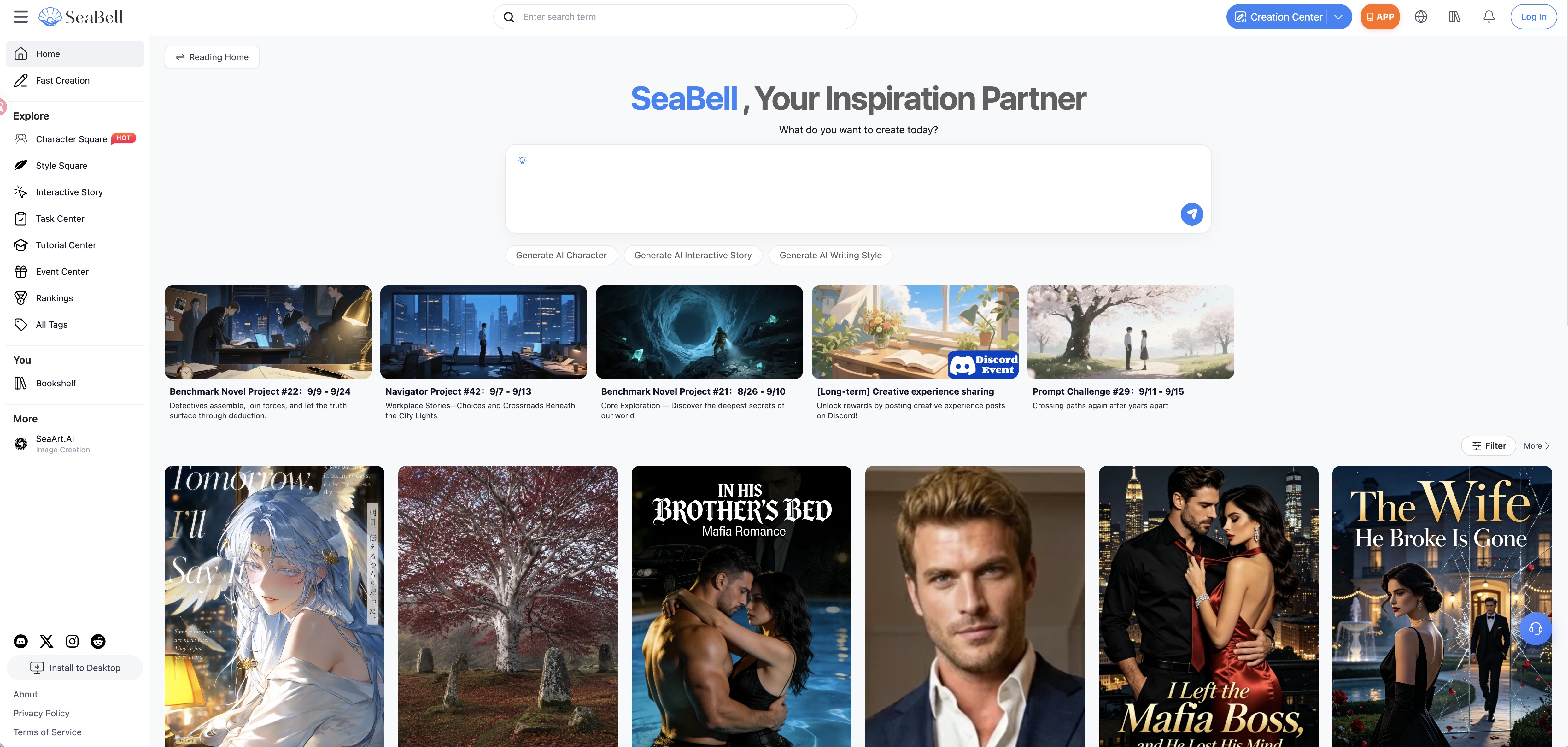
A few smaller tools fill specific niches. Story Illustrator is an iPhone app that writes short stories and illustrates them with AI images, a good fit for bedtime stories. SeaBell combines a reading platform with AI fiction writing and interactive stories. LiveLore publishes horror fiction that readers shape by voting. If you want a game-like experience with art and music, Endless Visual Novel generates the story, characters and soundtrack as you play. Writers who prefer an author-controlled editor can also look at NovelShaft, where you approve every AI change, and Type.
How to write a better story with AI
Decide what the AI is for. Brainstorming, outlining, drafting scenes or editing. Using it for everything usually produces generic fiction.
Build a story bible first. List your characters (goals, flaws, voice), setting rules, tone and point of view. Paste it into Sudowrite's Story Bible, a NovelAI Lorebook, or a Claude Project.
Prompt with specifics. For example:
Write a 1,200-word opening scene in close third person. Mara, a burned-out paramedic, finds a stranger's voicemail on her phone. Tone: quiet dread, no gore. Show, don't tell. End on a question.Work scene by scene. Generate one scene, edit it, then continue. Long one-shot generations drift.
Rewrite in your voice. Treat AI output as clay. Change word choices, cut clichés, and add details only you would think of.
Check continuity. Ask the AI to list every fact it has stated about each character, then fix contradictions.
Edit with a separate tool. Run the draft through ProWritingAid or ask Claude for a critique on pacing and character arcs.
Common mistakes with AI story generators
Accepting the first draft. AI fiction tends toward familiar plots and stock phrases. Regenerate, steer and rewrite.
Letting the context overflow. On small-context tools, re-state key facts in memory or story cards so characters do not change names mid-book.
Copyright and publishing AI-assisted stories
Two rules matter if you plan to publish. First, in the US, the Copyright Office has said that purely AI-generated material is not protected by copyright, while human-authored contributions, including your selection, arrangement and substantial edits, can be. The more of the writing that is genuinely yours, the stronger your claim. Its report on copyrightability explains the details.
Second, Amazon KDP asks authors to disclose AI-generated content (text, images or translations) when publishing, while AI-assisted work you edited yourself does not need disclosure. Many magazines and contests ban AI-generated submissions, so read the guidelines first.
FAQ
What is the best AI story generator?
For writing novels and long fiction, Sudowrite is the best AI story generator because its Story Bible, fiction-tuned Muse model and scene tools are built for manuscripts. For free short stories, ChatGPT and Claude are excellent. NovelAI is best for private, freeform storytelling, and AI Dungeon is best if you want an interactive text adventure.
What is the best free AI story generator?
ChatGPT and Claude both have free plans that write complete short stories from a prompt, and Claude is often preferred for prose quality. AI Dungeon's free Wanderer tier is the best free interactive option, and Squibler's free plan includes 1,000 AI credits a month for testing book drafts. Sudowrite and NovelAI offer free trials rather than free plans.
Is Sudowrite better than NovelAI?
They serve different writers. Sudowrite is better for novelists who want structured help: outlines, chapter beats, scene expansion and editing feedback. NovelAI is better for writers who want privacy, fewer content restrictions and fine control over how the AI continues their text. Sudowrite starts at $10 a month and NovelAI's Tablet tier also costs $10.
Can AI write a whole book?
Yes, tools like Squibler and Sudowrite can generate a full-length draft from a concept and outline. The result usually needs heavy rewriting to gain a distinct voice, consistent characters and real surprises. Most AI-assisted authors use AI for outlining, scene drafts and revision, and keep the creative decisions and final prose their own.
Can I publish a story written by AI?
You can, but rules apply. Amazon KDP requires you to disclose AI-generated text, images or translations, and many magazines and contests ban AI-generated submissions. In the US, purely AI-generated text is not protected by copyright, so significant human writing and editing strengthens your rights. Always check the platform's current policy.
Which AI is best for roleplay stories?
AI Dungeon is best for game-style adventures with choices and community scenarios. Character.AI is best for dialogue with characters, and NovelAI is best for private, freeform roleplay with lorebooks and few content limits. Hidden Door suits players who want stories that stay true to licensed worlds like Sherlock Holmes or Oz.
Bottom line
Novelists should start with Sudowrite, and pair it with ProWritingAid or Claude for editing. Claude is the best general-purpose AI for fiction prose, and ChatGPT is the easiest free starting point. NovelAI suits writers who value privacy and freedom, Squibler gets you a full draft fastest, and AI Dungeon and Hidden Door are the picks if you want to play a story rather than write one. Whatever you choose, keep the creative decisions yours: that is what makes a story worth reading, and what copyright rules reward.
More writing help: our roundups of the best AI writing tools and the best AI paraphrasing tools, and our comparison of Claude vs ChatGPT for writing.
Browse every fiction and writing tool we track in the AI writing tools category, or find story games in lifestyle. Built a storytelling tool we have missed? Submit it for a listing.