Elicit vs Consensus vs SciSpace (2026): Which AI Research Tool Fits Your Review?
Elicit is the pick for systematic reviews and data extraction, Consensus is the fastest way to see what the evidence says about a question, and SciSpace is the broadest workspace for reading, drafting and agent-style research. Here is how the three compare on databases, accuracy, workflow and October 2026 pricing.
Short verdict: in the Elicit vs Consensus vs SciSpace matchup, choose Elicit if you run systematic or structured literature reviews and need to screen papers and extract data into tables. Choose Consensus if you want a fast, cited answer to a research question and a quick read on whether studies agree. Choose SciSpace if you want one workspace for searching, reading dense papers, chatting with PDFs and drafting, with an AI agent that can run multi-step tasks. Students on a budget can do a lot with Consensus and the free tiers; research teams doing formal evidence work will get the most from Elicit.
All three tools search the academic literature and summarize it with AI, so they look similar on a landing page. In practice they are built for different stages of research. This comparison is based on each vendor's official pricing and product pages as of October 2026, third-party price trackers where official pages hide details, and public feedback from researchers and librarians. We did not run a formal benchmark, and you should treat any vendor-published accuracy numbers with caution.



Quick verdict: Elicit vs Consensus vs SciSpace by use case
Systematic reviews, meta-analysis prep and evidence tables: Elicit. Its screening and extraction workflow is the most rigorous of the three.
"Does X cause Y?" questions and quick evidence checks: Consensus. The Consensus Meter shows how many studies say yes, no or possibly.
Reading papers outside your field: SciSpace. Highlight a passage, equation or table and get a plain-language explanation.
First drafts of a literature review or related-work section: SciSpace, with Elicit reports as a more controlled alternative.
Biggest paper index: Consensus says 400M+ papers, SciSpace 280M+, Elicit 138M+. Bigger is not automatically better, as we explain below.
Best free plan: Elicit for unlimited search, summaries and paper chat; Consensus for a limited monthly allowance of its best search modes.
Cheapest paid plan: Consensus Pro and SciSpace Premium, both around $12/mo billed annually. Elicit Pro is $49/mo billed annually.
What each tool is, in one paragraph
Elicit: the systematic review machine
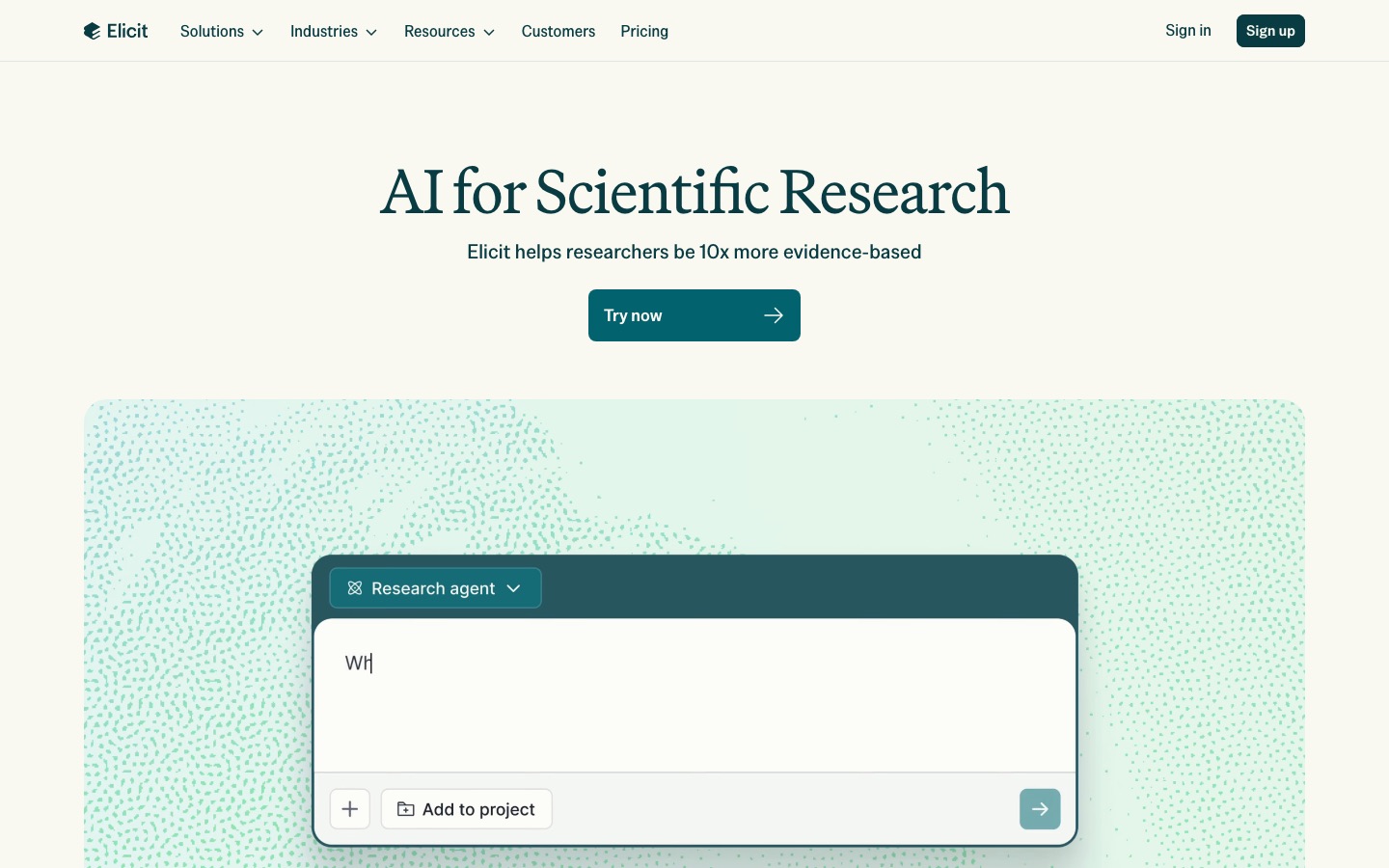
Elicit treats literature work as a structured process. You ask a research question, it finds relevant papers from a corpus of more than 138 million, and it lays them out in a table where each column is something you want to know: sample size, intervention, outcome, study design, limitations. You can add custom columns, screen papers against inclusion criteria and generate research reports where you control which papers and data points are included. Claims are backed by sentence-level citations, so you can click through to the exact passage. Elicit's strength is defensible, repeatable evidence work rather than quick answers.
Consensus: an answer engine for science
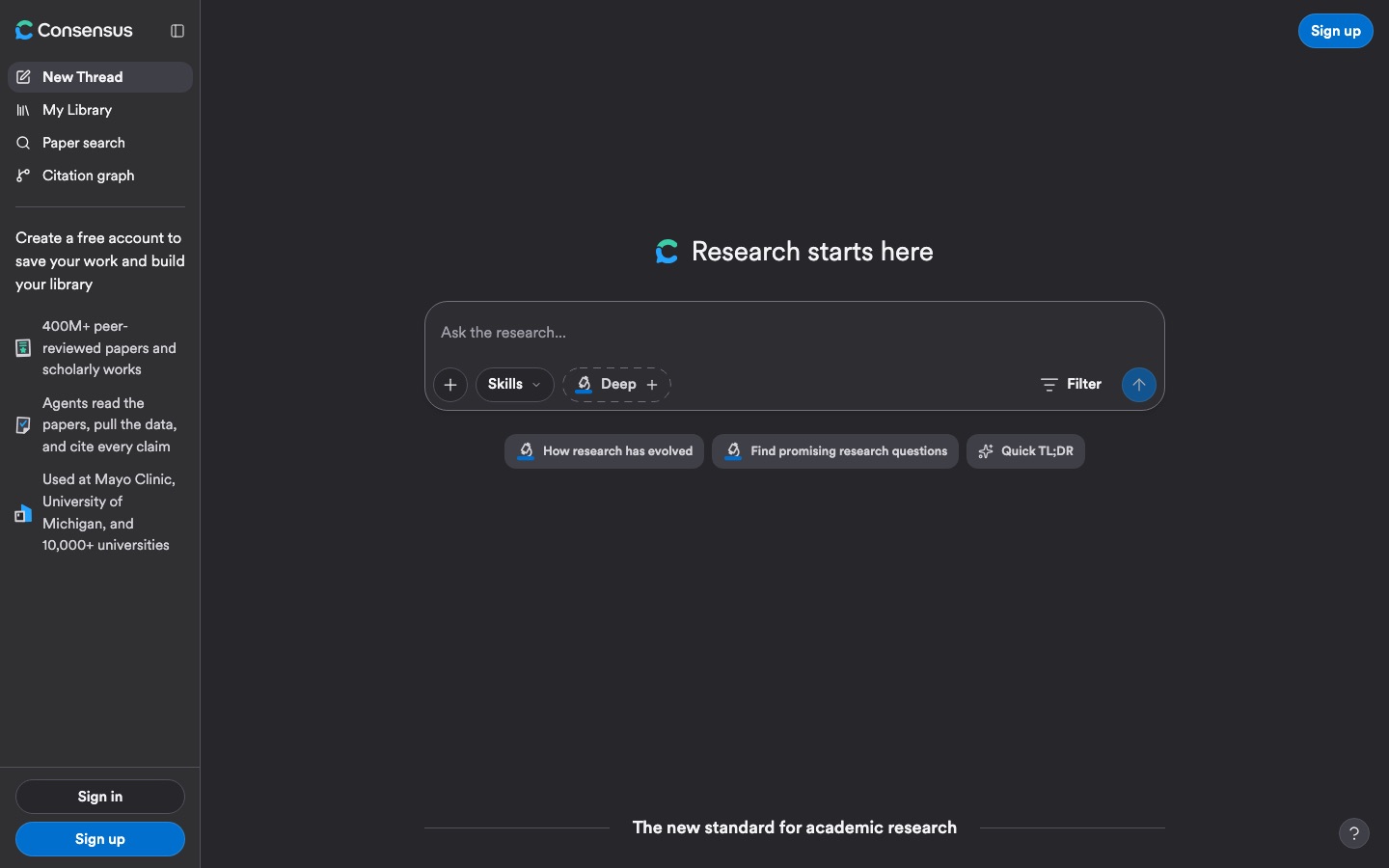
Consensus is closer to a search engine that only reads peer-reviewed research. Type a question and it returns a synthesized answer with citations, plus a Consensus Meter for yes/no questions that shows the share of relevant studies leaning yes, no or mixed. Study Snapshots summarize a paper's population, methods and findings at a glance, Ask Paper lets you chat with a single study, and a Citation Graph shows how papers connect. Its homepage now claims an index of 400M+ papers, and its pricing page says more than 5 million researchers, students and clinicians use it. It is the most approachable of the three for non-specialists.
SciSpace: the all-in-one research workspace
SciSpace (formerly Typeset) started as a copilot for reading hard papers and has grown into a broad platform. It searches 280M+ papers according to its own comparison pages, builds literature review tables, lets you chat with PDFs, and adds an AI writer, paraphraser, citation generator and thousands of journal templates. Its headline feature in 2026 is the SciSpace Agent, which can run multi-step workflows from one prompt: plan a search, retrieve papers, extract variables, and draft sections, slides or posters. It is the widest toolset of the three.
Pricing compared (as of October 2026)
Prices below come from Elicit's pricing page, Consensus pricing and SciSpace pricing. Consensus and SciSpace load their plan details dynamically, so we cross-checked them against third-party trackers verified in October 2026. All three change limits often, so confirm on the official page before you pay. Student, clinician and institutional discounts exist for some plans.
| Plan level | Elicit | Consensus | SciSpace |
|---|---|---|---|
| Free | Basic: unlimited search, summaries and chat with full-text papers; limited agent and reports | Free: limited Pro searches and about 3 Deep Search reviews a month | Limited free access (credit-based); some trackers list no free plan, so check |
| Entry paid | Pro: $49/user/mo billed annually ($588/yr) | Pro: about $12/mo billed annually (higher monthly) | Premium: $12/mo billed annually, $20 monthly |
| Power user | Scale: $229/user/mo billed annually | Deep: about $45/mo billed annually, about $65 monthly | Advanced: $70/mo billed annually, $90 monthly; Max: $160 to $200/mo |
| Teams and institutions | Enterprise: custom, SSO, 40,000-paper screening | Teams and Enterprise: contact sales; university deals | Teams and Enterprise: contact sales |
What the money actually buys. Elicit Pro adds the dedicated systematic review workflow (screening up to 5,000 papers), 20 extraction columns at a time, reports that draw on up to 135 sources, custom extraction from your own uploaded PDFs, Routines that track new evidence, and API access. Scale raises usage five-fold, adds figure extraction and real-time collaboration. Consensus Pro removes the cap on Pro searches and raises Deep Search reviews; the Deep plan is for people who run long synthesized reviews every week. SciSpace's plans are credit-based, with the Agent consuming credits, and credits do not roll over month to month.
Value verdict: for an individual student, Consensus Pro or SciSpace Premium at roughly $12 a month (annual) is the realistic spend. Elicit's paid plan is priced for professional research teams. If you only need its review features for one thesis chapter, ask your library first: many universities license one of these tools.
Elicit vs Consensus vs SciSpace, feature by feature
Paper database and coverage
On raw numbers, Consensus (400M+) leads SciSpace (280M+) and Elicit (138M+). All three build heavily on open scholarly infrastructure such as Semantic Scholar and OpenAlex, so the overlap is large. A bigger index mostly helps with obscure, older or non-English literature; for mainstream questions, ranking and full-text access matter more. None of the three can read paywalled full text you do not have access to, so extraction from abstracts only is a common limitation. Upload the PDFs you have through your library to get better extraction in Elicit and SciSpace.
Search and answers
Consensus is the fastest path from question to answer. Phrase your query as a yes/no question ("Does intermittent fasting improve insulin sensitivity?") and you get a short synthesis, the Consensus Meter and a list of papers with Study Snapshots. Elicit gives a short summary of the top papers but puts the emphasis on the table underneath. SciSpace sits in between: its literature review mode returns a synthesized answer plus a customizable table of papers, and its Deep Review mode runs a longer search. SciSpace publishes a benchmark claiming its Deep Review surfaces more highly relevant papers per query than Consensus; it is a vendor test, so weigh it accordingly.
Systematic reviews and data extraction
This is where Elicit pulls clearly ahead. Its systematic review workflow walks you from question to search, screening against inclusion and exclusion criteria, extraction and report, with every extracted value linked to the source sentence. Pro screens up to 5,000 papers and Enterprise up to 40,000, with PRISMA-style screening and extraction. SciSpace offers extraction tables and its Agent can pull pre-defined variables into a table, which is good enough for a scoping review or a thesis chapter. Consensus is not built for screening hundreds of papers at all. Whatever you use, librarians are consistent on one point: these tools speed up a systematic review but do not replace a documented database search in PubMed, Scopus or Web of Science.
Reading and understanding papers
SciSpace wins for reading. Its copilot sits beside the PDF, and you can highlight a paragraph, a formula or a table and ask it to explain, simplify or translate. That makes it the friendliest tool for undergraduates and non-native English readers. Consensus offers Ask Paper for chatting with one study, and Elicit offers unlimited chat with full-text papers even on the free plan. Both are capable, but neither is as focused on the reading experience.
Writing and drafting
SciSpace has the most writing help: an AI writer with templates for literature reviews, abstracts and proposals, a paraphraser, a citation generator, and journal formatting templates. Elicit's research reports are more controlled drafts: you pick the papers and data that feed them, which is useful for evidence briefs. Consensus can generate a structured summary with citations but is not a writing tool. For drafting the actual paper, many researchers pair one of these with a dedicated writing tool; see our Jenni AI vs QuillBot vs Paperpal comparison.
Agents and automation
All three now have agent-style features. Elicit's Research Agent and Routines run searches and keep a topic up to date as new papers appear. Consensus's Deep Search runs a multi-step review and writes a long report. The SciSpace Agent is the most ambitious: from one prompt it can design a search strategy, gather papers, extract data, build charts and draft documents or slides. The trade-off is control: the more an agent does alone, the more you must check its paper choices and numbers.
Accuracy and hallucinations
Because all three retrieve real papers before summarizing, they do not invent references the way a general chatbot sometimes does. The common errors are subtler: a misread table, a number from the wrong trial arm, or an overstated finding. Elicit's sentence-level citations make spot-checking fastest. Consensus's Study Snapshots help you judge study quality before trusting the meter. SciSpace's agent outputs need the most review simply because they cover more ground. A good habit with any of them: verify every number that will appear in your final paper against the PDF.
Feature comparison table
| Feature | Elicit | Consensus | SciSpace |
|---|---|---|---|
| Papers indexed | 138M+ | 400M+ | 280M+ |
| Best at | Systematic reviews, extraction | Quick evidence answers | Reading, drafting, all-in-one |
| Evidence agreement view | No | Yes, Consensus Meter | No |
| Screening workflow | Yes, up to 5,000 papers on Pro | No | Partial, via tables and Agent |
| Custom extraction columns | Yes, 20 at a time on Pro | No | Yes |
| Chat with a paper | Yes, free | Yes, Ask Paper | Yes, highlight-to-explain copilot |
| Writing tools | Research reports | Summaries only | AI writer, paraphraser, citations |
| Agent features | Research Agent, Routines | Deep Search | SciSpace Agent |
| Free plan | Yes, generous for search | Yes, limited | Limited, check current terms |
| Entry paid price | $49/mo (annual) | About $12/mo (annual) | $12/mo (annual) |
Pros and cons
Elicit
Pros: the most rigorous screening and extraction workflow; sentence-level citations; unlimited search and paper chat on the free plan; Routines keep reviews current.
Cons: Pro starts at $49/mo billed annually; smaller index than the other two; best in empirical fields with structured studies, weaker for theory-heavy humanities work.
Consensus
Pros: fastest answers; the Consensus Meter is genuinely useful for a quick read on the evidence; cheap Pro plan; easy for students, journalists and clinicians.
Cons: the meter only works for yes/no questions and can flatten nuance; not built for screening or bulk extraction; the free plan's best modes run out quickly.
SciSpace
Pros: the best reading copilot; the widest set of tools in one subscription; strong multilingual support; the Agent automates multi-step tasks.
Cons: the breadth can feel scattered; credit-based limits are harder to predict; agent outputs need careful checking; free access has become less clear in 2026.
Who should pick which
Choose Elicit if...
You run systematic, scoping or rapid reviews and need a documented screening and extraction trail.
You work in health, life sciences, policy or economics, where studies report comparable variables.
Choose Consensus if...
You want a fast, cited answer to a specific question before deciding whether to dig deeper.
You are a student, clinician, journalist or curious professional who is not doing a formal review.
Choose SciSpace if...
You read many papers outside your specialty or in a second language.
You want search, reading, writing and citations in one place rather than three tools.
You like the idea of an agent that drafts a first pass you then refine.
Use two of them if...
A common pattern is to test a question in Consensus, then build the structured review in Elicit. Another is to use SciSpace for reading and drafting while Elicit handles extraction. Discovery tools like ResearchRabbit, Connected Papers and Litmaps complement all three by mapping citation networks so you do not miss a cluster of work. Our roundup of the best AI research tools covers how these fit together.
Alternatives worth knowing
Scite: shows whether a paper's claims were supported or contrasted by later citing papers.
Undermind: deep, iterative search for narrow questions that keyword search misses.
Semantic Scholar: free paper search with AI summaries, the foundation many of these tools build on.
Gemini Notebook (formerly NotebookLM): free, and answers only from PDFs you upload. Great once you already have your papers; see our NotebookLM tutorial.
Perplexity: general answer engine with an academic focus option; broader but less rigorous. See our Perplexity vs ChatGPT guide.
FAQ
Is Elicit better than Consensus?
It depends on the job. Elicit is better for systematic reviews, screening and extracting data from many papers into a table. Consensus is better for quick, cited answers to a specific question and for seeing whether studies agree. If you are writing a formal review, start with Elicit. If you want to know what the evidence says in five minutes, use Consensus.
Is SciSpace better than Elicit?
SciSpace is better for reading dense papers, chatting with PDFs, writing help and broad first drafts. Elicit is better for structured, defensible evidence extraction and systematic review workflows. Students reading outside their field usually prefer SciSpace; researchers building evidence tables usually prefer Elicit. Many people use SciSpace to read and Elicit to extract.
Is Consensus AI free?
Yes, Consensus has a free plan with unlimited basic searches and a small monthly allowance of its Pro searches and Deep Search reviews (around three Deep reviews a month, according to third-party trackers in October 2026). Pro, at about $12 a month billed annually, removes the Pro search cap. Check the official pricing page for current limits.
How much does Elicit cost?
Elicit's Basic plan is free and includes unlimited search across 138M+ papers, summaries and chat with papers. Pro costs $49 per user per month billed annually ($588 a year) and adds the systematic review workflow, more extraction columns and API access. Scale is $229 per user per month billed annually, and Enterprise is custom.
Can Elicit or SciSpace do a systematic review for me?
They can speed up most steps, especially screening and data extraction, but they cannot replace a documented search of databases such as PubMed or Scopus, or human judgment on inclusion decisions. Use them to work faster, keep a record of your criteria, and verify every extracted value against the original paper before publishing.
Which AI tool is best for literature reviews?
For formal and systematic literature reviews, Elicit is the strongest of the three. For scoping a topic and drafting a narrative review, SciSpace is the most complete. For quickly checking claims and the weight of evidence, Consensus is fastest. Pair any of them with a citation mapping tool like ResearchRabbit or Connected Papers to cover gaps.
Do these tools make up citations?
Rarely, because all three retrieve real papers before they write. The bigger risk is misinterpretation: a misread number, an overstated conclusion or a paper that does not fit your question. Click through to the cited passage for anything you plan to use, and check study quality before trusting a summary.
Final verdict
There is no single winner in Elicit vs Consensus vs SciSpace, because each one is the best at a different stage of research. Elicit is the professional's choice for systematic reviews and evidence tables, and its free plan is strong for search and reading. Consensus is the fastest and cheapest way to get a cited, evidence-weighted answer. SciSpace is the most complete workspace for reading, writing and agent-driven first drafts. If you can only pay for one as a student, start with Consensus or SciSpace at about $12 a month on an annual plan. If your job involves formal reviews, Elicit Pro earns its higher price. For more study-focused picks, see our guide to the best AI tools for students and our new list of AI study tools.
Browse every literature and paper tool in our AI research tools category, or see learning tools in the education category. Built a research tool academics should know about? Submit it for a listing.