Krea vs Leonardo AI (2026): Which Creative AI Platform Is Better?
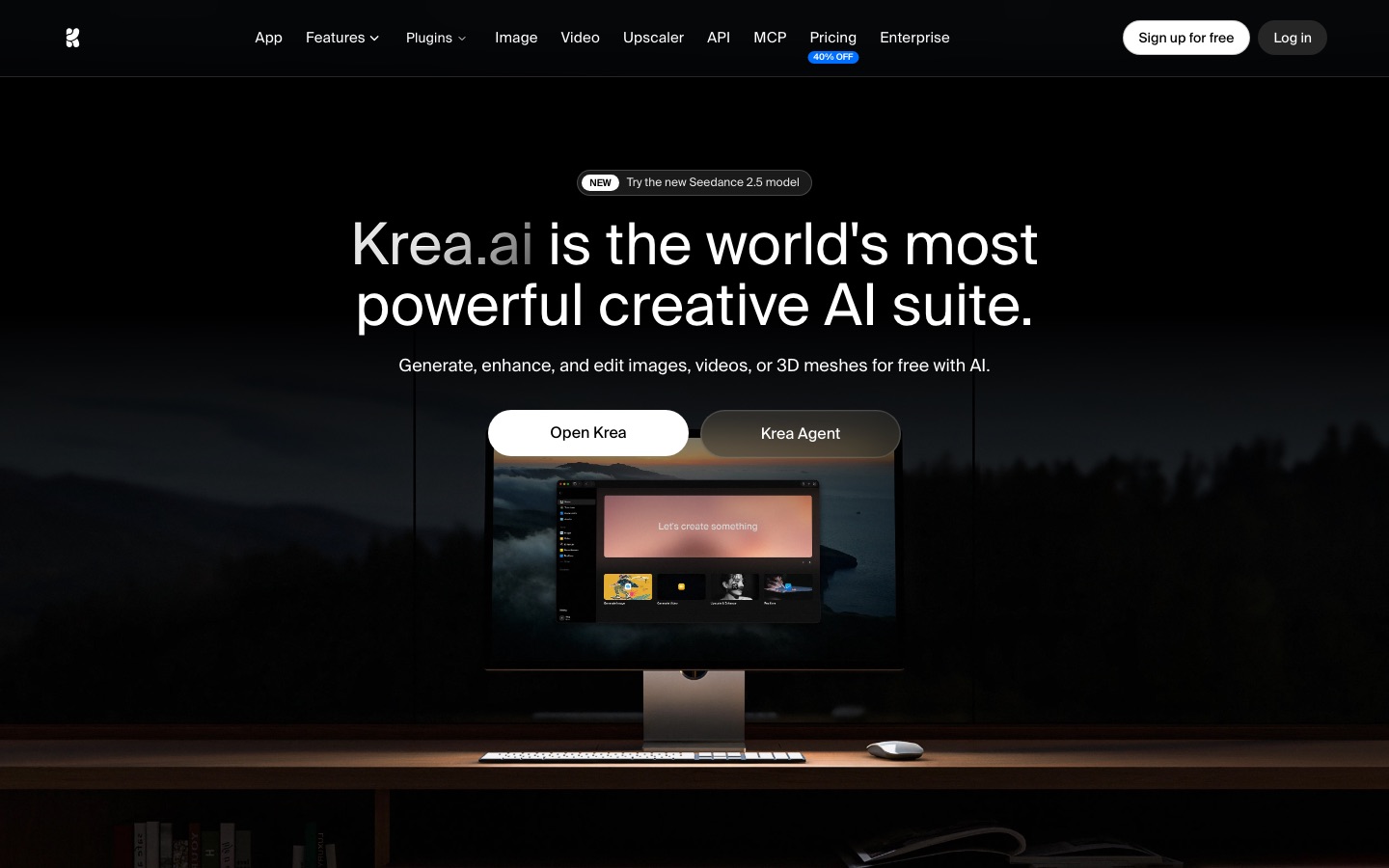
Krea is the better pick for real-time creation, the widest model menu, 22K upscaling and node workflows. Leonardo AI is better for predictable unlimited image and video generation, game and character work, and a simpler token system. Here is a full comparison of models, pricing, free plans and features in 2026.
Short verdict: in the Krea vs Leonardo AI matchup, choose Krea if you want the broadest set of image, video and 3D models in one place, real-time generation as you sketch, an enhancer that upscales to 22K, and node workflows and an agent for automating creative work. Choose Leonardo AI if you want predictable, unlimited relaxed image generation for $30 a month (and unlimited relaxed video for $60), strong tools for consistent characters and game assets, and a simpler interface built around its own Lucid and Phoenix models.
Both platforms grew from niche tools into full creative studios. Krea launched its Krea 2 model in May 2026, released open weights in June, opened the Krea Agent to every plan in September, and made Krea 3 its default image model on October 16. Leonardo, owned by Canva since 2024, has added Lucid Origin and Lucid Realism, a rotating catalog of third-party models such as Nano Banana and Veo, and unlimited relaxed video on its top plan. This comparison is based on official pricing pages, help center articles, release notes and public user feedback as of October 2026. We have not run our own benchmarks.


Quick verdict by use case
Real-time drawing to image: Krea, which pioneered real-time canvas generation.
Most models in one subscription: Krea, with 60+ image, video and 3D models.
Unlimited image generation on a budget: Leonardo Premium at $30/mo. Krea also offers unlimited relaxed generation, but only on its in-house image models.
Unlimited video: Leonardo Ultimate, with unlimited relaxed video on several models.
Upscaling and enhancing: Krea, with an enhancer up to 22K and video upscaling.
Game assets and consistent characters: Leonardo, thanks to its game-art roots, Elements and character reference.
Automation and pipelines: Krea, with Nodes, the Krea Agent, an API, MCP and plugins for Blender and TouchDesigner.
Best free plan: close. Leonardo gives 150 tokens a day; Krea gives 100 compute units a day with access to real-time models.
Krea vs Leonardo AI at a glance
| Krea | Leonardo AI | |
|---|---|---|
| Owner | Krea (independent, San Francisco) | Canva (acquired 2024) |
| Own image models | Krea 3 (default), Krea 2, Krea Realtime | Lucid Origin, Lucid Realism, Phoenix |
| Third-party models | 60+ across image, video and 3D (Nano Banana 2, FLUX 3, Ideogram, GPT Image, Seedance, Kling, Wan and more) | Rotating catalog including Nano Banana, FLUX, Veo, MiniMax, Hailuo and Wan |
| Free plan | 100 compute units a day | 150 tokens a day, public generations |
| Paid plans | $9 to $105/mo, Business $200/mo | $12 to $60/mo, plus Teams |
| Unlimited mode | Relaxed generations on in-house image models | Relaxed images on Premium, images and video on Ultimate |
| Rollover | No (Business and Enterprise only) | Yes, up to 3 months of tokens |
| Real-time generation | Yes, images and video | Yes, Realtime Canvas |
| Upscaling | Up to 22K, including Topaz models | Built-in upscalers |
| Custom training | LoRA training (50 images, unlimited on Max) | Custom models and Elements |
| Workflow tools | Nodes, Apps, Agent, API, MCP | Blueprints, Canvas editor, API |
Pricing compared (as of October 2026)
Krea sells compute units that work across every model, and Leonardo sells tokens. Neither maps neatly to a number of images, because premium models and video cost far more than a standard image. Check the official Krea pricing page and Leonardo pricing page for current numbers; Leonardo's token FAQ explains how its unlimited modes kick in.
| Tool | Plan | Monthly price | What you get |
|---|---|---|---|
| Krea | Free | $0 | 100 compute units a day, real-time models, upscaling to 2K |
| Basic | $9 (about $5 billed yearly) | 5,000 units a month (about 112 Nano Banana 2 images), selected video models, upscale to 22K | |
| Pro | $35 ($21 billed yearly) | 20,000 units (about 450 Nano Banana 2 images), all video models | |
| Max | $105 ($63 billed yearly) | 60,000 units (about 1,350 Nano Banana 2 images), unlimited LoRA training up to 2,000 images | |
| Business | $200 ($160 billed yearly) | 80,000 units, up to 50 seats, rollover | |
| Leonardo AI | Free | $0 | 150 tokens a day, no rollover, public generations |
| Essential | $12 | 8,500 fast tokens, private generations, rollover | |
| Premium | $30 | 25,000 fast tokens plus unlimited relaxed image generation | |
| Ultimate | $60 | 60,000 fast tokens plus unlimited relaxed image and video generation |
Krea's yearly discount is large, about 40%, which makes Krea Pro at $21 a month a strong deal if you commit. Leonardo's annual plans are discounted too. Both have team plans: Krea Business shares one pool of units across up to 50 seats, and Leonardo's Teams plans start at three seats.
The fine print that changes the math
Rollover: Leonardo banks unused paid tokens up to three months' worth (for example 75,000 tokens on Premium), but you lose the bank if you cancel. Krea's Basic, Pro and Max units do not roll over.
Unlimited modes: Leonardo's relaxed mode activates only after your fast tokens run out and covers a set list of models, including Lucid Origin, Lucid Realism, Phoenix and FLUX Dev and Schnell for images, plus MiniMax H3, Wan 2.6, Hailuo 2.3 and Motion 2.0 for video on Ultimate. Krea's relaxed generation covers its in-house image models only, not premium third-party models or video.
Top-ups: Leonardo top-up tokens never expire. Krea Business offers compute packs, and its Business and Enterprise units roll over.
Commercial use: Krea's paid plans include a commercial license. Leonardo's paid plans give you private generations and ownership of outputs, while free-tier images are public.
Image models and quality
Krea: its own models plus almost everyone else's
Krea 3 became Krea's default image model on October 16, 2026, and left beta four days later, with regional edits and 4K output in the API. Krea 2, launched in May, focused on aesthetics and style control, with style references, moodboards and generative sliders, and its Raw and Turbo versions were released as open weights in June. Around those sit dozens of partner models, including Nano Banana 2, FLUX 3, Ideogram, GPT Image 2.5 and Seedream. The appeal is that you can compare the best models on the market without separate subscriptions.
Leonardo: tuned house models with control
Leonardo's own Lucid Origin targets Full HD, cinematic images with strong prompt adherence, Lucid Realism focuses on photographic results, and Phoenix remains popular for following complex prompts and rendering text. Leonardo also offers style presets such as Cinematic Kino, Concept Art and Illustrative Albedo, plus third-party models including Google's Nano Banana. The catalog is smaller than Krea's, but the house models are covered by the unlimited relaxed mode, which matters if you generate a lot.
Winner: Krea for range and access to frontier models. Leonardo for high volume generation on its own models.
Real-time generation
Real-time generation is where Krea made its name. Its Realtime Canvas turns shapes, scribbles, webcam input or a screen share into images almost instantly as you move, Realtime Edit lets you paint changes live, and Krea Realtime extends the idea to video with clips of up to 15 seconds. In September Krea soft-launched Realtime Director for directing scenes live. Leonardo has its own Realtime Canvas and Realtime Generation, which are fun and useful for quick ideation, but Krea's tools are deeper and more central to the product.
Winner: Krea.
Video generation
Both now do serious video. Krea hosts many of the leading video models, including Kling 4.0, Seedance 2.5, Wan 3.0, MiniMax H3 and FLUX 3 video, plus tools like Restyle, Motion Transfer and Lipsync, and it can upscale video to 8K. The catch is cost: video burns compute units quickly, and Krea's own pricing page estimates around 65 Seedance 2.5 videos on the Pro plan per month.
Leonardo's advantage is predictability. The Ultimate plan at $60 includes unlimited relaxed video on Motion 2.0, MiniMax H3 at 480p, Wan 2.6 and Hailuo 2.3 once your tokens run out, and premium models such as Veo use tokens. If you make lots of short clips and can wait for a slower queue, that is hard to beat. Compare more options in the best AI video generators.
Winner: Krea for model choice and quality. Leonardo for unlimited video on a fixed budget.
Editing, upscaling and enhancement
Krea's Enhancer is one of its best features: it upscales images up to 22K on paid plans using several models, including Topaz options, and can add detail as it upscales. Krea also offers image editing with reference images, Elements for reusable characters and objects, and bounding boxes for regional edits on Krea 3. Leonardo's Canvas editor handles inpainting and outpainting, and it has built-in upscalers, background removal and image guidance with up to four reference images.
If upscaling is a big part of your work, Krea is the stronger choice. Our guide to the best AI image upscalers compares Krea with Magnific and Topaz Labs.
Winner: Krea.
Consistency, characters and custom training
Leonardo started as a tool for game asset creation, and it shows. Character reference, Elements and custom model training let you lock a character, product or art style and reuse it across hundreds of images, and Blueprints package multi-step workflows into one-click templates. Krea answers with LoRA training on your own images (up to 50 images on most plans, unlimited with up to 2,000 images on Max), Elements for recurring characters and objects, and moodboards for style.
Winner: Leonardo for game and character pipelines, with Krea close behind.
Workflows, automation and API
Krea has invested heavily in tools for power users and teams. Krea Nodes is a visual workflow builder that chains models, edits and effects and turns them into shareable Apps. The Krea Agent, open on every plan since September 10, plans and runs multi-step jobs and can now build custom Nodes for you. Krea has a public API, an MCP server, a ChatGPT plugin, and integrations for Blender and TouchDesigner. Organizations features added shared workspaces, member usage limits and usage reporting.
Leonardo offers a mature pay-as-you-go API, Blueprints and a Canvas editor, and its tight link with Canva means its technology also feeds Canva's own AI features. For a solo creator, Leonardo's simpler interface is an advantage. For a studio that wants to automate a pipeline, Krea's tooling goes further.
Winner: Krea.
Ease of use
Leonardo is easier to learn. Its interface is organized around a few clear tools (image generation, video, Canvas, Blueprints), and the house models give good results without picking from dozens of options. Krea's breadth is also its learning curve: with 60+ models, real-time tools, Nodes and an agent, new users can feel lost. Krea's March 2026 redesign helped by unifying navigation and exposing model selection more clearly.
Winner: Leonardo AI.
Free plans compared
Both free plans are genuinely useful. Leonardo's 150 daily tokens do not accumulate, generations are public, and Leonardo retains broad rights to free-tier images. Krea's 100 daily compute units refill each day, include real-time models and a few images on premium models, and upscale to 2K. Krea's free plan is better for trying many models; Leonardo's is better for generating more images with its house models. For more options, see the best free AI image generators.
Who should pick which
Choose Krea if...
You want access to the newest image and video models without juggling subscriptions.
You like to sketch and iterate in real time.
Upscaling and enhancing images to print resolution is part of your job.
You want to automate workflows with Nodes, an agent, the API or MCP.
You can commit to annual billing for the 40% discount.
Choose Leonardo AI if...
You generate a lot and want unlimited relaxed images for $30 a month.
You want unlimited relaxed video on a fixed $60 budget.
You build game assets, characters or product visuals that must stay consistent.
You prefer a simpler interface with strong house models.
You value token rollover and top-ups that never expire.
Alternatives worth a look




Midjourney: the most distinctive artistic look, compared in Freepik AI vs Midjourney vs Leonardo AI.
Magnific (formerly Freepik AI): another multi-model suite, with a large stock library included.
Adobe Firefly: commercially safe models inside Creative Cloud. See Adobe Firefly vs Midjourney.
Magnific Upscaler: creative upscaling that adds detail, a rival to Krea's enhancer.
Stable Diffusion: open models you can run locally, alongside Krea 2's open weights.
FAQ
Is Krea better than Leonardo AI?
Krea is better for model variety, real-time generation, upscaling and automation. Leonardo AI is better for unlimited relaxed image and video generation at a fixed price, consistent characters and ease of use. Designers and studios exploring many models tend to prefer Krea; game artists and high-volume creators tend to prefer Leonardo.
Is Krea AI free?
Yes. Krea's free plan gives you 100 compute units a day with no credit card, access to real-time models and upscaling up to 2K. Paid plans start with Basic at $9 a month, or about $5 a month billed yearly, which adds 5,000 units a month and upscaling up to 22K.
How much does Leonardo AI cost?
Leonardo AI has a free plan with 150 tokens a day. Paid plans are Essential at $12 a month (8,500 tokens), Premium at $30 (25,000 tokens plus unlimited relaxed images) and Ultimate at $60 (60,000 tokens plus unlimited relaxed images and video). Annual billing is cheaper; check the pricing page for current offers.
Can I use Krea and Leonardo images commercially?
Krea's Basic, Pro, Max, Business and Enterprise plans include a commercial license. Leonardo's paid plans give you private generations and ownership of what you create, while free-tier images are public and Leonardo keeps broader rights to them. Always read each platform's current terms before using images in client work.
What is Krea 3?
Krea 3 is Krea's newest in-house image model, which became the default on the platform on October 16, 2026 and left beta on October 20. It supports regional edits with bounding boxes and 4K output through the API, and an Ultra version is available in the API.
Does Leonardo AI have unlimited generations?
Yes, on higher plans. Premium includes unlimited relaxed image generation and Ultimate adds unlimited relaxed video. Relaxed mode activates automatically once your fast tokens run out, runs slower depending on load, and only covers a specific list of Leonardo and partner models.
Is Leonardo AI owned by Canva?
Yes. Canva acquired Leonardo AI in 2024. Leonardo continues to operate as its own product with its own plans, and its technology also powers some of Canva's AI features. Canva has said user content is not shared with Leonardo unless users opt in.
Final verdict
There is no universal winner, because Krea and Leonardo AI optimize for different things. Krea is the better creative studio for people who want everything: the newest models, real-time generation, a 22K enhancer, LoRA training and automation through Nodes and the Agent, at a very good price on annual billing. Leonardo AI is the better value for heavy generators who want unlimited relaxed images at $30 or unlimited relaxed video at $60, plus dependable tools for consistent characters and game assets. Try both free plans with the same three prompts, and pay for the one whose results and workflow you would actually use every day.
Compare every image generator, upscaler and creative AI studio we track in the AI image tools category, or read our full Leonardo AI review. If you build an image tool we have missed, you can submit it for a listing.