ElevenLabs Review (2026): Eleven v4, Pricing, Pros and Cons
Our ElevenLabs review for 2026: what Eleven v4 changed, how voice cloning, Studio, dubbing, music and agents work, what each plan really includes, the common complaints about credits, and when Murf, Cartesia, Speechify or Descript is the better pick.
Verdict: this ElevenLabs review comes to a clear conclusion. ElevenLabs is still the best all-round AI voice platform in 2026, and the September launch of Eleven v4 widened its lead on natural, emotive speech. It is the right pick for YouTubers, audiobook narrators, podcasters, game and app developers, and anyone who wants a voice clone without talking to sales. Skip it if you only need simple read-aloud, if you narrate slide decks with a team (Murf AI fits better), or if your budget cannot absorb credits that disappear quickly on long projects.
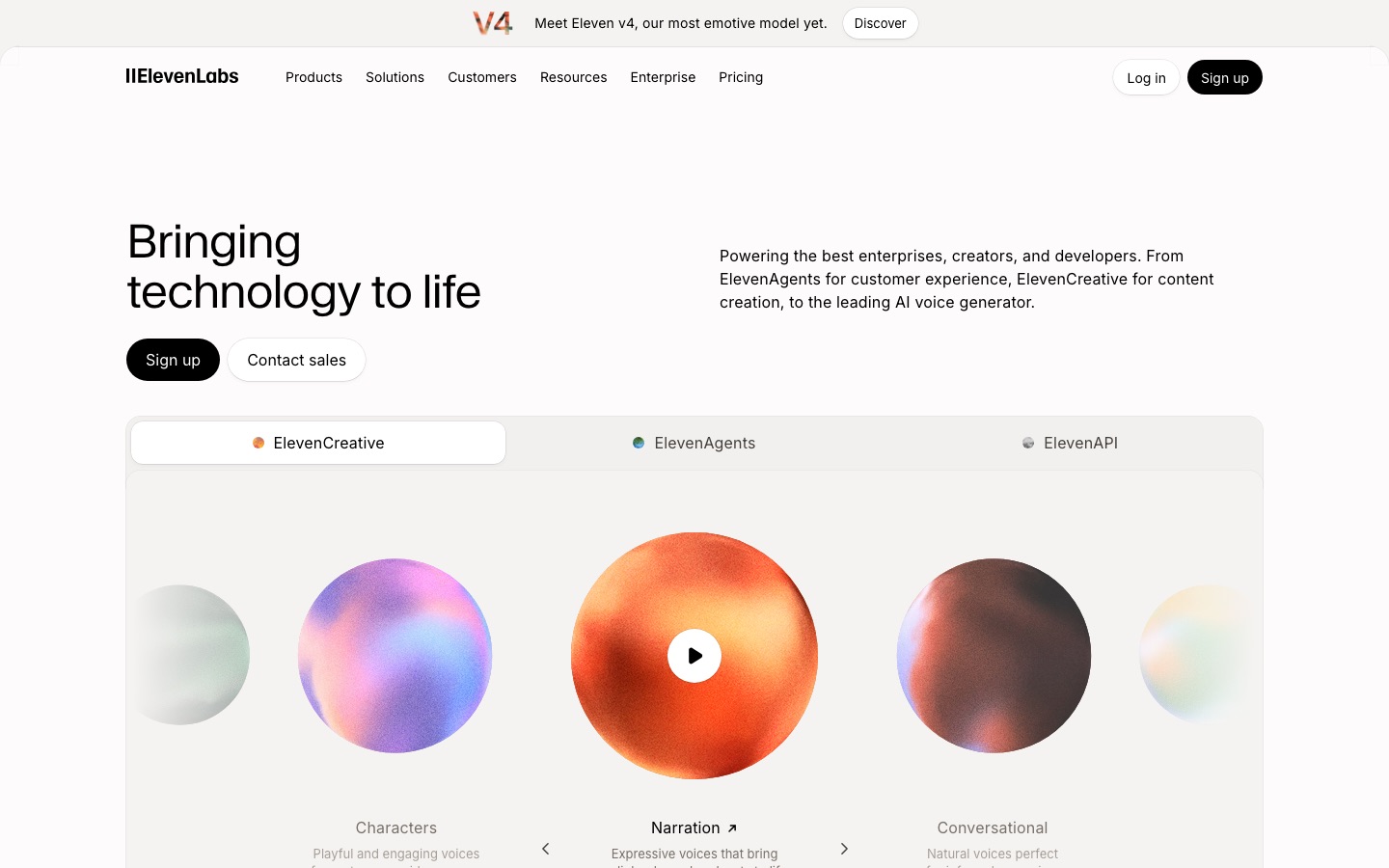
ElevenLabs started as a text-to-speech tool and is now three products in one account: ElevenCreative for voiceovers, dubbing, music and studio projects; ElevenAgents for voice agents; and ElevenAPI for developers. This review covers what changed this year, every major feature, what each plan really gets you, the complaints that show up in public reviews, and how it compares with the closest alternatives. It is based on the official pricing page, product documentation, the ElevenLabs blog and public user feedback as of October 2026, not on hands-on benchmark tests.

ElevenLabs at a glance
What it is: an AI audio platform for text to speech, voice cloning, dubbing, sound effects, music, speech to text and conversational voice agents.
Newest model: Eleven v4 and Eleven v4 Turbo, launched September 28, 2026, with 90+ languages.
Free plan: yes, 10,000 credits a month (about 10 minutes of speech), no commercial license.
Paid plans: from $6/mo (Starter) to $990/mo (Business), with Enterprise on quote.
Voice cloning: Instant Voice Cloning from Starter, a Professional Voice Clone from Creator.
Best for: narration, audiobooks, YouTube voiceovers, localization, games and voice agents.
Not ideal for: teams that want slide and video narration tied to PowerPoint or Canva, or anyone who needs a fixed, unlimited monthly price.
What ElevenLabs is, and what changed in 2026
2026 was a busy year for ElevenLabs. The company raised a Series D at an $11 billion valuation in February and said in late September that it was valued at $22 billion. Product-wise, almost every part of the platform got a new version. Here are the launches that matter to users, from the ElevenLabs blog:
January 9: Scribe v2, the speech-to-text model, now with a Realtime and a Medical variant.
February 2: Eleven v3 became generally available, bringing audio tags such as [whispers] and [laughs] to everyone.
April: ElevenMusic launched as a standalone iOS app for creating and remixing songs.
May 26 and 28: Music v2 and Dubbing v2, with the music update cutting self-serve music prices by up to 50%, according to launch coverage.
September 10: a multi-year licensing deal with Universal Music Group, starting with a licensed fan remix platform, followed by the Music v2.5 model.
September 28: Eleven v4 and Eleven v4 Turbo, the company's most emotive speech models so far.
Key features, tested against the documentation
Text to speech with Eleven v4
Text to speech is still the core product. You paste a script, pick a voice and a model, and generate. The web app lets you generate up to 10,000 characters at once with Eleven v4 (about 10 minutes of audio) and 5,000 with most other models, according to the Text to Speech documentation. The model menu currently includes Eleven v4, Eleven v4 Turbo, Eleven v3, Eleven v3 Conversational, Multilingual v2 and Flash v2.5.
Eleven v4 is built on a new architecture. ElevenLabs says it reads tone, pacing and emotion from context, handles multi-speaker dialogue that reacts to the previous line, keeps a speaker's identity steady across long content, and follows inline audio tags such as [laughs], [said angrily in French accent] or [phone buzzing] more reliably than v3. It also supports custom pronunciation written in IPA.
Eleven v4 Turbo is the low-latency version for live use. ElevenLabs quotes a median inference latency of about 100 ms and a median time to first speech of about 150 ms.
Voice Library and Voice Design
You rarely need to clone a voice to find the right tone. The shared Voice Library holds more than 10,000 voices made by the community and by ElevenLabs, searchable by accent, age, gender and use case. Voice Design creates a brand new synthetic voice from a text description, such as "a warm, slightly raspy male voice in his 50s with a soft Irish accent".
Voice cloning: Instant and Professional
There are two kinds of voice clone. Instant Voice Cloning (Starter and up) works from a short sample: the cloning docs recommend one to two minutes of clean, single-speaker audio, and say samples longer than about three minutes add little. Professional Voice Cloning (Creator and up) trains a dedicated model on 30 minutes to three hours of audio. You must verify that the voice is yours, and fine-tuning usually takes three to six hours, sometimes up to a day when the queue is busy.
With Eleven v4, ElevenLabs says an instant clone can capture a voice from about 10 seconds of audio, and professional clones are now supported on the new model. Some launch coverage also noted that clones made before v4 may need retraining to sound their best on it, so re-test any older clone before a big project.
Studio: audiobooks, podcasts and video
Studio is the long-form editor. You can start from a prompt (a Studio Agent builds a first draft), a blank audio or video project, or an imported file such as EPUB, PDF, DOCX, TXT or a URL. Chapters are detected automatically, you assign voices paragraph by paragraph, and each paragraph gets two free regenerations if you have not changed the text or voice. GenFM turns a document into a two-host podcast and needs a paid plan.
Exports are MP3 or WAV per chapter or for the whole project. Free, Starter and Creator plans export at 128 kbps, while Pro and above get 192 kbps MP3 or 44.1 kHz WAV, which matters if you publish audiobooks to retailers with strict audio specs.
Dubbing v2
Dubbing translates video or audio into 90+ languages while keeping the original speaker's voice. You upload a file (up to 2 GB and 180 minutes) or paste a YouTube or TikTok link, pick target languages, and adjust a Speaker similarity slider from 0 to 10 (the default is 7). Free-plan dubs carry a watermark that cannot be removed. Two caveats from the dubbing docs: there is no lip sync, and the older Dubbing Studio editor is in maintenance mode.
Music and sound effects
Eleven Music generates full songs, with or without vocals, from a prompt. It is available on the free plan for personal use, and commercial use starts on Starter. ElevenLabs says its music models were built with licensed partners, which is one reason marketers are trying it as an alternative to Suno (see our Suno review). Sound Effects creates foley, ambience and UI sounds from a text prompt. Both draw on your normal credits: about 900 credits per minute of music and 200 per sound effect generation.
Speech to text, Voice Changer and Voice Isolator
Scribe v2 transcribes 90+ languages with speaker labels and timestamps, and Scribe v2 Realtime handles live transcription for agents. Voice Changer turns your own recorded performance into another voice while keeping your timing and emotion, which is often better than text to speech for acting. Voice Isolator strips background noise from dialogue. The changer and isolator cost about 1,000 credits per minute, and transcription about 330.
ElevenAgents and the API
ElevenAgents builds voice agents for support lines, receptionists and in-app assistants, with knowledge bases, phone connections through Twilio or SIP, batch calling and a website widget. Developers get the full platform through a REST API with official Python and TypeScript SDKs, and Eleven v4 Turbo is tuned for agent latency. If you want to build one, our guide on how to use ElevenLabs covers the API basics.
ElevenLabs pricing (as of October 2026)
All figures come from the official ElevenLabs pricing page in October 2026. Yearly billing costs ten times the monthly price, so you get two months free. First-month promotions often show Starter at $1 and Creator at $11 at checkout.
| Plan | Monthly | Yearly (per month) | Credits per month | What you really get |
|---|---|---|---|---|
| Free | $0 | Not applicable | 10,000 (about 10 min of speech) | All core tools, 3 custom voices, 128 kbps audio. No commercial license, no cloning, watermarked dubs. |
| Starter | $6 | $5 | 30,000 (about 30 min) | Commercial license, Instant Voice Cloning, Dubbing, Image and Video, 10 custom voices. |
| Creator | $22 | $18.33 | 121,000 (about 2 hours) | 1 Professional Voice Clone, 192 kbps audio, 30 custom voices, usage-based extra credits. |
| Pro | $99 | $82.50 | 600,000 (about 10 hours) | 44.1 kHz PCM via API, 160 custom voices, more concurrent requests. |
| Scale | $299 | $249.17 | 1.8 million (about 30 hours) | 3 workspace seats, 3 Professional Voice Clones, team collaboration. |
| Business | $990 | $825 | 6 million (about 100 hours) | 10 seats, 10 Professional Voice Clones, low-latency speech from about 5 cents a minute. |
| Enterprise | Custom | Custom | Custom | Custom terms, SSO, HIPAA BAAs, managed dubbing, priority support. |
Credits are shared across products. Speech costs about 1 credit per character on the standard models (Flash and Turbo models cost less through the API), and dubbing costs 2,000 to 10,000 credits per minute depending on the type. On paid plans, unused credits roll over for up to two months, but you lose them if you downgrade or cancel. That rule is the source of many complaints, so read it before you switch plans.
The plans are cheap to start but meter everything. Budget by the minute of finished audio you need, then add a margin for retakes.
Pros and cons
Pros
The most natural voices you can buy self-serve. Eleven v4 handles emotion, dialogue and pacing better than most rivals.
Cheap entry to voice cloning. A commercial instant clone costs $6 a month, and a professional clone starts at $22.
One account for the whole audio pipeline. Speech, dubbing, music, sound effects, transcription and agents all share one credit pool.
Huge language coverage. 90+ languages on v4, with a cloned voice able to speak languages you do not.
Developer friendly. A mature API, SDKs and low-latency models make it a default choice for voice apps.
Cons
Credits run out fast on long projects. Retakes, long scripts and dubbing eat credits, and heavy users often need Pro or more.
Credits are lost on downgrade. Rollover only applies while you keep or upgrade your plan.
Output still needs a listen. Mispronounced names, odd emphasis and occasional artifacts mean you should review every take.
Lower audio quality on cheaper plans. 192 kbps exports start on Creator, and lossless WAV from Studio starts on Pro.
Limitations and common complaints
Voice quality gets near-universal praise in public reviews. The complaints are about money and support. On Trustpilot and similar sites, the most repeated issue in 2026 is users losing large credit balances after downgrading. Others say credits are spent on takes they did not keep. Support gets mixed marks: some users report quick help, others say responses took a long time.
There are also limits worth knowing before you buy. Dubbing has no lip sync, so on-camera speakers may look out of step. Eleven v3 and v4 do not support the old break tags for pauses, so you control timing with punctuation and audio tags instead. Free-plan audio is for personal use only.
ElevenLabs vs the alternatives
| Tool | Best for | Free plan | Paid from | Where it beats ElevenLabs |
|---|---|---|---|---|
| ElevenLabs | Realistic voices, cloning, dubbing | Yes | $6/mo | Benchmark |
| Murf AI | Training and slide narration | Yes, limited | About $19/mo yearly | Timeline studio, PowerPoint and Canva integrations |
| Cartesia | Real-time voice agents | Yes | Check site | Latency-focused models for live conversations |
| Speechify | Listening to documents | Yes | Check site | Read-aloud apps across devices |
| Descript | Editing podcasts and video | Yes | $16/mo yearly | Edit recordings by editing text, fix lines with your cloned voice |
| WellSaid | Enterprise voiceover | Trial | Check site | Voices built with consenting voice actors |
ElevenLabs vs Murf AI
Murf AI is the better studio for teams who narrate slides and explainer videos, thanks to its timeline and Office and Canva integrations. ElevenLabs wins on realism, languages and self-serve cloning; our ElevenLabs vs Resemble AI vs Murf AI comparison goes plan by plan.
ElevenLabs vs Cartesia
Cartesia is built for real-time agents and markets very low latency. If you only need a fast voice for a phone bot, test both. If you also need narration, dubbing and music, ElevenLabs covers more ground.
ElevenLabs vs Speechify
Speechify is mainly a reading app that turns documents and web pages into audio, with voiceover tools on top. Pick it to listen, and ElevenLabs to produce. See our Speechify review for details.
ElevenLabs vs Descript
Descript is an editor first. It lets you fix a podcast or video by editing the transcript and patch flubbed lines with a clone of your own voice. Our Descript review covers its plans.
For a wider field, see our roundups of the best AI text-to-speech tools and the best AI voice cloning tools.
Who should use ElevenLabs
YouTubers and faceless channels: Starter or Creator. Use a Voice Library voice or your own clone for narration, and add sound effects in the same account.
Audiobook narrators and publishers: Pro, for Studio's chapter tools and lossless WAV exports.
Podcasters: Creator for GenFM episodes, intros and fixing lines. Pair it with an editor from our best AI podcast tools guide.
Marketers and localization teams: Creator or Scale for dubbing into many languages without hiring voice actors per market.
Developers building voice apps: the API and ElevenAgents, with Eleven v4 Turbo for live conversation.
FAQ
Is ElevenLabs free?
Yes. The free plan gives 10,000 credits a month, roughly 10 minutes of speech, plus access to text to speech, speech to text, sound effects, Voice Design and music. It does not include a commercial license or voice cloning, and dubs are watermarked. Paid plans start at $6 a month for Starter.
Is ElevenLabs worth it in 2026?
For anyone who publishes voice content, usually yes. Eleven v4 is among the most natural voices available, Starter unlocks commercial use and cloning for $6 a month, and one account covers dubbing and music. It is less worth it if you need many hours a month on a tight budget, because credits add up quickly.
Can I use ElevenLabs voices commercially?
Yes, on any paid plan from Starter up, which includes a commercial license. Free plan audio is for personal, non-commercial use only. With clones, make sure you have consent from the person whose voice it is.
Is it legal to clone a voice with ElevenLabs?
Cloning your own voice, or a voice you have clear permission to use, is allowed. ElevenLabs asks you to confirm consent for instant clones and to verify your own voice for professional clones, and it blocks prominent public figures. Cloning someone without consent can break the terms and, in many places, the law.
What is Eleven v4?
Eleven v4 is ElevenLabs' newest text-to-speech model, released on September 28, 2026. It supports 90+ languages, follows audio tags and emotional cues more closely, handles multi-speaker dialogue and keeps cloned voices more consistent. Eleven v4 Turbo is a faster variant built for voice agents and live conversation.
How many languages does ElevenLabs support?
Eleven v4, Eleven v4 Turbo, Scribe v2 and Dubbing all support more than 90 languages. Older models cover fewer: Eleven v3 lists 70+, Flash v2.5 lists 32 and Multilingual v2 lists 29. Check the model you pick in the app, since availability can differ by feature.
Do ElevenLabs credits roll over?
On paid plans, unused credits roll over for up to two months while your subscription stays active, with a cap based on your monthly quota. You lose them if you downgrade or cancel. Free plan credits do not roll over. Separately purchased top-up credits are not subject to the rollover cap.
Final verdict
ElevenLabs earns its reputation. Eleven v4 makes it the strongest self-serve choice for realistic narration, character voices and multilingual dubbing, and no rival bundles as much (cloning, Studio, music, sound effects, transcription and agents) under one login. Start on the free plan to test voices with your own script, move to Starter the moment you publish anything, and step up to Creator or Pro only when you know how many minutes you really produce.
The trade-off is cost control. Plan your credit budget, keep an active plan if you have a big balance, and review every take. Do that, and ElevenLabs is the AI voice generator to beat in 2026.
Compare more speech, music and transcription tools in the AI audio tools category, or read our step-by-step guide on how to use ElevenLabs. Built an AI voice tool we should cover? Submit it for a listing.