Perplexity Review (2026): Is the AI Answer Engine Worth It?
Perplexity is still the fastest way to get a cited answer from the web, and in 2026 it added a cloud agent (Computer), Model Council and the free Comet browser. Here is what each plan really gets, where it falls short, and when ChatGPT, Gemini or a research tool is the better pick.
Verdict: in this Perplexity review, our short answer is that Perplexity is the best AI tool for getting a fast, sourced answer to a factual question, and Pro at $20 a month is worth it if you search and research every day. It suits students, analysts, journalists, marketers and anyone who needs to check where a claim came from. Skip it if you mainly want an AI to write long drafts, edit documents or code: a general assistant like ChatGPT or Claude does that better, and Perplexity's best models now sit behind the $200 Max plan.
Perplexity changed more in 2026 than in any year since launch. It launched Perplexity Computer, a cloud agent that runs long tasks on credits, in February. It added Model Council, which asks several frontier models the same question and merges their answers, and Brain, a memory system for Computer. Its model picker now spans OpenAI, Anthropic, Google, xAI, Moonshot and others. This review is based on Perplexity's official help center, pricing information, published studies and public user feedback, not our own hands-on benchmark. Limits change often, so check the linked pages.

Perplexity at a glance
What it is: an AI answer engine that searches the web live and writes answers with numbered, clickable citations.
Best for: fact-finding, current events, product and market research, literature scans and checking sources.
Not ideal for: long-form writing, editing your own documents, heavy coding or image work.
Pricing: Free; Pro $20/mo or $200/yr; Education Pro $10/mo; Max $200/mo or $2,000/yr; Enterprise from $40/seat/mo.
Platforms: web, iOS, Android, Mac and Windows apps, plus the free Comet browser.
2026 highlights: Computer agent, Model Council, Brain memory (preview), GPT-6, Claude 5.5 and Gemini 4 models in the picker.
What Perplexity is and how it works
Most chatbots answer from what the model learned in training and search only when they decide to. Perplexity flips that. It searches first, reads the results, then writes a short answer with inline citations next to each claim. Follow-up questions keep the context, and the sources panel shows every page used. That design makes it easy to check the answer, which is the main reason people switch to it from Google or a general chatbot.
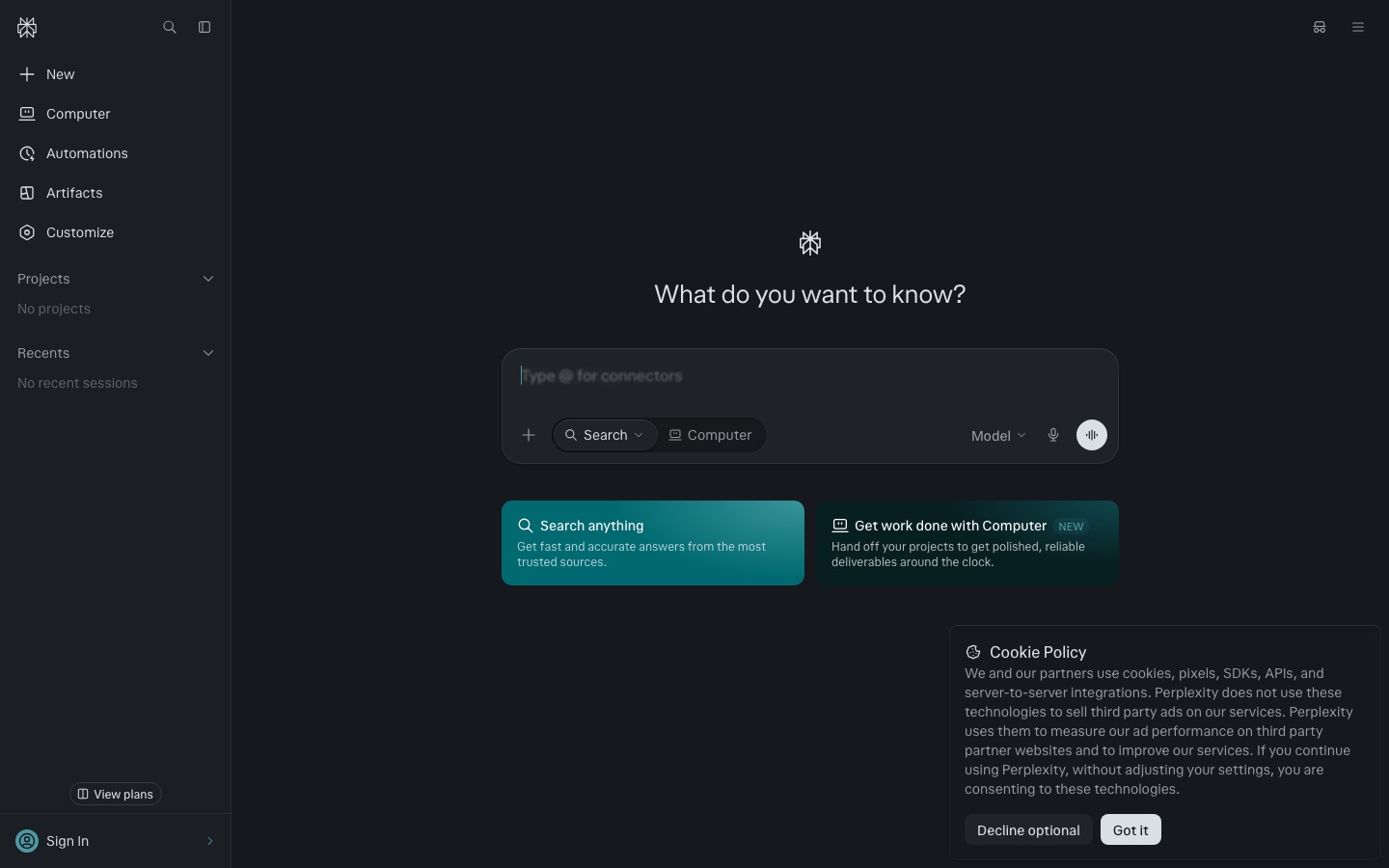
Around that core, Perplexity has built a full product: deeper search modes, a long-form Research mode, a choice of models, tools that create files and apps, persistent Projects, the Comet browser and the Computer agent. If you want a step-by-step walkthrough, our how to use Perplexity AI guide covers the basics.
Key features in 2026
Search and Pro Search
Standard search is unlimited on every plan and handles most everyday questions. Pro Search runs multiple searches, reasons about what it finds and returns longer answers with more sources. According to the help center, Pro answers include 10x as many citations, and Pro Search is applied automatically up to your plan's limit. Free users get 3 Pro Searches a day; Pro and Max have weekly limits described as "average" and "advanced" use rather than a fixed number.
Research mode
Research mode is Perplexity's deep research feature. It runs dozens of searches, reads hundreds of sources and refines its plan as it learns, then writes a structured report. Most tasks finish in under three minutes, though a full response can take four to five. You can export the report to PDF or a document, or turn it into a shareable Perplexity Page. Research picks its own models, so you cannot choose one. Free users get one Research query a month; limits on paid plans reset on a rolling basis rather than on your billing date.
Model picker and Model Council
Paid plans let you choose the model behind each answer. As of October 27, 2026, Perplexity's model list gives Pro users GPT-6.1 Sol, Claude Sonnet 5.5, Gemini 3.8 Flash, Grok 4.7, Kimi K3, GLM 5.3 and NVIDIA's Nemotron 3.5 Super VL. Max adds the frontier tier: GPT-6 Astra, Gemini 4 Argon, Claude Opus 5.5 and Claude Fable 5.1. A Best mode picks a model automatically and has no quota.
Model Council sends one question to three frontier models (by default one each from Anthropic, OpenAI and Google), then a synthesizer writes a single answer showing where they agree and differ. It is a genuinely useful way to catch one model's blind spots. On the web and iOS it is limited to Max and Enterprise Max, with a monthly cap. Inside Computer, any paid plan can run a council of two to eight models, paid in credits.
Create files and apps
Formerly called Labs, Perplexity's creation tools turn a research task into a report, spreadsheet, dashboard, presentation or simple web app. They are not on the free plan. Pro gets monthly access for average use and Max gets more, with Max running these tasks on stronger models. Results are good for first drafts of research deliverables, less polished than ChatGPT's Work agent for finished documents.
Perplexity Computer
Computer is Perplexity's autonomous worker. It runs in an isolated cloud environment, does parallel web research, builds documents, presentations and working apps, manages email, connects to tools such as Gmail, Outlook, GitHub, Slack, Notion and Salesforce, and runs scheduled background tasks like a morning briefing. It routes subtasks to different models and keeps memory across sessions.
Computer runs on credits, where 100 credits equal $1. Perplexity's credits guide estimates 15 to 70 credits for a quick fact, 350 to 950 for a multi-step research report, 2,400 to 9,800 for a data dashboard and 15,000 or more for a full app. Max includes 10,000 credits a month. Pro includes no monthly credits but gets a weekly Computer allowance that is used first. New subscribers get one-time bonuses (4,000 credits on Pro, 35,000 on Max) that expire after about 30 days. Monthly credits do not roll over.
Brain, a research preview for Max and Enterprise Max, is a memory system for Computer. It reviews your sessions, files and corrections and writes what it learns into memory, with each entry linked to its source so you can check or edit it. You can switch it off in settings.
Comet browser
Comet is Perplexity's Chromium-based browser for Windows and Mac. It uses Perplexity as its search engine and adds an assistant that can summarize the page, compare tabs, answer questions about your Gmail and calendar, manage tabs with plain-language commands and complete multi-step tasks on websites. It supports most Chrome extensions and has a built-in ad blocker. Assistant queries are metered by plan, and running the assistant in Work mode uses Computer credits. Our Comet browser review and best AI browsers guide go deeper.
Projects, memory and files
Projects are persistent, shareable workspaces where you keep files, instructions and threads for one topic; paid plans allow up to 50 files per Project. Memory lets Perplexity remember your preferences across searches. You can upload PDFs, spreadsheets, images, audio and video and ask questions about them, with higher upload limits on paid plans.
Images and video
Pro and Max include image generation; the free plan does not. Video generation is limited: the Pro help article mentions limited video access, while Perplexity's plan comparison lists video (15 eight-second clips with audio a month) only on Enterprise Max. Treat Perplexity as a research tool, not a creative studio. For visuals, a dedicated generator is a better buy.
Perplexity pricing: what each plan really gets (as of October 2026)
Figures come from Perplexity's plan comparison and its Max help article. US prices.
| Plan | Price | What you really get |
|---|---|---|
| Free | $0 | Unlimited basic search, 3 Pro Searches/day, 1 Research query/month, no model picker, no image generation or file creation |
| Pro | $20/mo or $200/yr | Weekly Pro Search limits, monthly Research and creation limits, model picker without the frontier tier, image generation, weekly Computer usage, Comet Assistant queries |
| Education Pro | $10/mo (verified students and educators) | Everything in Pro plus Computer access and Learn Mode |
| Max | $200/mo or $2,000/yr | Highest limits, GPT-6 Astra, Gemini 4 Argon, Claude Opus 5.5 and Fable 5.1, Model Council, 10,000 Computer credits/mo, Brain preview, top Comet limits |
| Enterprise Pro | $40/seat/mo or $400/seat/yr | 400 Pro Searches/week, 50 Research queries/month, 500 credits/mo, seat management, data never used for training |
| Enterprise Max | Check with Perplexity | 4,000 Pro Searches/week, 500 Research queries/month, 15,000 credits/mo, video generation, SCIM, audit logs, retention controls |
Is Perplexity Pro worth it? For daily researchers, yes. $20 buys deeper search, Research mode, a choice of strong models and Comet Assistant access, and the annual plan works out to about $16.67 a month. Is Max worth $200? Only if you need the frontier models, Model Council or heavy Computer use. Note that Pro no longer includes the top models from OpenAI, Google and Anthropic; they moved to Max.
Pros and cons
Pros
Citations by default. Every answer shows its sources inline, which makes checking claims fast.
Fresh information. Answers are grounded in live search, so prices, news and specs are current.
Many models in one plan. Pro covers OpenAI, Anthropic, Google, xAI and open models.
Research mode is quick. Reports usually arrive in a few minutes, with exports.
Strong free tier for basic search. Standard search is unlimited at $0.
Cheap annual Pro and a $10 education plan.
Cons
Frontier models are Max only. GPT-6 Astra, Gemini 4 Argon, Opus 5.5 and Fable 5.1 need the $200 plan.
Vague limits. Pro and Max limits are described as average or advanced use, not numbers.
Computer credits add up. Dashboards and app builds can cost thousands of credits.
Weaker at long-form writing and back-and-forth editing than ChatGPT or Claude.
Citations are not proof. It sometimes cites a real page for a claim the page does not make.
Training is on by default for Free, Pro and Max until you switch it off.
Limitations and common complaints
Accuracy and citation errors
Perplexity makes checking easy, not mistakes impossible. In a March 2025 study by Columbia Journalism Review's Tow Center, Perplexity had the lowest error rate of eight AI search tools at identifying news sources, yet still got 37 percent of queries wrong. Models have improved since, but users still report answers that misread a source or lean on low-quality pages. For statistics, quotes and medical, legal or financial facts, click through and read.
Usage limits and model throttling
The most common complaint from paying users is uncertainty about limits. The help center says advanced model access "may be limited during weeks of especially heavy usage", and Research limits refill gradually on a rolling window. Power users who hit the ceiling often feel pushed toward Max.
Credit costs and agent reliability
Computer is impressive but metered. A spending cap (default $200 a month on Max) protects you from runaway tasks, and tasks pause rather than fail when credits run out. Like every browser and cloud agent, it can be tricked by prompt injection hidden in web pages, so do not let it act on banking or admin accounts unattended.
Publisher disputes and privacy
Perplexity has faced lawsuits and criticism from news publishers over how it uses their content, which matters if you care where your answers come from. On privacy, the AI Data Retention setting is on by default for Free, Pro and Max; Perplexity's data collection page explains how to turn it off under Preferences, and opting out only covers data collected afterward. Enterprise data is never used for training.
Perplexity vs the alternatives
ChatGPT: the better all-purpose assistant for writing, files, images and coding, with Deep Research and the Work agent. Perplexity wins on transparent sourcing. See our full Perplexity vs ChatGPT comparison.
Google Gemini: free Deep Research, Google Search underneath and native Gmail and Docs integration; AI Pro at $19.99 includes 5 TB of storage. Better if you live in Google apps.
Claude: stronger writing and long-document analysis, with web search and Research, but less focused on fast cited lookups.
You.com: another search-first assistant with research tools and developer APIs.
Consensus and Elicit: better than Perplexity for peer-reviewed papers and literature reviews.
Developers who want Perplexity-style search inside their own apps should read our Exa vs Tavily vs Perplexity API comparison, and our best AI research tools guide covers the wider field.
Who should use Perplexity
Students: Education Pro at $10 is excellent for finding and citing sources, as long as you read them.
Analysts and consultants: Pro Search and Research mode cut hours of desk research; Max adds Model Council for high-stakes questions.
Marketers and SEO teams: fast competitor, product and trend research with links you can verify.
Journalists and writers: a quick first pass on facts, followed by primary-source checks.
Operators automating work: Computer and scheduled tasks, if you budget for credits.
Skip it if: you mostly write, edit or code. A general assistant is a better $20.
FAQ
Is Perplexity AI worth it?
Yes, if you search and research daily. The free plan is enough for casual fact-finding, and Pro at $20 a month adds Pro Search, Research mode, a model picker and image generation. If you mostly write or code, a general assistant like ChatGPT or Claude is a better use of $20.
Is Perplexity Pro better than ChatGPT Plus?
For research with sources, Perplexity Pro is better: every answer is grounded in live search with inline citations. For writing, file analysis, images, agents and coding, ChatGPT Plus is better. Both cost $20 a month, so pick based on whether finding information or working with it takes more of your time.
Is Perplexity accurate?
It is among the more accurate AI search tools, but not reliable enough to trust blindly. In a 2025 Columbia Journalism Review test it had the lowest error rate of eight tools, yet still misidentified sources in over a third of queries. Its strength is that citations make errors easy to spot, so always click through for important facts.
What is the difference between Perplexity Pro and Max?
Pro costs $20 a month and covers deeper search, Research, file creation, image generation and models like GPT-6.1 Sol and Claude Sonnet 5.5. Max costs $200 a month and adds the frontier models (GPT-6 Astra, Gemini 4 Argon, Claude Opus 5.5 and Fable 5.1), Model Council, 10,000 Computer credits a month and the highest limits.
Is Perplexity free?
Yes. The free plan includes unlimited standard searches, three Pro Searches a day and one Research query a month, and the Comet browser is free to download. The model picker, image generation, file and app creation and higher limits require Pro, or Education Pro at $10 a month for verified students.
What is Perplexity Computer?
Perplexity Computer is a cloud agent that completes multi-step tasks: research, documents, presentations, apps, email and scheduled jobs. It connects to tools like Gmail, Slack and GitHub and runs on credits, where 100 credits cost $1. Max includes 10,000 credits a month; Pro gets a weekly allowance instead.
Does Perplexity use my data for training?
On Free, Pro and Max, the AI Data Retention setting is on by default, so some data may be used to improve models. You can switch it off under Account settings, then Preferences; it applies to data collected after the change. Enterprise data is never used for training.
Final verdict
Perplexity is the best AI answer engine in 2026 and the right tool for anyone whose job starts with finding and checking information. The free plan covers casual use, and Pro at $20 is good value for daily researchers. Max is for power users who want frontier models, Model Council and heavy Computer use. Its weak spots are long-form writing, vague limits and a growing reliance on paid credits. Use it alongside a general assistant rather than instead of one, and keep clicking those citations.
Find more tools like this in the AI research category and the AI agents category. If you build an AI research tool we have missed, you can submit it for a listing.