Best AI Customer Service Tools (2026): 12 Picks for Chat, Email and Phone
The best AI customer service tools in 2026 resolve routine questions on their own and hand the rest to people with context attached. Tidio leads for small businesses, HubSpot's Customer Agent for HubSpot users, and Robylon for agents that take real actions across channels. Here are 12 picks with current pricing.
The best AI customer service tools for most small and midsize businesses in 2026 are Tidio (live chat plus the Lyro AI agent), HubSpot Breeze if your customers already live in HubSpot, and Robylon if you want an AI agent that looks up orders and takes action across chat, email, WhatsApp and voice. For phone support, echowin and Kalyvox answer calls around the clock, and Sapling helps human agents reply faster inside the helpdesk you already use.
AI customer service software has moved from scripted chatbots to agents that resolve requests, and pricing moved with it: many vendors now charge per resolution or per conversation rather than per seat. This guide ranks 12 tools by the support job they do best, based on official pricing pages, documentation and public user feedback as of October 2026, not hands-on testing. We also cover two big helpdesk options, Intercom's Fin and Zendesk, that are not in our directory yet.






Quick picks: the best AI customer service tool for each job
Best for small businesses and online stores: Tidio, with live chat, a shared inbox and Lyro AI.
Best for HubSpot users: HubSpot Breeze, whose Customer Agent answers from your CRM history.
Best AI agent that takes actions: Robylon, across chat, email, WhatsApp and phone.
Best budget website chatbot: ChatbotsAI, with a free plan and a built-in CRM.
Best custom chatbot builder: re:tune, for branded bots trained on your files.
Best for Instagram and WhatsApp DMs: Manychat.
Best AI voice and chat agents: echowin, pay as you go per minute.
Best AI phone receptionist for small businesses: Kalyvox.
Best agent assist for human teams: Sapling, inside Zendesk, Salesforce and more.
Best for high-volume multilingual calls: DialNexa.
All picks at a glance
Prices are list prices as of October 2026. Usage-based tools bill on conversations, credits or minutes, so your real cost depends on volume.
| Tool | Best for | Free plan | Starting price |
|---|---|---|---|
| Tidio | SMB live chat and AI | Yes, 50 conversations | Starter $24.17/mo; Lyro from $32.50/mo |
| HubSpot Breeze | CRM-aware Customer Agent | Free CRM, up to 2 users | Service Hub Starter per seat; agents use credits |
| Robylon | Action-taking AI agents | Yes, 300 credits/mo | Pro $25/mo ($22 yearly) |
| ChatbotsAI | Budget website chatbot | Yes, 100 messages/mo | Starter $29/mo |
| re:tune | Custom branded bots | Yes, Hobby plan | Check the official page |
| Manychat | Social DM automation | Yes | Priced by contacts (check site) |
| echowin | Voice and chat agents | Free to build and test | $0.20 per minute |
| Kalyvox | AI phone receptionist | 7-day trial | $95/mo plus per-minute usage |
| Sapling | Agent assist in the helpdesk | Yes | Pro $25/mo ($12 annual) |
| Zapier AI | Ticket routing and automation | Yes | From $19.99/mo |
| Lindy | AI employee for support tasks | Trial credits | From about $49/mo (check site) |
| DialNexa | Multilingual call volume | No | Pay as you go |
How to choose AI customer service software
Start with your channels. Website chat, email, WhatsApp, social DMs and phone need different tools. Most support volume for small stores is chat and email; local service businesses lose the most to missed calls.
Decide whether you are replacing or adding. If you already run Zendesk, HubSpot or Freshdesk, an add-on agent or your helpdesk's own AI is usually faster to deploy than switching platforms.
Check what the AI can do, not just say. Answering from help articles is table stakes. Looking up an order, issuing a refund or changing a booking requires integrations, so ask which systems it connects to.
Model the pricing on your volume. Per-resolution pricing (around $1 to $2 per resolved conversation at the big helpdesks) is cheap at low volume and expensive at high volume. Per-minute voice pricing works the same way.
Insist on a clean handoff. The best tools say when they are unsure and pass the conversation to a person with the history attached, instead of trapping customers in a loop.
AI chat and helpdesk platforms
1. Tidio: best for small businesses and online stores
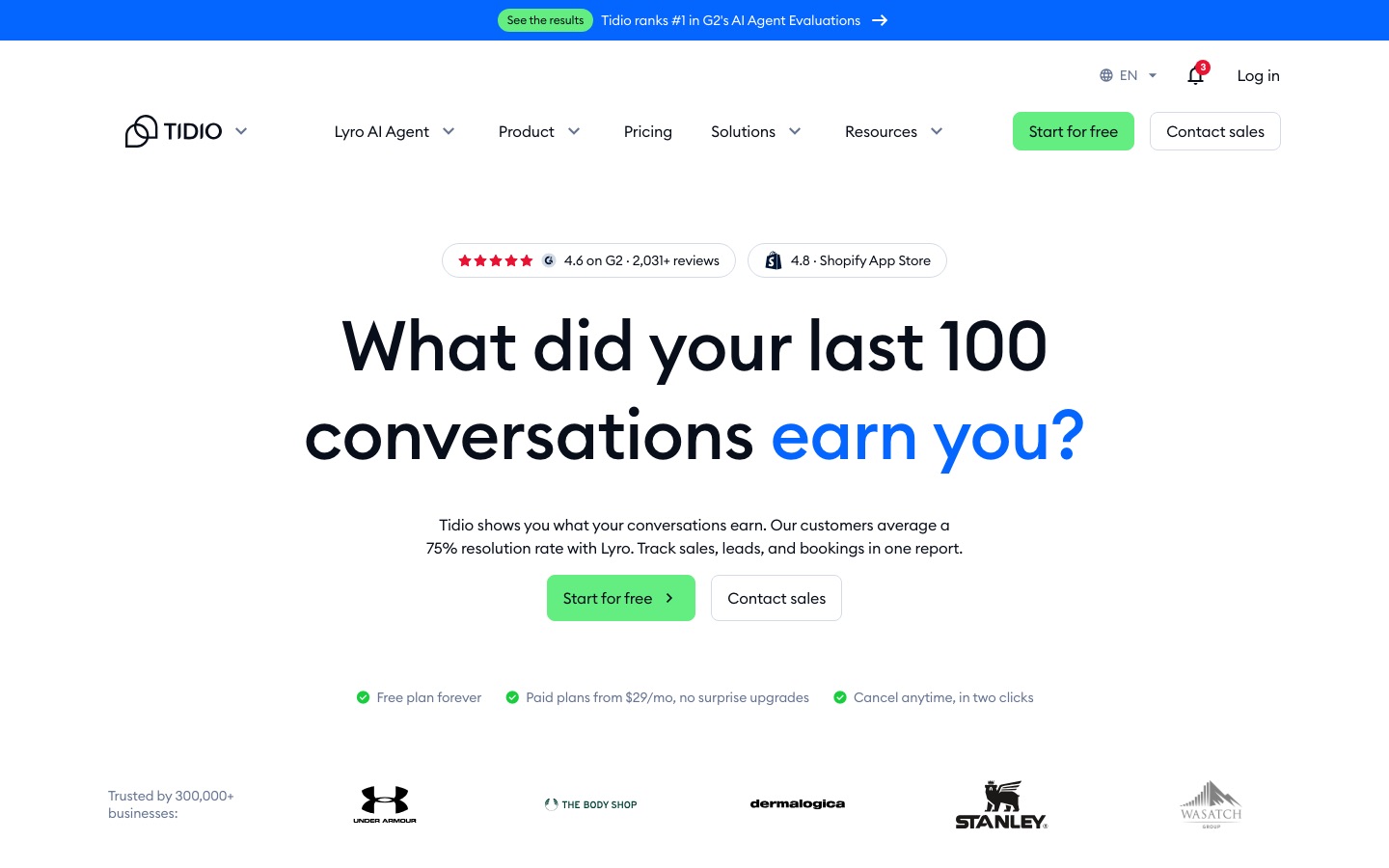
Tidio pairs live chat and a shared inbox with Lyro, an AI agent that answers from your website, help center and product data. Smart Actions let Lyro check order status or qualify leads by connecting to other systems, it detects each customer's language across chat and email, and the inbox brings in email, Instagram, Messenger and WhatsApp with one history per customer. More than 120 integrations include Shopify, WordPress and Wix.
Per the Tidio pricing page, the Free plan covers 50 billable conversations and a one-time 50 Lyro conversations. Starter is $24.17 a month, Growth starts at $49.17, and Plus starts at $300 a month plus usage. Lyro is an add-on from $32.50 a month for 50 conversations, and the Premium tier guarantees a 50% Lyro resolution rate with pay-per-resolution billing.
Pros: easy setup; strong ecommerce templates; Lyro hands off honestly when unsure.
Cons: Lyro is billed separately and conversation caps rise quickly with traffic.
Best for: Shopify and WooCommerce stores and service businesses without a support team.
2. HubSpot Breeze Customer Agent: best for HubSpot users
HubSpot Breeze includes a Customer Agent that resolves common questions around the clock using your knowledge base plus real contact and contract history from the HubSpot CRM. Because it sits in Service Hub, escalations land in the same ticket inbox your team already uses, and a data agent can answer questions about any customer from their calls, emails and documents.
The Service Hub pricing page lists a free plan for up to two users, then Starter, Professional (from $90 per seat a month plus a $1,500 onboarding fee) and Enterprise (from $150 per seat plus $3,500). The Customer Agent runs on HubSpot Credits, which cost $0.01 each beyond the monthly allowance (500 on Starter, 3,000 on Professional, 5,000 on Enterprise), and buying a Professional or Enterprise seat includes 14 days of free Customer Agent access.
Pros: answers with full customer context; one platform for marketing, sales and service.
Cons: credit usage takes planning; onboarding fees make Professional a real commitment.
Best for: SMB and mid-market companies already running on HubSpot.
3. Robylon: best AI agent that takes actions
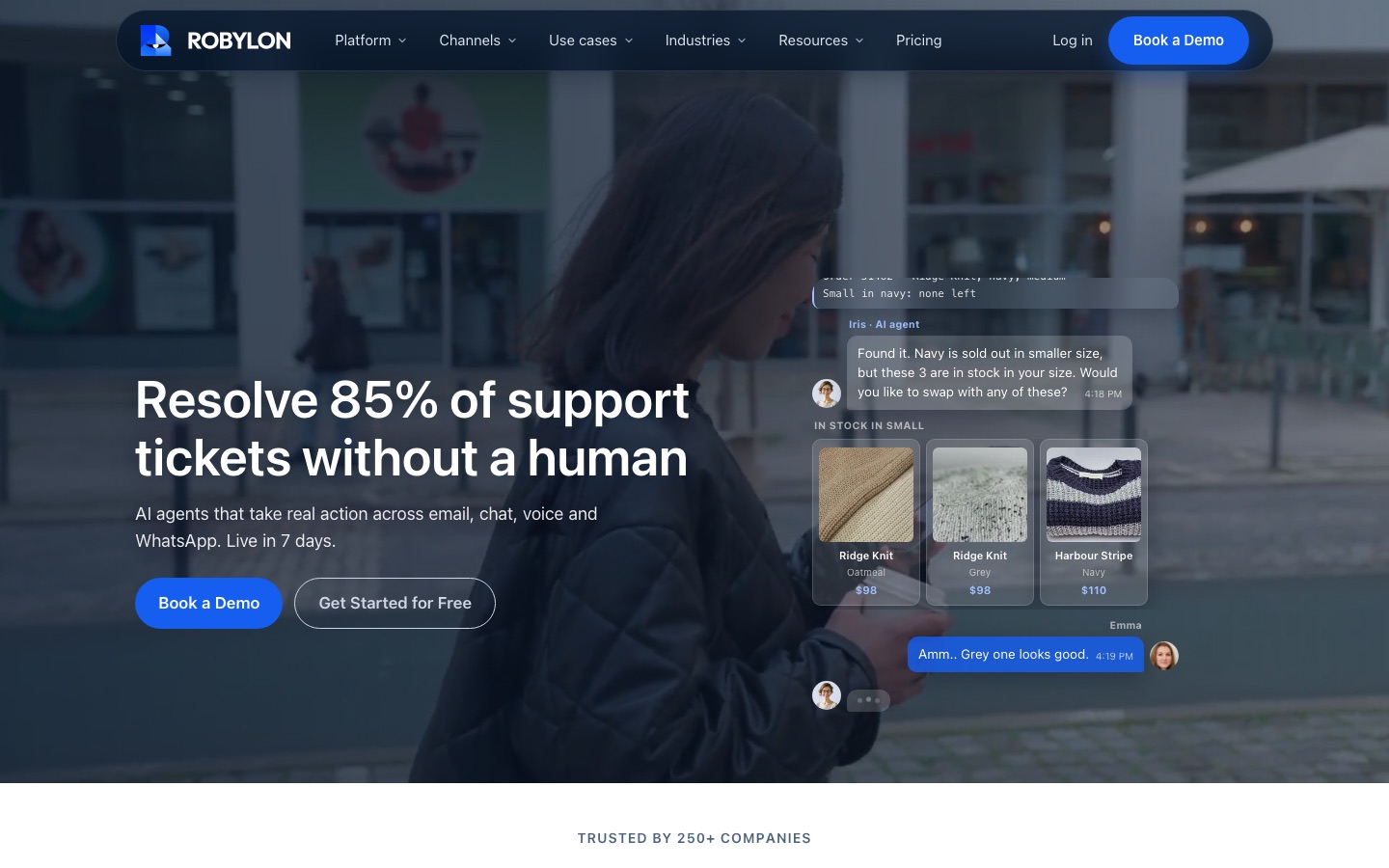
Robylon is built around doing, not just answering. Its agents connect to the systems where order, billing and account data live, so they can process a swap, check a refund or fix a subscription, then hand unresolved cases to a person with the checks already done. It covers chat, email, WhatsApp and voice, and integrates with Zendesk, Freshdesk, Zoho Desk, Slack and Microsoft Teams, so you can keep your helpdesk.
The Robylon pricing page lists a free Starter plan (300 credits, about 40 conversations, chat widget only), Pro at $25 a month ($22 yearly) with WhatsApp, email and ticketing, Business at $180 a month ($162 yearly) adding voice calls, and custom Enterprise.
Pros: real actions, not just answers; works alongside existing helpdesks; low entry price.
Cons: credits scale with volume; voice needs the Business plan.
Best for: ecommerce, SaaS and fintech teams automating repetitive tickets.
4. ChatbotsAI: best budget website chatbot
ChatbotsAI is a no-code builder for chat agents trained on a website crawl, documents, URLs and custom Q&A pairs. It deploys with one line of code, lets visitors upload photos for the bot to analyze, hands off to humans and includes a light CRM with a deal pipeline. Per its pricing page, Free includes 100 messages a month, Starter is $29 a month for 2,000 messages, Pro $79 for 10,000 and Agency $199 for 50,000.
Pros: cheap; many ways to feed knowledge; CRM included.
Cons: fewer deep integrations than Tidio or Robylon.
Best for: small businesses and agencies that want a support or sales bot fast.
5. re:tune: best custom chatbot builder
re:tune is a general no-code workshop for AI chatbots and agents. You connect website crawls and files, design behavior in a visual builder and publish a custom widget, with long-term memory on paid plans and white-label branding and custom domains at the top tier. A free Hobby plan exists for testing; our listing notes that its homepage and pricing page show different tier names and prices, so confirm at checkout.
Pros: flexible for support, sales or internal knowledge bots; white-label options.
Cons: more setup than a dedicated support tool; pricing is unclear.
Best for: agencies and builders who want branded bots for clients.
6. Manychat: best for Instagram and WhatsApp DMs
Manychat automates conversations in Instagram DMs, WhatsApp, Messenger, TikTok and SMS. Its AI recognizes intent in free-text messages and helps build flows, so common questions about shipping, sizing or booking get answered in the channel customers actually use. Pricing grows with active contacts; Manychat's pricing page blocked our reader, so check the official page.
Pros: best-in-class social channel coverage; visual flow builder.
Cons: built for marketing first, so ticketing and helpdesk features are light.
Best for: creators, DTC brands and local businesses whose customers message on social.
AI phone and voice support
7. echowin: best AI voice and chat agents
echowin lets you define an agent in plain English (how to greet callers, what to ask, when to transfer), then deploy it on phone numbers, website chat and WhatsApp. It connects tools, webhooks and an API, and tracks sentiment and an agent health score. Per the echowin pricing page, conversation time costs 20 cents a minute, with cheaper effective rates on minute bundles and free building and testing.
Pros: one agent across voice, chat and WhatsApp; simple usage pricing; white-label for agencies.
Cons: per-minute costs add up for long calls; set a spending cap.
Best for: local service businesses, multi-location operators and agencies.
8. Kalyvox: best AI phone receptionist for small businesses
Kalyvox picks up calls on your existing number, asks your screening questions, transfers to staff or takes messages and books appointments into your calendar. You choose whether it answers every call, only unanswered calls or only after hours, and a test mode lets you hear it first. Plans start at $95 a month for Solo plus per-minute usage, with Pro and Business tiers adding users and SMS alerts, and a 7-day trial with no card.
Pros: flexible answer modes; built for trades, clinics and law offices.
Cons: monthly fee plus usage; no included minutes listed.
Best for: small businesses where a missed call is a lost job.
9. DialNexa: best for high-volume multilingual calls
DialNexa runs inbound and high-concurrency outbound voice agents for support, collections and lead qualification. The company says it supports more than 70 languages with strong Indian language and Hinglish coverage, and it connects to CRMs, helpdesks, WhatsApp and webhooks. A pay-as-you-go plan has no minimum commitment.
Pros: built for scale; strong in Indian markets.
Cons: less suited to tiny call volumes; pricing details by request.
Best for: CX and collections teams handling thousands of calls.
AI for human support teams and workflows
10. Sapling: best agent assist inside your helpdesk
Not every team wants a bot talking to customers. Sapling helps human agents instead, with suggested responses, autocomplete, shared snippets and grammar fixes inside Zendesk, ServiceNow, Salesforce, Amazon Connect, Twilio Flex and Gmail. Per the Sapling pricing page, Free covers basic suggestions and 20 snippets, Pro is $25 a month or $12 billed annually, and Enterprise starts at 10 seats at $15 per seat with self-hosting, SSO and team analytics.
Pros: keeps humans in control; consistent tone across a team; PII redaction on Enterprise.
Cons: does not resolve tickets on its own.
Best for: support teams in regulated industries or with complex, high-touch tickets.
11. Zapier AI and Lindy: best for automating support workflows
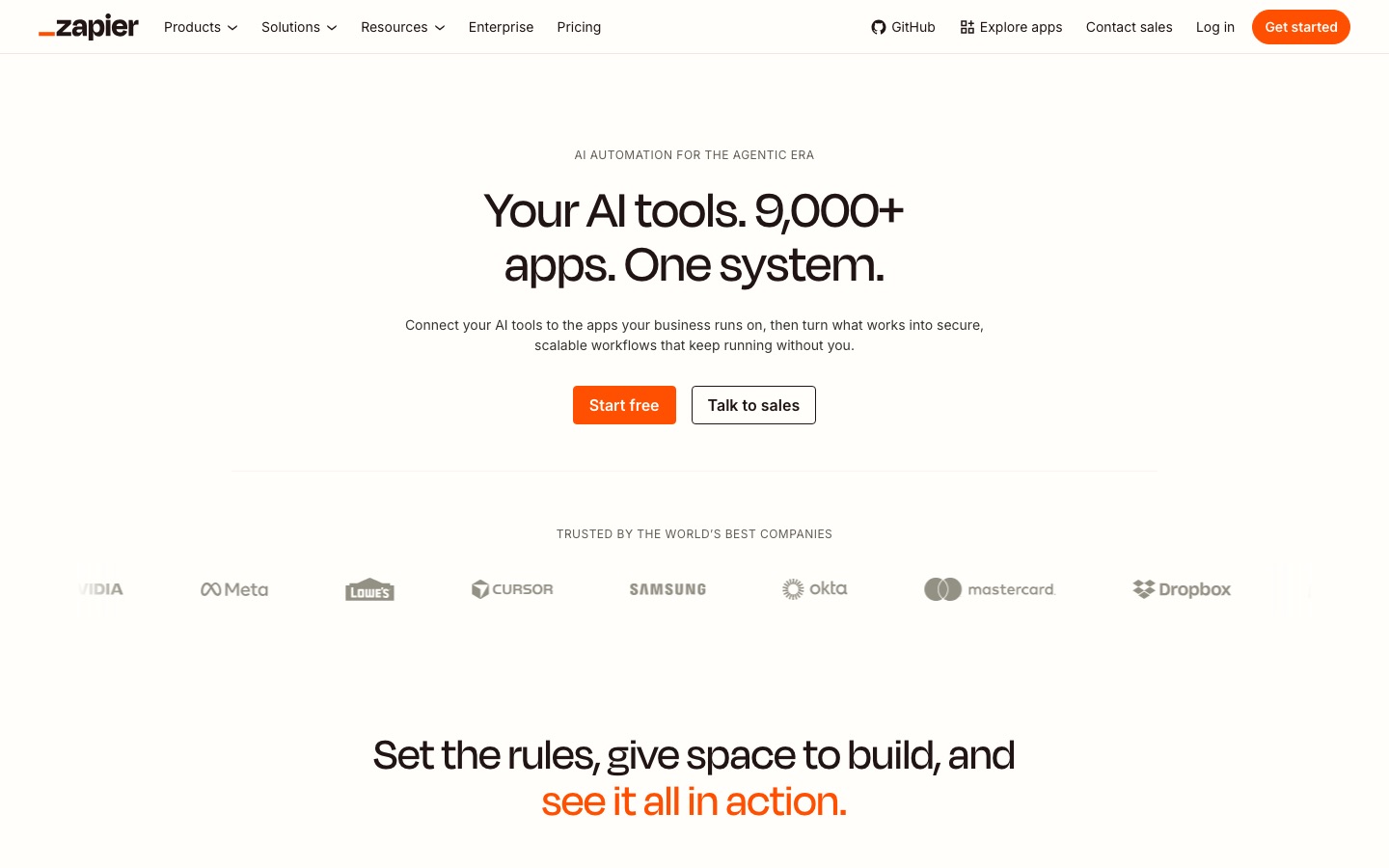
Much of support work happens around the conversation: tagging, routing, updating records and following up. Zapier AI agents run in the background across more than 9,000 apps to triage and route tickets, with every action logged; plans start free, with paid tiers from $19.99 a month. Lindy offers no-code "AI employees" with roles for customer support, inbox triage and call answering, with approvals before anything is sent.
If you prefer to build your own, our guides to n8n vs Zapier vs Make and building an AI agent with n8n show how.
Also consider: Intercom Fin and Zendesk AI
Two of the most common enterprise choices are not in our directory yet, but you should know their pricing:
Intercom Fin: per the Fin pricing page, $0.99 per outcome (such as a resolution or a handoff), with a 50-outcome monthly minimum on the plan that works with other helpdesks, including Salesforce, HubSpot, Freshworks, Zoho and Gorgias.
Zendesk: per the Zendesk pricing page, Suite Team is $55 and Suite Professional $115 per agent a month on annual billing. AI agents are included and billed on automated resolutions: 5 per agent a month on Team and 10 on Professional, then $1.50 each committed or $2.00 pay as you go.
Both make sense once you have a dedicated support team and thousands of conversations a month. Below that, Tidio or Robylon is usually cheaper.
Best free AI customer service tools
Tidio Free: 50 conversations and 50 one-time Lyro conversations.
Robylon Starter: 300 credits a month, about 40 AI conversations.
ChatbotsAI Free: 100 messages a month.
HubSpot Breeze: free CRM and help desk basics for two users.
Sapling Free: basic reply suggestions for human agents.
For more tools that help a lean team, see the best AI tools for small business and our roundup of the best AI agents.
Setup tips that raise resolution rates
Fix your knowledge base first. AI agents are only as good as the articles they read. Add your returns policy, shipping times, pricing and top 20 questions before launch.
Start with one channel. Launch on website chat, review transcripts for two weeks, then add email, WhatsApp or voice.
Review unanswered questions weekly. Most tools report what the AI could not answer; each gap is a missing article.
Tell customers it is AI. Clear disclosure and an easy route to a human build trust, and some regions require it.
FAQ
What is the best AI for customer service?
For small businesses, Tidio with Lyro is the easiest all-round choice, with live chat, a shared inbox and an AI agent from about $25 a month plus Lyro usage. HubSpot users should start with the Breeze Customer Agent. Larger support teams usually choose Intercom Fin or Zendesk's AI agents, which bill per resolution.
Can AI replace customer service agents?
AI can resolve a large share of routine questions, such as order status, returns and password resets, but not everything. Complaints, complex billing issues and upset customers still need people. Most teams use AI to handle repetitive volume and give human agents more time for the conversations that affect loyalty.
Is there a free AI chatbot for customer service?
Yes. Tidio, Robylon, ChatbotsAI and re:tune have free plans, and HubSpot offers a free CRM with basic help desk features. Free tiers cap conversations or messages, typically 50 to 100 a month, so they suit testing or very small sites rather than steady traffic.
How much does AI customer service cost?
Small business chat tools start around $25 to $30 a month plus AI usage. Helpdesk AI agents typically cost about $1 to $2 per resolved conversation, for example $0.99 per outcome for Intercom Fin and $1.50 to $2.00 per extra automated resolution at Zendesk. AI phone agents usually charge per minute, around $0.20.
What is the difference between a chatbot and an AI agent?
A traditional chatbot follows scripted flows and buttons. An AI agent understands free-text questions, answers from your knowledge base and can take actions in connected systems, such as checking an order or updating a booking. Most modern tools blend both: flows for predictable journeys, AI for everything else.
Which AI tool answers business phone calls?
echowin, Kalyvox and DialNexa all run AI voice agents. Kalyvox suits small businesses that want a receptionist on their existing number with appointment booking. echowin charges about 20 cents a minute and covers phone, chat and WhatsApp. DialNexa targets high call volumes and Indian languages.
Bottom line
Pick by channel and stack. Tidio is the fastest win for small businesses and online stores, HubSpot Breeze is the natural choice for HubSpot customers, and Robylon stands out when you need an agent that takes real actions. Add echowin or Kalyvox if missed calls cost you business, and Sapling if you want AI to help your people rather than replace the first reply. Whatever you choose, invest in your help content first: it decides how much the AI can resolve.
Browse every AI support, chatbot and voice agent tool we track in the AI business tools category and the AI agents category. Building a customer service tool we have missed? Submit it for a listing.