Best AI Sales Tools (2026): 12 Picks for Prospecting, Outreach and Deals
The best AI sales tools in 2026 cover four jobs: finding leads (Apollo, Clay), sending outreach that lands (Instantly, Smartlead, lemlist), running the CRM (HubSpot, Pipedrive) and learning from calls (Gong, Sybill). Here are 12 picks with current pricing, free plans and who each one suits.
The best AI sales tools for most teams in 2026 are Apollo.io for an all-in-one prospecting database with sequences, Clay for research and enrichment, and HubSpot Breeze if you want AI agents inside your CRM. Add Instantly or Smartlead when cold email volume is the job, and Gong or Sybill when you need to learn from every sales call.
Almost every vendor now sells an "AI SDR" agent on credit-based pricing, which makes plans hard to compare. This guide ranks 12 AI tools for sales by the job they do best, based on official pricing pages, product documentation and public user feedback as of October 2026, not hands-on testing. Each pick links to its full listing in our AI tools directory.





Quick picks: the best AI sales tool for each job
Best all-in-one for small teams: Apollo.io, with a contact database, sequences, dialer and AI agents in one plan.
Best for research and enrichment: Clay, with 150+ data providers and AI research agents.
Best AI CRM: HubSpot Breeze, with prospecting, deal and data agents on top of HubSpot.
Best simple CRM with AI: Pipedrive, with win odds and next-step suggestions.
Best for cold email at scale: Instantly, with unlimited sending accounts and warmup.
Best for agencies running many clients: Smartlead.
Best multichannel outreach: lemlist, mixing email, LinkedIn, calls and WhatsApp.
Best email writing coach: Lavender, which scores every draft as you type.
Best revenue intelligence for larger teams: Gong.
Best call assistant for reps: Sybill, with follow-ups and CRM autofill.
Best AI dialer: Nooks, for phone-first SDR teams.
Best hands-off AI SDR: Reply.io with its Jason AI agent.
All 12 AI sales tools at a glance
Starting prices are list prices as of October 2026. Sales software prices change often and many vendors discount annual plans, so confirm on each official page before you buy.
| Tool | Best for | Free plan | Starting price |
|---|---|---|---|
| Apollo.io | Data plus sequences in one tool | Yes, Gmail sending only | Basic from $49/user/mo |
| Clay | Enrichment, research, signals | Yes, 100 data credits/mo | Launch $185/mo ($167 annual) |
| HubSpot Breeze | AI agents inside a CRM | Yes, up to 2 users | Sales Hub Starter, about $20/seat/mo |
| Pipedrive | Visual pipeline CRM | No, 14-day trial | Check the official page |
| Instantly | High-volume cold email | No | $47/mo ($37.60 annual) |
| Smartlead | Agencies, many mailboxes | No, trial available | $39/mo |
| lemlist | Multichannel sequences | No, 14-day trial | $69/user/mo ($55 annual) |
| Lavender | Writing better sales emails | Yes, 5 analyses/mo | $29/mo ($27 annual) |
| Gong | Revenue intelligence | No | Custom quote |
| Sybill | Call notes and follow-ups | Yes, 20 meeting summaries/mo | $36/user/mo ($30 annual) |
| Nooks | Parallel dialing and coaching | No | Custom quote |
| Reply.io | AI SDR and sequences | No, 14-day trial | From about $59/mo (check site) |
How to choose AI sales software
Most teams overspend because they buy three tools that do the same thing. Map your needs to these four layers first, then pick one tool per layer:
Data and prospecting: a database like Apollo covers standard B2B targeting; Clay is worth it for custom research and signals.
Outreach: cold email at volume needs deliverability tools (Instantly, Smartlead); LinkedIn and calls point to lemlist or Reply.io.
CRM and pipeline: if you already use HubSpot or Pipedrive, turn on their AI before buying a separate assistant.
Conversations: Gong suits managers who forecast and coach at scale; Sybill and Avoma suit reps who want notes and follow-ups done.
Two buying tips: model credits, not seats, since data lookups and AI actions are where bills grow, and warm new domains for two to three weeks before scaling cold email.
Prospecting and data tools
1. Apollo.io: best all-in-one AI sales tool for small teams
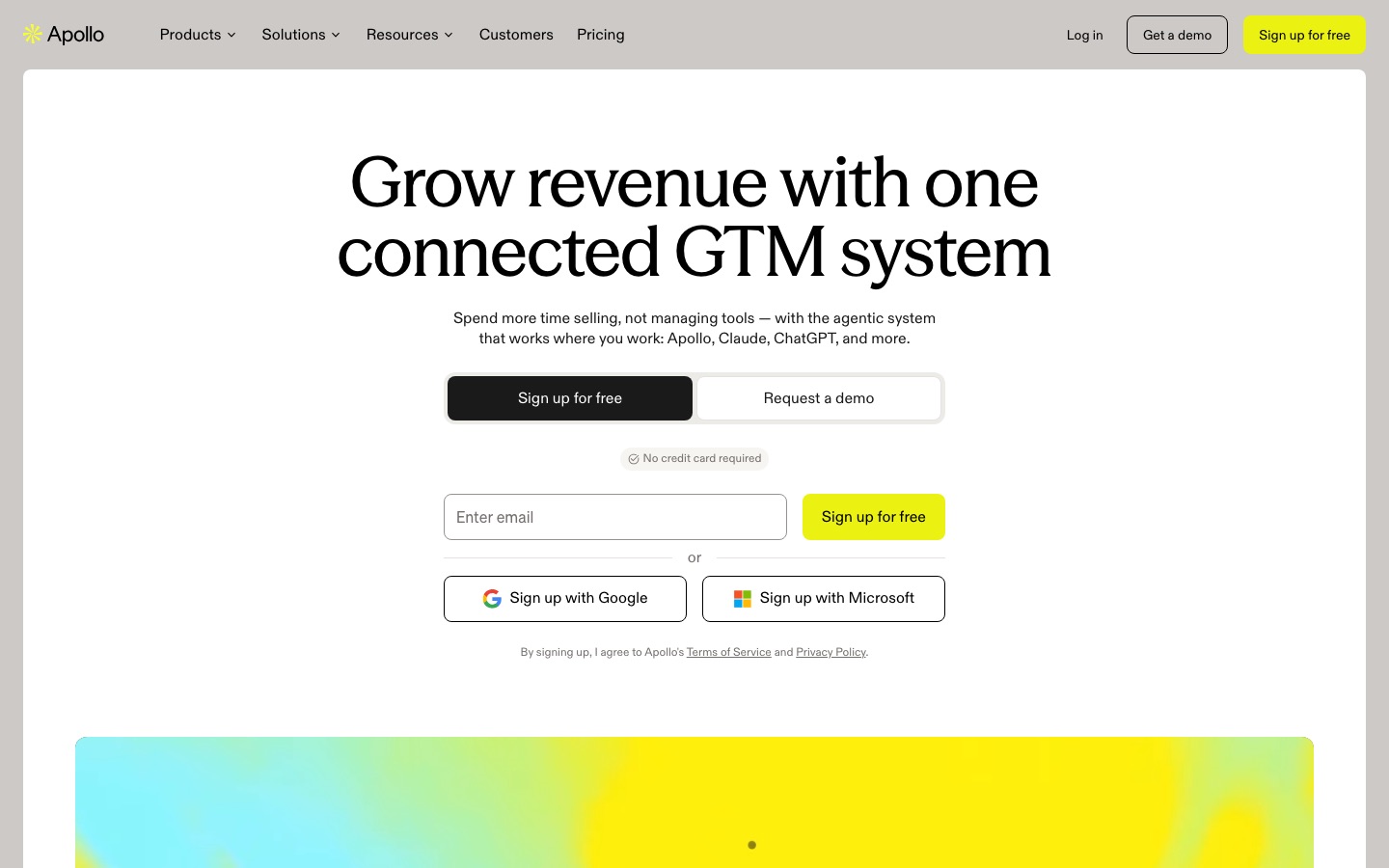
Apollo.io bundles the three things a small outbound team needs: a large B2B contact database, multichannel sequences and a dialer. Its AI layer adds an AI Context Center that learns your ideal customer profile, agents that research accounts and draft outreach, waterfall enrichment, and Apollo Anywhere, which brings its data into Gmail, your CRM and assistants like ChatGPT and Claude.
Per the Apollo pricing page, there is a free plan with no time limit (email campaigns from Gmail accounts only), then Basic, Professional and Custom tiers. As of October 2026, Basic starts at $49 per user per month and Professional is listed at $99, with lower rates on annual billing. Credits are shared and do not roll over.
Pros: data, sequences, dialer and call recording in one plan; generous free tier; strong integrations.
Cons: data accuracy varies by region and role; credits run out fast on phone numbers; all seats must be on the same plan.
Best for: startups, SMB sales teams and founders doing their own outbound.
Comparing Apollo with its closest rival? Read our Apollo vs Clay breakdown or the full list of Apollo.io alternatives.
2. Clay: best for AI research and enrichment
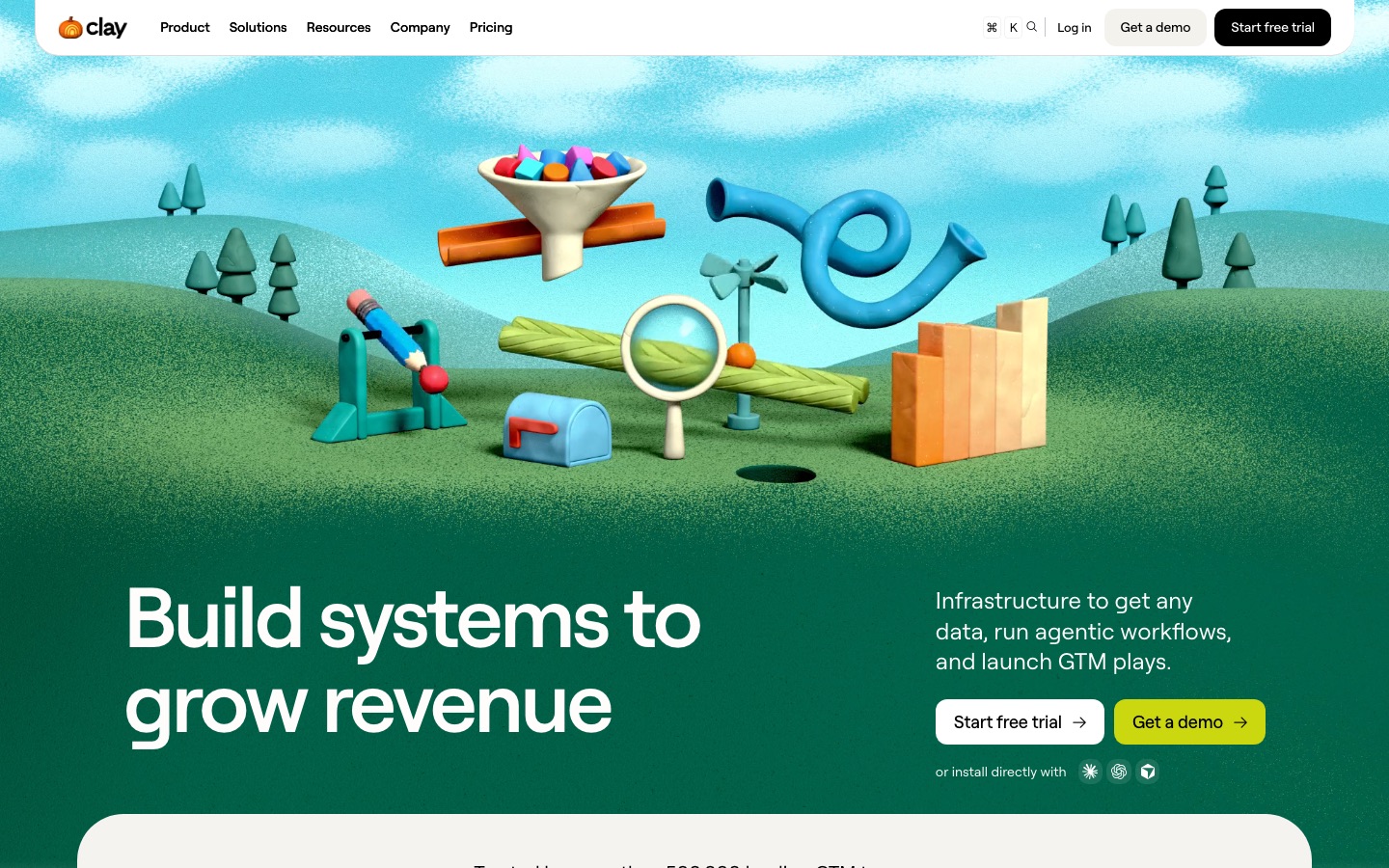
Clay is a spreadsheet-style workspace that pulls from more than 150 data providers and AI vendors under one contract. You build a table of accounts, then run waterfall enrichment, AI research agents ("find this company's pricing model"), scoring formulas and personalized first lines. Signals trigger workflows on job changes and hiring.
The Clay pricing page lists a Free plan (500 actions and 100 data credits a month, 200 rows per table), Launch at $185 a month ($167 annual), Growth at $495 a month ($446 annual) and custom Enterprise.
Pros: unmatched flexibility, best-in-class enrichment coverage, strong community templates.
Cons: steep learning curve; costs are hard to predict until you model credit usage; not an outreach tool on its own.
Best for: RevOps, growth teams and agencies that build custom outbound and inbound plays.
AI CRMs
3. HubSpot Breeze: best AI CRM
HubSpot Breeze is HubSpot's AI layer. Its agents now live in Agent Hub and work from your CRM data: a prospecting agent watches accounts for buying signals and drafts outreach, smart deal progression writes follow-ups and CRM updates after calls, a data agent answers questions about any contact or company, and you can build custom agents without code.
The HubSpot Sales Hub pricing page lists a free CRM for up to two users, Starter at about $20 per seat per month (less on annual billing), Professional at roughly $90 to $100 per seat plus a $1,500 onboarding fee, and Enterprise at $150 per seat. Agents run on HubSpot Credits (500 a month on Starter, 3,000 on Professional), with extras at $0.01 each.
Pros: AI that knows your whole customer history; marketing, sales and service in one platform; free CRM to start.
Cons: Professional gets expensive with onboarding fees; agent availability varies by tier and needs checking with sales.
Best for: SMB and mid-market teams that already run on HubSpot or want one platform.
4. Pipedrive: best simple CRM with AI built in
Pipedrive keeps the CRM visual: every deal is a card moving through stages. Its AI Sales Assistant works from your own pipeline data to predict win probability, recommend next actions, summarize deals and flag winning patterns and lost-deal reasons.
Pipedrive offers a 14-day free trial. Its pricing page blocked our reader, so check the official pricing page for current per-seat prices and which tier includes each AI feature.
Pros: reps actually keep it updated; fast setup; focused AI that does not get in the way.
Cons: lighter marketing and service features than HubSpot; advanced AI and automation sit on higher tiers.
Best for: small and midsize sales teams that want a focused CRM.
Outreach and sales engagement tools
5. Instantly: best for cold email at scale
Instantly treats deliverability as the foundation: unlimited sending accounts, automated warmup, inbox placement tests and account provisioning. On top sit an AI Copilot that builds campaigns from a chat request, an AI Reply Agent, a 450M+ lead database and a built-in CRM.
The Instantly pricing page lists outreach plans at $47 a month for Growth (1,000 uploaded contacts, 5,000 emails), $97 for Hypergrowth (25,000 contacts) and $358 for Light Speed (100,000 contacts), about 20% less on annual billing. Lead database credits are a separate subscription from $47 a month.
Pros: flat pricing for unlimited mailboxes; excellent warmup; fast campaign setup.
Cons: outreach and lead credits are billed separately; email-first, with lighter multichannel features.
Best for: founders, agencies and SDR teams sending cold email in volume.
6. Smartlead: best for agencies
Smartlead also offers unlimited mailboxes, warmup and sender rotation, but it is built for agencies managing many clients in one account. SmartAgents research leads and write emails, AI categorizes replies by intent inside a unified inbox, SmartDelivery runs inbox placement tests, and SmartDialer adds calling.
Per the Smartlead pricing page, Base costs $39 a month (2,000 active leads, 6,000 emails), Pro $94, Unlimited Smart $174 and Unlimited Prime $379, with 17% off on annual billing.
Pros: best client management for agencies; low entry price; good API and webhooks.
Cons: interface is busier than Instantly; you bring your own lead data on most setups.
Best for: lead generation agencies and high-volume outbound teams.
We compare the big three cold email platforms head to head in Smartlead vs Instantly vs lemlist.
7. lemlist: best multichannel outreach
lemlist mixes email, LinkedIn messages and voice notes, calls, WhatsApp and SMS in one sequence. Every seat includes lemwarm for warmup, intent signal agents suggest who to contact and what to say, and a 450M+ contact database handles lead finding.
The lemlist pricing page lists Email at $69 per user a month ($55 annual) and Multichannel at $109 ($87 annual), with custom Enterprise. A 14-day trial is available.
Pros: the most channels in one cadence; strong personalization; warmup included.
Cons: per-user pricing adds up for larger teams; LinkedIn automation carries account risk.
Best for: SDR teams and founders who sell on LinkedIn as much as email.
8. Lavender: best AI email coach
Lavender sits inside Gmail, Outlook and sales platforms like Outreach, Salesloft and HubSpot and scores each draft as you write, coaching length, tone, readability and personalization. It learns from your historic emails, and its newer Ora agent researches prospects and drafts emails modeled on top sellers.
Per the Lavender Coach pricing, Basic is free with 5 analyses a month, Starter is $29 a month ($27 annual), Individual Pro is $49 ($45 annual) and Team is $99 per seat ($89 annual).
Pros: improves the emails your team already writes; quick to install; free for students and job seekers.
Cons: a coach, not a sending platform; the free tier is very limited.
Best for: SDRs and AEs who write their own outbound and want higher reply rates.
9. Reply.io: best hands-off AI SDR
Reply.io runs sequences across email, LinkedIn, calls, SMS and WhatsApp, with a built-in B2B database. Its Jason AI agent writes messages, handles replies and books meetings, sold on contact volume with unlimited users. Plans start around $59 a month with a 14-day trial (confirm on Reply.io's site).
Pros: classic sequences and an AI SDR in one product; unlimited users on Jason AI plans.
Cons: AI SDR output needs review before you trust it with key accounts.
Best for: agencies and teams that want to test an autonomous SDR.
Call intelligence and dialers
10. Gong: best revenue intelligence platform
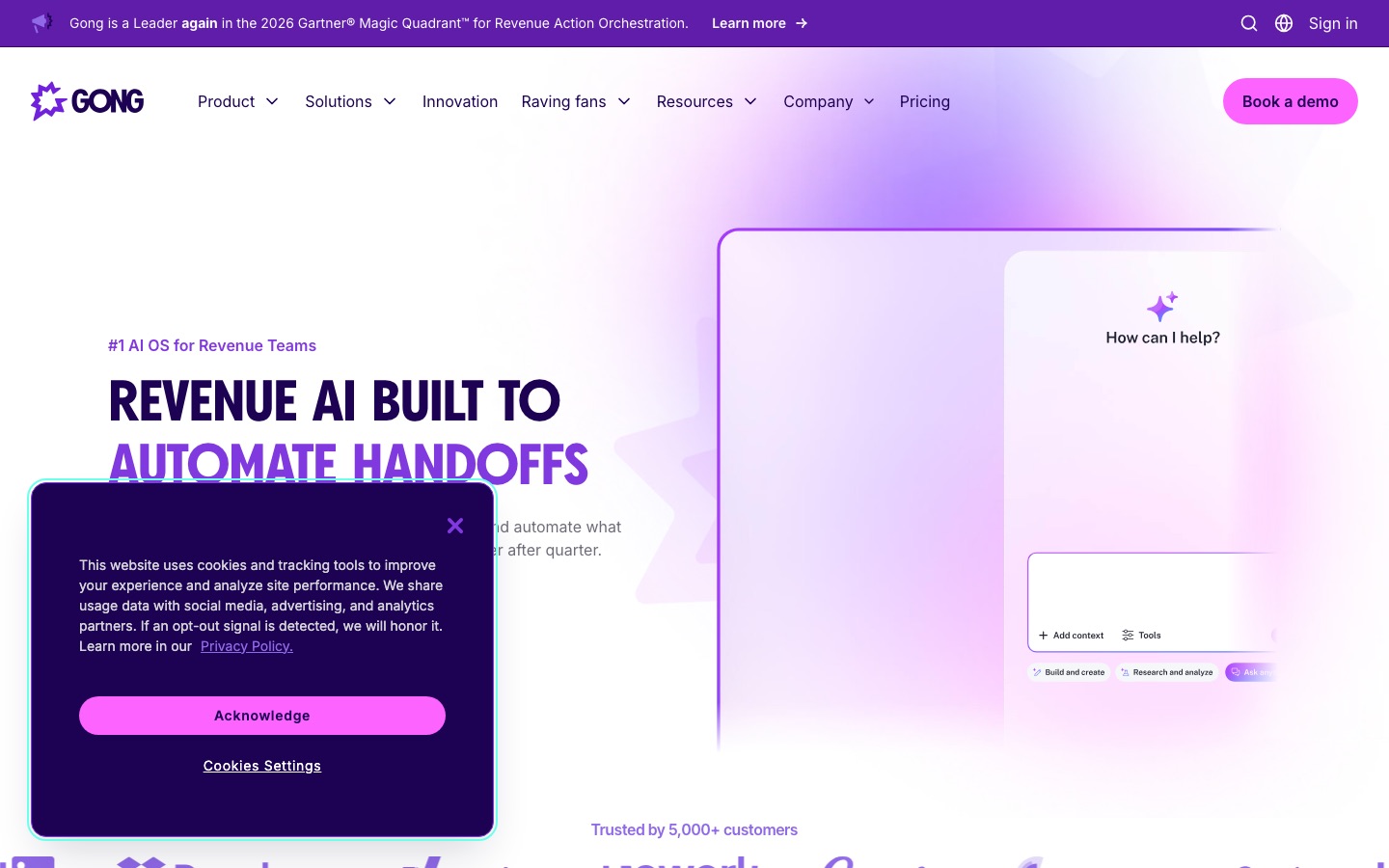
Gong records and analyzes calls and emails, then turns them into deal risk alerts, coaching insights and forecasts. It now positions itself as a revenue AI operating system: Gong Agents automate follow-ups, update pipeline fields and suggest forecast corrections, alongside Gong Engage for sequences, Gong Forecast and Gong Enable for training.
Gong does not publish prices. Its pricing page says licenses are priced per user plus a platform fee based on team size, with integrations included. Expect an annual contract.
Pros: deepest conversation analytics; strong forecasting; a large research library from Gong Labs.
Cons: expensive and annual only; overkill for teams under about 10 reps.
Best for: B2B sales and revenue operations teams with managers who coach and forecast.
11. Sybill: best AI call assistant for reps
Sybill is built for the rep rather than the manager. It records calls, writes summaries and follow-up emails, autofills CRM fields, and answers questions about any deal with cited sources through Ask Sybill. It supports more than 100 languages.
Sybill's pricing page lists Free (summaries for 20 meetings a month), Pro at $36 per user a month ($30 annual), Business at $108 ($90 annual) with CRM Autofill, and custom Enterprise. For the full comparison, see Sybill vs Gong vs Avoma.
Pros: cuts post-call admin; strong follow-up drafts; usable free plan.
Cons: lighter coaching and forecasting than Gong; CRM Autofill needs Business.
Best for: AEs and small revenue teams drowning in notes and CRM updates.
12. Nooks: best AI dialer
Nooks started as a parallel dialer and grew into a platform for phone-first teams: it dials several prospects at once, skips bad numbers, surfaces buying signals, runs AI sequencing and offers AI roleplay coaching for new reps. Pricing is by quote.
Pros: big lift in live conversations per hour; coaching built on real call data.
Cons: custom pricing; value depends on how much your team relies on the phone.
Best for: SDR and BDR teams where cold calling is a core channel.
Honorable mentions
Regie.ai: AI agents for prospecting research, sequences and parallel dialing, aimed at SDR teams.
Outplay: affordable sales engagement with AI sequences, a dialer and a free plan.
Bardeen: agentic web scraping and enrichment for leads that are not in standard databases.
Avoma: modular meeting notes plus conversation and revenue intelligence at SMB prices.
Best free AI sales tools
You can build a working stack without paying, as long as volumes stay small:
Apollo.io Free: contact lookups and email campaigns from Gmail, with a small credit allowance.
HubSpot Breeze Free CRM: up to two users, with basic AI features.
Clay Free: 100 data credits a month, enough to learn the tool.
Sybill Free: call recordings and summaries for 20 meetings a month.
Lavender Basic: 5 email analyses a month.
ChatGPT and Claude also handle account research and call prep. See also the best AI email assistants and the best AI LinkedIn tools for social selling.
FAQ
What is the best AI tool for sales?
For most small teams, Apollo.io is the best single AI sales tool because it combines a contact database, sequences, a dialer and AI agents in one plan from $49 per user a month, with a free tier. Larger teams usually pair a CRM like HubSpot with Clay for data and Gong for call intelligence.
What is an AI SDR?
An AI SDR is an agent that does the work of a sales development rep: it finds and researches prospects, writes personalized outreach, answers replies and books meetings. Examples include Reply.io's Jason AI, Instantly's AI agents and Regie.ai. They save time on volume, but human review is still needed for messaging quality and key accounts.
Are there free AI sales tools?
Yes. Apollo.io, HubSpot's CRM, Clay, Sybill and Lavender all have free plans, and Outplay offers one too. Free tiers cap credits, meetings or analyses, so they suit testing and very small teams. Cold email platforms like Instantly and Smartlead are paid only, though they offer trials.
Can AI replace salespeople?
Not in 2026. AI handles research, list building, first drafts, call notes and CRM updates well, which frees reps for conversations. Complex deals still depend on trust, negotiation and judgment. Most teams use AI to let each rep cover more accounts rather than to cut the team entirely.
Which AI sales tool is best for cold email?
Instantly is the best fit for most cold email senders thanks to unlimited mailboxes, warmup and simple pricing from $47 a month. Smartlead is better for agencies managing many clients, and lemlist is better if you also want LinkedIn and calls in the same sequence.
Is Gong worth it for small teams?
Usually not. Gong prices per user plus a platform fee on annual contracts, and its forecasting and coaching depth pays off with several managers and reps. Small teams get most of the value, meaning notes, follow-ups and deal insights, from Sybill or Avoma for a fraction of the cost.
Bottom line
Start with the layer that hurts most. If you lack leads, begin with Apollo.io (or Clay if you need custom research). If emails do not land, use Instantly or Smartlead. If deals slip between calls, turn on HubSpot Breeze or Pipedrive's AI, and add Sybill or Gong for conversation intelligence. One well-configured tool per layer beats a pile of overlapping AI subscriptions.
Browse every AI sales, outreach and CRM tool we track in the AI marketing category and the AI business tools category. Building a sales tool we have missed? Submit it for a listing.